Odysseus slept in the cloister on an undressed bullock’s hide. He threw several skins of the sheep the suitors had eaten on top of it, and Eurynome threw a cloak over him after he lay down. Odysseus lay there wakefully, brooding on how he would kill the suitors. Soon, the women who had been misconducting themselves with them left the house, giggling and laughing. This made Odysseus very angry, and he wondered whether to get up and kill every single one of them then and there, or to let them sleep one more and last time with the suitors. His heart growled within him, and as a bitch with puppies growls and shows her teeth when she sees a stranger, so did his heart growl with anger at the evil deeds being done. But he beat his breast and said,
“Heart, be still. You had worse than this to bear the day the terrible Cyclops ate your brave companions. Yet you bore it in silence until your cunning got you safely out of the cave, though you were sure to be killed.”
Thus he chided his heart, and checked it into endurance. But he tossed about like someone turning a paunch full of blood and fat in front of a hot fire, doing it first on one side and then the other, to get it cooked as soon as possible. He turned himself from side to side, thinking how, single-handed, he could kill so many wicked suitors. Then Athena came down from heaven in the likeness of a woman, and hovered over his head, saying,
“My poor, unhappy man, why are you lying awake like this? This is your house. Your wife is safe inside, and so is your son, who is just the kind of young man any father would be proud of.”
“Goddess, all that you have said is true, but I doubt how I can kill these wicked suitors single-handed, seeing how many of them there always are. And there's this further, even greater difficulty: supposing that with Zeus’s and your help I succeed in killing them, where am I to escape to from their avengers when it's all over?”
“For shame! Anyone else would trust a worse ally than me, even if that ally were only a mortal and less wise than I am. Am I not a goddess? Haven't I protected you throughout all your troubles? I tell you plainly that even if there were fifty bands of men surrounding us and eager to kill us, you could take all their sheep and cattle and drive them away with you. But go to sleep. It's a very bad thing to lie awake all night, and you'll be out of your troubles before long.”
As she spoke, she shed sleep over his eyes, and then went back to Olympus.
While Odysseus was yielding to a very deep slumber that eased his sorrows, his admirable wife awoke and sat up in her bed, crying. When she had relieved herself by weeping, she prayed to Artemis, saying,
“Great Goddess Artemis, daughter of Zeus, drive an arrow into my heart and slay me, or let some whirlwind snatch me up and bear me through paths of darkness until it drops me into the mouths of overflowing Oceanus, as it did the daughters of Pandareus. The daughters of Pandareus lost their father and mother, for the gods killed them, so they were left orphans. But Aphrodite took care of them and fed them on cheese, honey, and sweet wine. Hera taught them to excel all women in beauty of form and understanding; Artemis gave them an imposing presence, and Athena endowed them with every kind of accomplishment. But one day, when Aphrodite had gone up to Olympus to see Zeus about getting them married (for he knows what will happen and what won't happen to everyone), the storm winds came and spirited them away to become handmaids to the dread Erinyes. I wish the gods who live in heaven would hide me from mortal sight, or that fair Artemis might strike me, for I want to go even beneath the sad earth if I might do so still looking towards Odysseus only, and without having to yield myself to a worse man than he was. Besides, no matter how much people grieve by day, they can put up with it as long as they can sleep at night, for when the eyes are closed in slumber people forget good and ill alike, whereas my misery haunts me even in my dreams. This very night I thought there was someone lying by my side who was like Odysseus as he was when he went away with his host, and I rejoiced, for I believed that it was no dream, but the very truth.”
Then dawn broke, but Odysseus heard her weeping, and it puzzled him, for it seemed as though she already knew him and was by his side. He gathered up the cloak and the fleeces on which he had lain, and set them on a seat in the cloister, but he took the bullock’s hide out into the open. He lifted up his hands to heaven and prayed, saying
“Father Zeus, since you have seen fit to bring me over land and sea to my own home after all the afflictions you have laid upon me, give me a sign from the mouth of someone waking within the house, and let me have another sign from outside.”
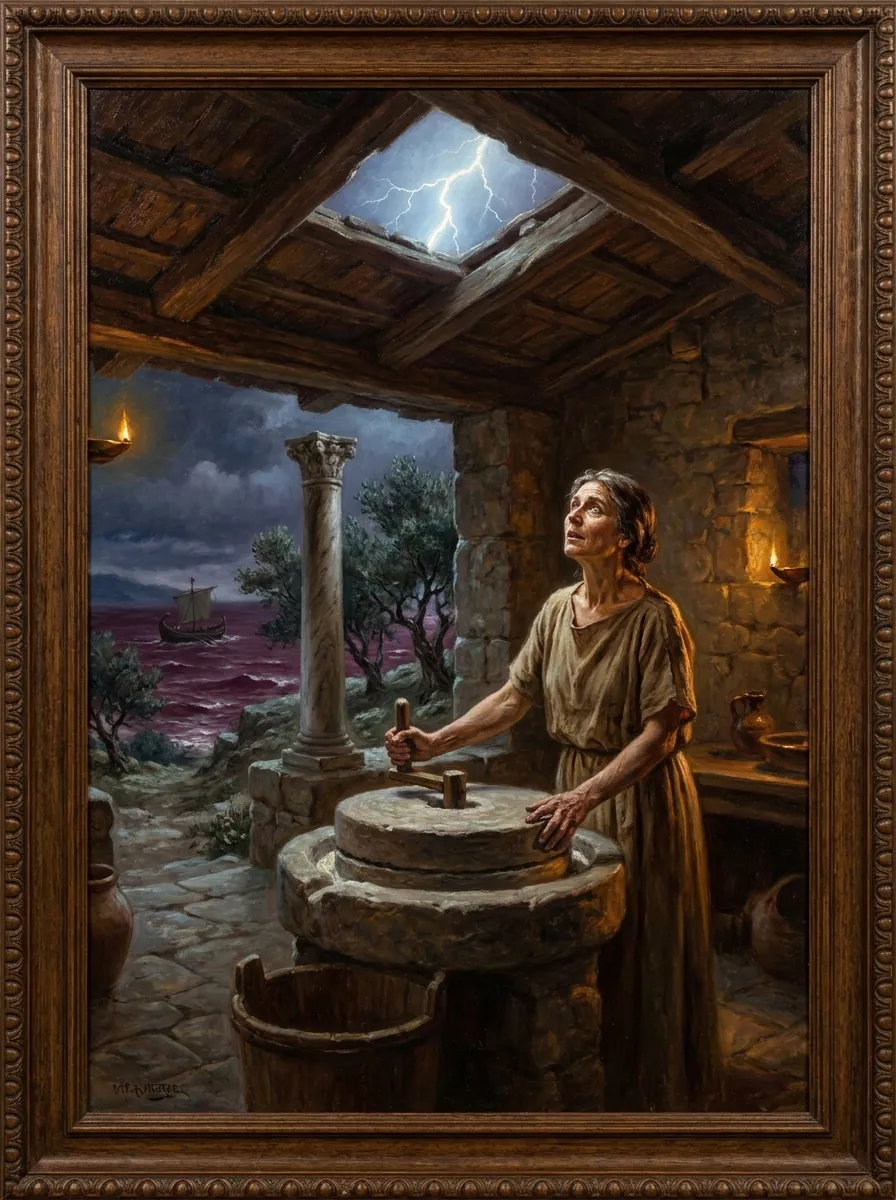
Thus he prayed. Zeus heard his prayer and immediately thundered high up among the clouds from Olympus, and Odysseus was glad when he heard it. At the same time, inside the house, a miller-woman from nearby in the mill room lifted up her voice and gave him another sign. There were twelve miller-women whose job it was to grind wheat and barley, the staff of life. The others had finished their task and had gone to rest, but this one had not yet finished, for she was not as strong as they were. When she heard the thunder, she stopped grinding and gave the sign to her master.
“Father Zeus, you who rule over heaven and earth, you have thundered from a clear sky without so much as a cloud in it, and this means something for somebody. Grant the prayer, then, of me, your poor servant who calls upon you, and let this be the very last day that the suitors dine in the house of Odysseus. They have worn me out with the labor of grinding meal for them, and I hope they may never have another dinner anywhere at all.”
Odysseus was glad when he heard the omens conveyed to him by the woman’s speech and by the thunder, for he knew they meant that he would avenge himself on the suitors.
Then the other maids in the house rose and lit the fire on the hearth. Telemachus also rose and put on his clothes. He girded his sword about his shoulder, bound his sandals on his feet, and took a doughty spear with a point of sharpened bronze. Then he went to the threshold of the cloister and said to Eurycleia,
“Nurse, did you make the stranger comfortable as regards both bed and board, or did you let him fend for himself? My mother, good woman though she is, tends to pay great attention to second-rate people, and to neglect others who are really much better men.”
“Don't find fault, child, when there is no one to find fault with. The stranger sat and drank his wine as long as he liked. Your mother did ask him if he would take any more bread, and he said he would not. When he wanted to go to bed, she told the servants to make one for him, but he said he was such a wretched outcast that he would not sleep on a bed and under blankets. He insisted on having an undressed bullock’s hide and some sheepskins put for him in the cloister, and I threw a cloak over him myself.”
Then Telemachus went out of the court to the place where the Achaeans were meeting in assembly. He had his spear in his hand, and he was not alone, for his two dogs went with him. But Eurycleia called the maids and said,
“Come, wake up! Start sweeping the cloisters and sprinkling them with water to lay the dust. Put the covers on the seats. Wipe down the tables with a wet sponge, some of you. Clean out the mixing-jugs and the cups, and go for water from the fountain at once. The suitors will be here directly; they'll be here early, for it's a feast day.”
She spoke, and they did as she said. Twenty went to the fountain for water, and the others set to work in the house. The men who waited on the suitors also came and began chopping firewood. Soon the women returned from the fountain, and the swineherd followed with the three best pigs he could find. He let them feed around the place, and then said good-humoredly to Odysseus,
“Stranger, are the suitors treating you any better now, or are they as insolent as ever?”
“May heaven repay them for the wickedness with which they act so high-handedly in another man’s house, without any shame.”
They talked. Meanwhile Melanthius the goatherd came up, bringing his best goats for the suitors’ dinner, with two shepherds. They tied the goats up under the gatehouse, and then Melanthius began jeering at Odysseus.
“Still here, stranger, bothering people by begging around the house? Why can’t you go somewhere else? You and I won’t come to an understanding before we’ve traded some punches. You beg without any decency. Aren’t there feasts elsewhere among the Achaeans, as well as here?”
Odysseus didn’t answer, but bowed his head and thought. Then Philoetius joined them, bringing in a barren heifer and some goats. Boatmen brought them over, the ones who ferry people across when they come. Philoetius secured his heifer and goats under the gatehouse, and then went to the swineherd.
“Swineherd, who is this stranger who’s just arrived? Is he one of your men? Who is his family? Where does he come from? Poor fellow, he looks like he might have been someone important, but the gods give sorrow to whomever they want—even to kings, if they please.”
As he spoke, he went to Odysseus and greeted him with his right hand.
“Good day, father stranger. You seem to be very badly off now, but I hope you’ll have better times later. Father Zeus, you’re the most malicious of all the gods. We are your own children, yet you show us no mercy in all our misery and afflictions. I broke into a sweat when I saw this man, and my eyes filled with tears, because he reminds me of Odysseus, who I fear is going around in just such rags as this man’s, if he’s even still alive. If he’s already dead and in the house of Hades, then, alas! for my good master, who made me his stockman when I was quite young among the Cephallenians. Now his cattle are countless. No one could have done better with them than I have, because they’ve bred like ears of corn. Nevertheless, I have to keep bringing them in for others to eat, who pay no attention to his son even though he’s in the house, and don’t fear the wrath of heaven, but are already eager to divide Odysseus’ property among them because he’s been away so long. I’ve often thought—only it wouldn’t be right while his son is living—of going off with the cattle to some foreign country. As bad as that would be, it’s still harder to stay here and be mistreated over other people’s herds. My position is intolerable, and I would have run away long ago and put myself under the protection of some other chief, except that I believe my poor master will return and send all these suitors flying out of the house.”
“Stockman, you seem to be a very well-disposed person, and I can see that you’re a man of sense. Therefore, I’ll tell you, and I’ll confirm my words with an oath. By Zeus, the chief of all gods, and by that hearth of Odysseus to which I’ve now come, Odysseus will return before you leave this place, and if you want, you’ll see him killing the suitors who are masters here now.”
“If Zeus were to make this happen, you’d see how I would do my very best to help him.”
Eumaeus likewise prayed that Odysseus might return home.
They talked. Meanwhile the suitors were plotting to murder Telemachus, but a bird flew near them on their left—an eagle with a dove in its talons. Amphinomus said,
“My friends, this plot to murder Telemachus won’t succeed. Let’s go to dinner instead.”
The others agreed, so they went inside and laid their cloaks on the benches and seats. They sacrificed the sheep, goats, pigs, and the heifer, and when the cooked meat was ready, they served it around. They mixed the wine in the mixing-bowls, and the swineherd gave every man his cup, while Philoetius handed around the bread in the bread baskets, and Melanthius poured their wine. Then they laid their hands on the good things before them.
Telemachus purposely made Odysseus sit in the part of the cloister that was paved with stone. He gave him a shabby-looking seat at a small table, and had his portion of the cooked meat brought to him, with his wine in a gold cup.
“Sit there, and drink your wine among the great people. I’ll put a stop to the suitors’ jeers and blows, because this isn’t a public house, but belongs to Odysseus, and has passed from him to me. So, suitors, keep your hands and your tongues to yourselves, or there will be trouble.”
The suitors bit their lips, marveling at his boldness. Then Antinous said:
“We don’t like such talk, but we’ll put up with it, because Telemachus is threatening us in earnest. If Zeus had let us, we would have stopped his brave talk before now.”
Antinous spoke, but Telemachus ignored him. Meanwhile, the heralds were bringing the holy hecatomb through the city, and the Achaeans gathered in Apollo’s shady grove.
They roasted the outer meat, drew it off the spits, gave each man his portion, and feasted to their heart’s content. Those who waited at table gave Odysseus exactly the same portion as the others, because Telemachus had told them to.
But Athena wouldn’t let the suitors drop their insolence for a moment; she wanted Odysseus to become even more bitter toward them. Now, there happened to be a ribald fellow among them named Ctesippus, who came from Same. Confident in his great wealth, this man was paying court to Odysseus’s wife, and he said to the suitors:
“Listen to what I have to say. The stranger has already had as large a portion as anyone else; this is good, because it isn’t right or reasonable to mistreat any guest of Telemachus who comes here. However, I’ll make him a present on my own account, so he can give something to the bath-woman, or to some other of Odysseus’ servants.”
As he spoke, he picked up a heifer’s foot from the meat-basket and threw it at Odysseus. But Odysseus turned his head slightly and avoided it, smiling grimly, and the foot hit the wall instead of him. Telemachus then spoke fiercely to Ctesippus:
“It’s a good thing for you that the stranger turned his head, so you missed him. If you had hit him, I would have run you through with my spear, and your father would have had to worry about burying you instead of seeing you married in this house. So, let me have no more unseemly behavior from any of you. I’m grown up now, with the knowledge of good and evil, and I understand what’s going on, instead of being the child I was before. I’ve long seen you killing my sheep and making free with my corn and wine. I’ve put up with this, because one man is no match for many, but do me no further violence. Still, if you wish to kill me, kill me; I would much rather die than see such disgraceful scenes day after day—guests insulted, and men dragging the women servants around the house in an unseemly way.”
They all held their peace until Agelaus, son of Damastor, finally said:
“No one should take offense at what’s just been said, or gainsay it, because it’s quite reasonable. Therefore, stop mistreating the stranger, or any of the servants who are about the house. However, I would like to say a friendly word to Telemachus and his mother, which I trust may appeal to both. As long as you had reason to hope that Odysseus would one day come home, no one could complain about your waiting and suffering the suitors to be in your house. It would have been better if he had returned, but it’s now clear enough that he never will. Therefore, discuss all this quietly with your mother, and tell her to marry the best man, the one who makes her the most advantageous offer. This way, you’ll be able to manage your own inheritance, and to eat and drink in peace, while your mother will look after some other man’s house, not yours.”
“By Zeus, Agelaus, and by the sorrows of my unhappy father, who has either perished far from Ithaca or is wandering in some distant land, I put no obstacles in the way of my mother’s marriage. On the contrary, I urge her to choose whomever she will, and I’ll give her countless gifts in addition. But I dare not insist point blank that she leave the house against her own wishes. Heaven forbid that I should do this.”
Athena now made the suitors laugh immoderately and set their wits wandering; but their laughter was forced. Their meat became smeared with blood, their eyes filled with tears, and their hearts were heavy with forebodings. Theoclymenus saw this and said:
“Unhappy men, what’s ailing you? A shroud of darkness is drawn over you from head to foot, your cheeks are wet with tears, the air is alive with wailing voices, the walls and roof-beams drip blood, the gate of the cloisters and the court beyond them are full of ghosts trooping down into the night of hell, the sun is blotted out of heaven, and a blighting gloom is over all the land.”
He spoke, and they all laughed heartily. Eurymachus then said:
“This stranger who has lately come here has lost his senses. Servants, turn him out into the streets, since he finds it so dark here.”
“Eurymachus, you don’t need to send anyone with me. I have eyes, ears, and a pair of feet of my own, not to mention an understanding mind. I’ll take these out of the house with me, because I see mischief overhanging you, from which not one of you men who are insulting people and plotting ill deeds in Odysseus’s house will be able to escape.”
He left the house and went back to Piraeus, who welcomed him. But the suitors kept looking at one another and provoking Telemachus by laughing at the strangers. One insolent fellow said to him:
“Telemachus, you aren’t happy in your guests. First, you have this importunate tramp, who comes begging bread and wine and has no skill for work or hard fighting, but is perfectly useless. And now here’s another fellow who is setting himself up as a prophet. Let me persuade you—it’ll be much better to put them on board ship and send them off to the Sicels to sell for whatever they’ll bring.”
Telemachus paid him no attention, but sat silently watching his father, expecting him to attack the suitors at any moment.
Meanwhile, the daughter of Icarius, wise Penelope, had a fine seat placed for her facing the court and cloisters, so she could hear everything that was being said. Dinner had been prepared with much merriment; it was both good and abundant, since they had sacrificed many animals. But supper was yet to come, and nothing could be more gruesome than the meal a goddess and a brave man were about to set before them—for they had brought their doom upon themselves.
Translation: Samuel Butler (1900) · Public domain · SPDX: PD-1900-Butler