So he spoke, and they all listened in silence throughout the covered cloister, enthralled by his story, until Alcinous began to speak.
“Odysseus, now that you've reached my house, I believe you'll get home without further trouble, no matter how much you've suffered. As for the rest of you who come here night after night to drink my best wine and listen to my bard, I have a request. Our guest has already packed the clothes, worked gold, and other valuables you gave him. Let's each present him with a large tripod and a cauldron. We'll cover the cost with a general tax; private individuals can't be expected to bear the burden of such a handsome gift.”
Everyone agreed, and then went home to bed. When dawn came, they hurried down to the ship with their cauldrons. Alcinous went on board and made sure everything was stowed securely under the benches, so nothing could break loose and injure the rowers. Then they went to Alcinous's house for dinner, and he sacrificed a bull to honor Zeus, lord of all. They grilled the steaks and had an excellent dinner, after which the inspired bard, Demodocus, a favorite with everyone, sang for them. But Odysseus kept looking towards the sun, as if to hurry its setting, longing to be on his way. As a man who has been plowing a fallow field all day with a pair of oxen thinks about his supper and is glad when night comes so he can get it, because his legs can barely carry him, so Odysseus rejoiced when the sun went down, and he said to the Phaeacians, addressing Alcinous:
“Sir, and all of you, farewell. Make your drink offerings and send me on my way rejoicing. You've fulfilled my heart's desire by giving me an escort and presents. May the gods grant I turn them to good account. May I find my admirable wife living in peace among friends, and may you whom I leave behind satisfy your wives and children. May the gods grant you every good grace, and may no evil come among your people.”
So he spoke. His listeners all approved his words and agreed he should have his escort, since he had spoken reasonably. Alcinous then said to his servant,
“Pontonous, mix some wine and hand it around, so we can offer a prayer to father Zeus and speed our guest on his way.”
Pontonous mixed the wine and handed it to everyone in turn. The others each made a drink offering to the blessed gods in heaven from his seat, but Odysseus rose and placed the double cup in Queen Arete's hands.
“Farewell, queen, now and forever, until age and death, the common lot of mankind, take hold of you. I now take my leave; be happy in this house with your children, your people, and with King Alcinous.”
As he spoke, he crossed the threshold, and Alcinous sent a man to conduct him to his ship and the seashore. Arete also sent some maidservants with him—one with a clean shirt and cloak, another to carry his strongbox, and a third with corn and wine. When they reached the water, the crew took these things and put them on board, with all the food and drink. They spread a rug and a linen sheet on deck for Odysseus to sleep soundly in the stern. Then he went on board and lay down without a word. The crew took their places and loosed the hawser from the pierced stone it had been bound to. As they began rowing out to sea, Odysseus fell into a deep, sweet, almost deathlike slumber.
The ship bounded forward as a four-horse chariot flies over the course when the horses feel the whip. Her prow curvetted like a stallion's neck, and a great wave of dark blue water seethed in her wake. She held steadily on her course; even a falcon, the swiftest of birds, couldn't have kept pace. She cut through the water, carrying one as cunning as the gods, now sleeping peacefully, forgetful of all he had suffered in battle and on the weary sea.
When the bright star that heralds dawn began to appear, the ship neared land. In Ithaca, there's a harbor of the old merman Phorcys, between two points that break the sea line and shut the harbor in. These shelter it from the storms outside, so a ship within can lie without mooring. At the head of this harbor is a large olive tree, and nearby a fine overarching cavern sacred to the Naiad nymphs. Inside are mixing bowls and stone wine jars, and bees hive there. There are also great stone looms where the nymphs weave their sea-purple robes—very curious to see—and water is always present. It has two entrances, one facing north for mortals to enter, the other from the south and more mysterious; mortals can't enter that way; it's the gods' path.
Into this harbor they steered their ship, knowing the place. She had so much momentum she ran half her length onto the shore. Once landed, they lifted Odysseus with his rug and linen sheet from the ship and laid him on the sand, still asleep. Then they took out the gifts Athena had persuaded the Phaeacians to give him when he set out for home. They put these together by the olive tree's root, away from the road, fearing a passerby might steal them before Odysseus awoke; then they hurried home.
But Poseidon didn't forget his threats against Odysseus, so he consulted with Zeus.
“Father Zeus, I'll no longer be respected among you gods if mortals like the Phaeacians, my own flesh and blood, show such little regard for me. I said I'd let Odysseus get home when he had suffered enough. I didn't say he should never get home, for I knew you'd already nodded your head and promised he would. But now they've brought him in a ship, fast asleep, and landed him in Ithaca, loaded with more magnificent presents of bronze, gold, and raiment than he would have brought back from Troy if he'd had his share of the spoil and gotten home without trouble.”
“What are you talking about, Lord of the Earthquake? The gods aren't lacking in respect for you. It would be monstrous to insult someone as old and honored as you. As for mortals, if any are acting insolently and treating you disrespectfully, it's always up to you to deal with them as you see fit. Do as you please.”
“I would have done so at once, if I weren't anxious to avoid displeasing you. Now, I'd like to wreck the Phaeacian ship as it returns from its escort. That will stop them from escorting people in the future. I'd also like to bury their city under a huge mountain.”
“My friend, I recommend turning the ship into a rock near the land, looking like a ship, just as the people are watching it from the city. This will astonish everyone, and then you can bury their city under the mountain.”
When earth-encircling Poseidon heard this, he went to Scheria, where the Phaeacians live, and waited until the ship, making rapid progress, got close in. Then he went up to it, turned it to stone, and drove it down with the flat of his hand to root it in the ground. After this, he left.
The Phaeacians began talking among themselves, and one turned to his neighbor, saying,
“Good heavens, who could have rooted the ship in the sea just as she was getting into port? We could see the whole of her only a moment ago.”
That's how they talked, but they knew nothing about it; and Alcinous said,
“I remember my father's old prophecy. He said that Poseidon would be angry with us for escorting everyone so safely across the sea. He said Poseidon would one day wreck a Phaeacian ship as it returned from an escort mission, and bury our city under a high mountain. That's what my father used to say, and now it's all coming true. So let's do as I say: first, we must stop giving people escorts when they come here; next, let's sacrifice twelve choice bulls to Poseidon, so he may have mercy on us and not bury our city under the high mountain.”
When the people heard this, they were afraid and got the bulls ready.
Thus did the chiefs and rulers of the Phaeacians pray to King Poseidon, standing around his altar. At the same time, Odysseus woke up on his own soil. He had been away so long that he didn't recognize it. Moreover, Athena, daughter of Zeus, had made it a foggy day, so people wouldn't know he had come. She wanted to tell him everything without his wife, fellow citizens, or friends recognizing him until he had taken revenge on the wicked suitors. Everything seemed different to him—the long straight tracks, the harbors, the cliffs, and the fine trees all appeared changed as he looked upon his native land. He slapped his thighs with his hands and cried out in despair.
“Alas, what kind of people have I stumbled upon? Are they savage and uncivilized, or hospitable and humane? Where can I put all this treasure, and which way should I go? I wish I had stayed with the Phaeacians, or gone to some other great chief who would have been good to me and given me an escort. As it is, I don't know where to put my treasure, and I can't leave it here for fear someone else will get hold of it. In truth, the chiefs and rulers of the Phaeacians haven't been dealing fairly with me, and have left me in the wrong country. They said they would take me back to Ithaca, but they haven't done so. May Zeus, protector of suppliants, punish them, for he watches over everyone and punishes those who do wrong. Still, I suppose I must count my goods and see if the crew made off with any of them.”
He counted his fine coppers and cauldrons, his gold and all his clothes, but nothing was missing. Still, he kept grieving about not being in his own country, and wandered up and down by the shore of the sounding sea, bewailing his hard fate. Then Athena came up to him disguised as a young shepherd of delicate and princely bearing, with a good cloak folded double about her shoulders. She had sandals on her feet and held a javelin in her hand. Odysseus was glad when he saw her, and went straight up to her.
“My friend, you're the first person I've met in this country. I salute you, therefore, and beg you to be well disposed towards me. Protect these my goods, and myself too, for I embrace your knees and pray to you as though you were a god. Tell me, then, and tell me truly, what land and country is this? Who are its inhabitants? Am I on an island, or is this the seaboard of some continent?”
“Stranger, you must be very simple, or must have come from somewhere far away, not to know what country this is. It's a very celebrated place, and everyone knows it East and West. It's rugged and not good for driving, but it's by no means a bad island for what it is. It grows plenty of corn and wine, for it's watered by both rain and dew. It breeds cattle and goats too. All kinds of timber grow here, and there are watering places where the water never runs dry. So, sir, the name of Ithaca is known even as far as Troy, which I understand to be a long way off from this Achaean country.”
Odysseus was glad to find himself, as Athena told him, in his own country, and he began to answer, but he didn't speak the truth, and made up a lying story in the instinctive wiliness of his heart.
“I heard of Ithaca when I was in Crete beyond the seas, and now it seems I've reached it with all these treasures. I've left as much more behind for my children, but I'm fleeing because I killed Orsilochus, son of Idomeneus, the fleetest runner in Crete. I killed him because he wanted to rob me of the spoils I had gotten from Troy with so much trouble and danger, both on the battlefield and by the waves of the weary sea. He said I hadn't served his father loyally at Troy as a vassal, but had set myself up as an independent ruler. So I lay in wait for him with one of my followers by the roadside, and speared him as he was coming into town from the country. It was a very dark night and nobody saw us. It wasn't known, therefore, that I had killed him, but as soon as I had done so, I went to a ship and begged the owners, who were Phoenicians, to take me on board and set me down in Pylos or in Elis, where the Epeans rule, giving them as much spoil as satisfied them. They meant no guile, but the wind drove them off course, and we sailed on until we came here by night. It was all we could do to get inside the harbor, and none of us said a word about supper, though we wanted it badly. We all went ashore and lay down just as we were. I was very tired and fell asleep directly, so they took my goods out of the ship and placed them beside me where I was lying on the sand. Then they sailed away to Sidonia, and I was left here in great distress of mind.”
Such was his story, but Athena smiled and caressed him with her hand. Then she took the form of a woman, fair, stately, and wise.
“He must be a shifty, lying fellow indeed who could surpass you in all manner of craft, even though you had a god for your antagonist. Daredevil that you are, full of guile, unwearying in deceit, can't you drop your tricks and your instinctive falsehood, even now that you're in your own country again? We'll say no more about this, however, for we can both deceive on occasion—you're the most accomplished counselor and orator among all mankind, while I have no equal among the gods for diplomacy and subtlety. Didn't you know Athena, daughter of Zeus—me, who has been ever with you, who kept watch over you in all your troubles, and who made the Phaeacians take such a liking to you? And now, again, I've come here to talk things over with you, and help you hide the treasure I made the Phaeacians give you. I want to tell you about the troubles that await you in your own house. You've got to face them, but tell no one, neither man nor woman, that you've come home again. Bear everything, and put up with every man's insolence, without a word.”
“Goddess, a man may know a great deal, but you're so constantly changing your appearance that when he meets you, it's hard for him to know whether it's you or not. However, I know this much exceedingly well: you were very kind to me as long as we Achaeans were fighting before Troy, but from the day on which we went on board ship after sacking the city of Priam, and heaven dispersed us—from that day, Athena, I saw no more of you, and can't ever remember your coming to my ship to help me in a difficulty. I had to wander on, sick and sorry, until the gods delivered me from evil and I reached the city of the Phaeacians, where you encouraged me and took me into the town. And now, I beg you in your father's name, tell me the truth, for I don't believe I'm really back in Ithaca. I'm in some other country, and you're mocking me and deceiving me in all you've been saying. Tell me then truly, have I really gotten back to my own country?”
“You're always getting something of that sort in your head,” Athena replied, “and that's why I can't desert you in your afflictions. You're so plausible, shrewd, and shifty. Anyone but yourself, on returning from so long a voyage, would at once have gone home to see his wife and children, but you don't seem to care about asking after them or hearing any news about them until you've exploited your wife, who remains at home vainly grieving for you, and having no peace night or day for the tears she sheds on your behalf. As for my not coming near you, I was never uneasy about you, for I was certain you'd get back safely, though you'd lose all your men, and I didn't wish to quarrel with my uncle Poseidon, who never forgave you for blinding his son. I'll now, however, point out to you the lie of the land, and you'll then perhaps believe me. This is the haven of the old merman Phorcys, and here's the olive tree that grows at the head of it; near it is the cave sacred to the Naiads; here too is the overarching cavern in which you have offered many an acceptable hecatomb to the nymphs, and this is the wooded mountain Neritum.”
As she spoke, the goddess dispersed the mist and the land appeared. Then Odysseus rejoiced at finding himself again in his own land, and kissed the bounteous soil. He lifted up his hands and prayed to the nymphs, saying,
“Naiad nymphs, daughters of Zeus, I was sure that I was never again to see you. Now, therefore, I greet you with all loving salutations, and I will bring you offerings as in the old days, if Zeus’s redoubtable daughter will grant me life, and bring my son to manhood.”
“Take heart, and don't trouble yourself about that. Let's rather set about stowing your things at once in the cave, where they'll be quite safe. Let's see how we can best manage it all.”
Therewith she went down into the cave to look for the safest hiding places, while Odysseus brought up all the treasure of gold, bronze, and good clothing which the Phaeacians had given him. They stowed everything carefully away, and Athena set a stone against the door of the cave. Then the two sat down by the root of the great olive, and consulted how to compass the destruction of the wicked suitors.
“Odysseus, son of Laertes, consider how you can seize these disreputable people who have been lording it in your house these three years, courting your wife and giving her wedding presents, while she does nothing but lament your absence, giving hope and sending encouraging messages to every one of them, but meaning the very opposite of all she says.”
“Goddess, it seems I would have come to much the same bad end in my own house as Agamemnon did, if you had not given me such timely information. Advise me how I can best avenge myself. Stand by my side and put your courage into my heart as on the day when we loosed Troy’s fair diadem from her brow. Help me now as you did then, and I will fight three hundred men, if you, goddess, will be with me.”
“Trust me, I will not lose sight of you once we set about it. I imagine that some of those who are devouring your substance will then splatter the pavement with their blood and brains. I will begin by disguising you so that no human being will know you. I will cover your body with wrinkles; you will lose all your yellow hair; I will clothe you in a garment that will fill all who see it with loathing. I will blear your fine eyes, and make you an unseemly object in the sight of the suitors, of your wife, and of the son whom you left behind. Then go at once to the swineherd who is in charge of your pigs; he has always been well-disposed towards you, and is devoted to Penelope and your son. You will find him feeding his pigs near the rock that is called Raven by the fountain Arethusa, where they are fattening on beechmast and spring water in their usual way. Stay with him and find out how things are going, while I proceed to Sparta and see your son, who is with Menelaus at Lacedaemon, where he has gone to try and find out whether you are still alive.”
“But why didn't you tell him, since you knew all about it? Did you want him too to go sailing about amid all kinds of hardship while others are eating up his estate?”
“Never mind about him. I sent him so that he might be well spoken of for having gone. He is in no difficulty, but is staying quite comfortably with Menelaus, and is surrounded with abundance of every kind. The suitors have put out to sea and are lying in wait for him, for they mean to kill him before he can get home. I don't think they will succeed. I think some of those who are now eating up your estate will find a grave themselves first.”
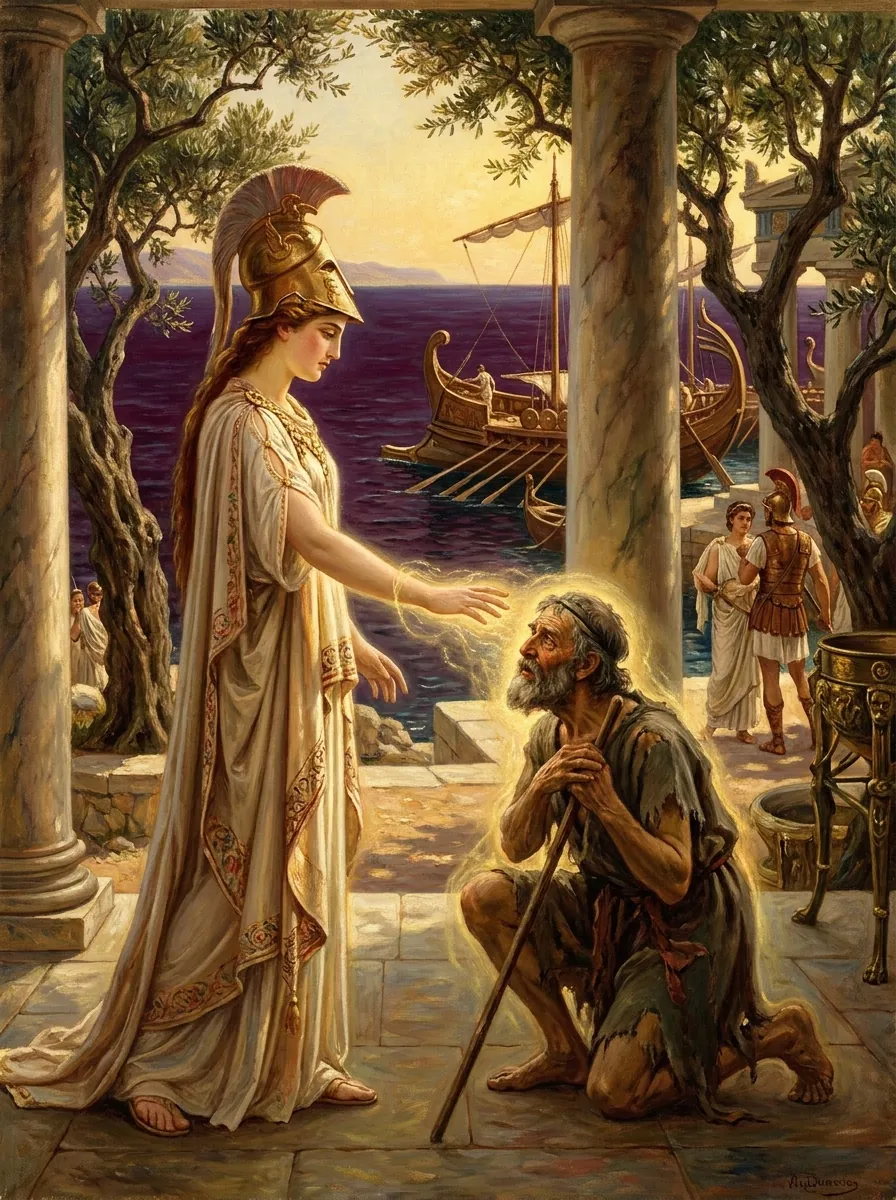
As Athena spoke, she touched him with her wand and covered him with wrinkles, took away all his yellow hair, and withered the flesh over his whole body. She bleared his eyes, which were naturally very fine. She changed his clothes and threw an old rag of a wrap about him, and a tunic, tattered, filthy, and begrimed with smoke. She also gave him an undressed deer skin as an outer garment, and furnished him with a staff and a wallet all in holes, with a twisted thong for him to sling it over his shoulder.
When the pair had thus laid their plans, they parted, and the goddess went straight to Lacedaemon to fetch Telemachus.
Translation: Samuel Butler (1900) · Public domain · SPDX: PD-1900-Butler