Once we were clear of the river Oceanus and out on the open sea, we kept going until we reached the Aeaean island, where dawn and sunrise are just like anywhere else. We pulled our ship onto the sand, got out, went to sleep, and waited for daybreak.
When dawn appeared, I sent some men to Circe’s house to get Elpenor’s body. We gathered firewood from a wood where the headland jutted into the sea. After weeping and lamenting, we performed his funeral rites. Once his body and armor had burned to ashes, we raised a cairn, set a stone over it, and fixed the oar he used to row with at the top.
While we were doing all this, Circe, knowing we had returned from the house of Hades, dressed and came to us as fast as she could. Her maidservants came with her, bringing bread, meat, and wine. She stood among us and said:
“You've done a bold thing, going down alive to the house of Hades. You'll have died two times to everyone else’s one. Now, stay here for the rest of the day, feast, and continue your voyage at daybreak tomorrow. I'll tell Odysseus about your course and explain everything to him, so you don't suffer any misadventure by land or sea.”
We agreed and feasted all day until sunset. When the sun had set and darkness fell, the men lay down to sleep by the stern cables of the ship. Then Circe took my hand and had me sit away from the others, while she reclined by my side and asked about our adventures.
“So far, so good. Now pay attention to what I'm about to tell you—heaven itself will remind you of it. First, you'll come to the Sirens, who enchant everyone who comes near them. Anyone who unwarily gets too close and hears the Sirens' song will never be welcomed home by his wife and children. They sit in a green field and warble him to death with their sweet song. There's a great heap of dead men’s bones lying all around, with the flesh still rotting. Pass these Sirens by. Stop your men’s ears with wax so none of them can hear. But if you want to listen yourself, have the men bind you as you stand upright on a cross piece halfway up the mast. Lash the rope’s ends to the mast itself, so you can enjoy listening. If you beg and pray the men to untie you, they must bind you even tighter.
“Once your crew has taken you past these Sirens, I can't give you coherent directions as to which of two courses to take. I'll lay the two alternatives before you, and you must consider them yourself. On one hand, there are overhanging rocks against which the deep blue waves of Amphitrite beat with terrific fury. The blessed gods call these rocks the Wanderers. Not even a bird may pass here, not even the timid doves that bring ambrosia to Zeus. The sheer rock always carries one off, and Zeus has to send another to make up their number. No ship that has ever come to these rocks has gotten away again. The waves and whirlwinds of fire are freighted with wreckage and the bodies of dead men. The only vessel that ever sailed through was the famous Argo on her way from the house of Aetes. She, too, would have gone against these great rocks, but Hera piloted her past them for her love of Jason.
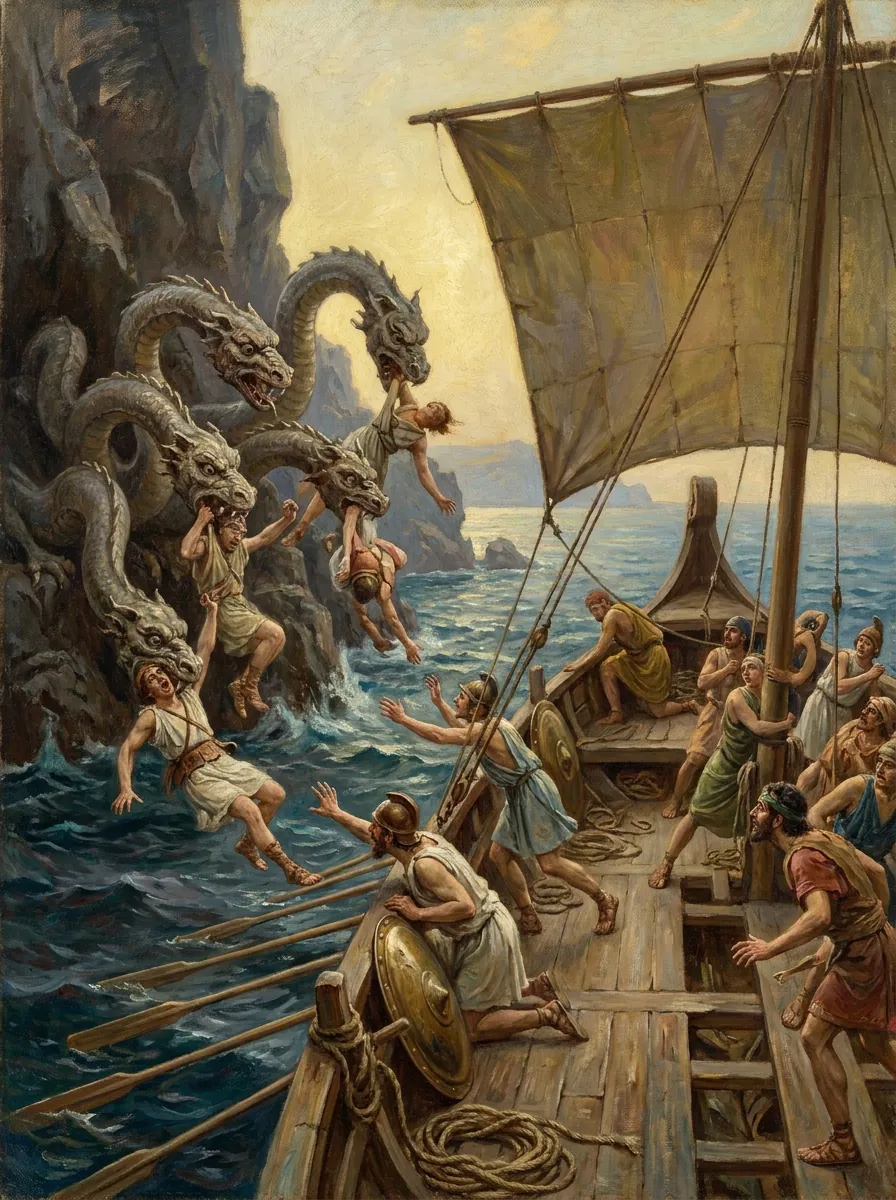
“Of these two rocks, one reaches heaven, and its peak is lost in a dark cloud. This never leaves it, so the top is never clear, not even in summer and early autumn. No man, even with twenty hands and twenty feet, could get a foothold and climb it. It runs sheer up, as smooth as if it had been polished. In the middle of it, there's a large cavern, facing West and turned towards Erebus. Take your ship this way, but the cave is so high up that not even the stoutest archer could shoot an arrow into it. Inside, Scylla sits and yelps with a voice like a young hound's, but she's a dreadful monster. No one—not even a god—could face her without being terror-struck. She has twelve misshapen feet and six necks of prodigious length. At the end of each neck is a frightful head with three rows of teeth, all set very close together, so they would crunch anyone to death in a moment. She sits deep within her shady cell, thrusting out her heads and peering around the rock, fishing for dolphins or dogfish or any larger monster she can catch from the thousands that Amphitrite teems with. No ship ever gets past her without losing some men, for she shoots out all her heads at once and carries off a man in each mouth.
“You'll find the other rock lower, but they're so close together that there's not more than a bow-shot between them. A large fig tree in full leaf grows upon it, and under it lies the sucking whirlpool of Charybdis. Three times a day she vomits forth her waters, and three times she sucks them down again. Make sure you're not there when she's sucking, because if you are, Poseidon himself couldn't save you. Hug the Scylla side and drive your ship by as fast as you can, because it's better to lose six men than your whole crew.”
“Is there no way to escape Charybdis and keep Scylla off when she's trying to harm my men?”
“You daredevil, you always want to fight somebody or something. You won't let yourself be beaten, not even by the immortals. Scylla isn't mortal. Moreover, she's savage, extreme, rude, cruel, and invincible. There's no help for it. Your best chance is to get by her as fast as you can. If you dawdle around her rock while putting on your armor, she may catch you with a second cast of her six heads and snap up another half dozen of your men. Drive your ship past her at full speed, and roar out lustily to Crataiis, Scylla’s mother—bad luck to her. She will then stop her from making a second raid upon you.
“You'll now come to the Thrinacian island. Here, you'll see many herds of cattle and flocks of sheep belonging to the sun-god—seven herds of cattle and seven flocks of sheep, with fifty head in each flock. They don't breed, nor do they become fewer. The goddesses Phaethusa and Lampetie, daughters of the sun-god Hyperion by Neaera, tend them. After their mother bore them and finished suckling them, she sent them to the Thrinacian island, which was far away, to live there and look after their father’s flocks and herds. If you leave these flocks unharmed and think only of getting home, you may yet reach Ithaca after much hardship. But if you harm them, I forewarn you of the destruction of both your ship and your comrades. Even if you yourself escape, you'll return late, in bad shape, after losing all your men.”
She finished, and dawn began to show in heaven. Then she returned inland. I went on board and told my men to loose the ship from her moorings. They got in, took their places, and began to hit the dark sea with their oars. Presently, the great and cunning goddess Circe helped us with a fair wind that blew dead aft and stayed steadily with us, keeping our sails filled. We did what needed doing to the ship’s gear and let her go as wind and helmsman headed her.
Then, troubled in mind, I said to my men:
“My friends, it's not right that only one or two of us know the prophecies Circe made to me. I'll tell you about them, so that whether we live or die, we may do so with our eyes open. First, she said we're to keep clear of the Sirens, who sit and sing beautifully in a field of flowers. But she said I could hear them myself as long as no one else did. Take me and bind me to the crosspiece halfway up the mast. Bind me as I stand upright, with a bond so fast that I can't possibly break away, and lash the rope’s ends to the mast itself. If I beg and pray you to set me free, then bind me more tightly still.”
I had hardly finished telling the men everything before we reached the island of the two Sirens, because the wind had been very favorable. Then, all of a sudden, it fell dead calm. There wasn't a breath of wind or a ripple on the water. The men furled the sails and stowed them. Taking to their oars, they whitened the water with the foam they raised in rowing. Meanwhile, I took a large wheel of wax and cut it up small with my sword. I kneaded the wax in my strong hands until it became soft, which it soon did between the kneading and the sun's rays. Then I stopped the ears of all my men, and they bound me hands and feet to the mast as I stood upright on the cross piece. They went on rowing. When we had gotten within earshot of the land, and the ship was going at a good rate, the Sirens saw we were getting close and began their singing.
“Come here, renowned Odysseus, honor to the Achaean name, and listen to our voices. No one ever sailed past us without staying to hear the enchanting sweetness of our song—and whoever listens will go on his way not only charmed but wiser. We know all the ills that the gods laid upon the Argives and Trojans before Troy, and can tell you everything that's going to happen over the whole world.”
They sang these words musically. As I longed to hear them further, I frowned at my men to set me free, but they quickened their stroke, and Eurylochus and Perimedes bound me with stronger bonds until we were out of hearing of the Sirens’ voices. Then my men took the wax from their ears and unbound me.
Immediately after we had passed the island, I saw a great wave from which spray was rising, and I heard a loud roaring sound. The men were so frightened that they let go of their oars, for the whole sea resounded with the rushing waters. The ship stayed where it was, because the men had stopped rowing. I went around and urged them not to lose heart.
“My friends, this isn't the first time we've been in danger. We're not in as bad a situation as when the Cyclops shut us up in his cave. Nevertheless, my courage and wise counsel saved us then, and we'll live to look back on all this as well. Now, let's all do as I say, trust in Zeus, and row on with might and main. Coxswain, these are your orders. Attend to them, because the ship is in your hands. Turn her head away from these steaming rapids and hug the rock, or she'll slip away and be over yonder before you know it, and you'll be the death of us.”
So they did as I told them. I said nothing about the awful monster Scylla, because I knew the men would panic and huddle in the hold instead of rowing. I disobeyed Circe’s strict instructions in only one way: I put on my armor. Then, seizing two strong spears, I took my stand on the ship’s bows, expecting to see the monster of the rock, who was to do my men so much harm. But I couldn’t make her out anywhere, though I strained my eyes looking all over the gloomy rock.
Then we entered the Straits, terrified, because on one side was Scylla, and on the other dread Charybdis kept sucking up the salt water. When she vomited it up, it was like water boiling over a great fire, and the spray reached the top of the rocks on either side. When she began to suck again, we could see the water whirling round and round, and it made a deafening sound as it broke against the rocks. We could see the bottom of the whirlpool, all black with sand and mud, and the men were at their wits’ end with fear. While we were caught up in this, expecting each moment to be our last, Scylla pounced and snatched up my six best men. I was looking after both ship and men at once, and I saw their hands and feet high above me, struggling in the air as Scylla carried them off. I heard them call out my name in one last despairing cry. Like a fisherman who sits spear in hand on a jutting rock and throws bait into the water to deceive the poor little fishes, spearing them with the ox’s horn on his spear, throwing them gasping on the land as he catches them one by one — so Scylla landed these panting creatures on her rock and munched them up at the mouth of her den, while they screamed and stretched out their hands to me in their mortal agony. This was the most sickening sight I saw throughout all my voyages.
When we had passed the [Wandering] rocks, with Scylla and terrible Charybdis, we reached the noble island of the sun-god, where were the goodly cattle and sheep belonging to the sun Hyperion. While still at sea, I could hear the cattle lowing as they came home to the yards, and the sheep bleating. Then I remembered what the blind Theban prophet Teiresias had told me, and how carefully Circe had warned me to shun the island of the blessed sun-god. Troubled, I said to the men:
“My men, I know you are hard pressed, but listen while I tell you the prophecy that Teiresias made me, and how carefully Circe warned me to shun the island of the blessed sun-god. She said our worst danger would lie here. Head the ship away from the island.”
The men were despairing, and Eurylochus gave me an insolent answer at once.
“Odysseus, you are cruel. You are strong and never get worn out; you seem to be made of iron. Now, though your men are exhausted from toil and lack of sleep, you won’t let them land and cook a good supper on this island. Instead, you tell them to put out to sea and go faring fruitlessly on through the watches of the flying night. It is at night that the winds blow hardest and do so much damage. How can we escape if one of those sudden squalls springs up from the southwest or west, which so often wreck a vessel when our lords the gods are unpropitious? Let us obey the needs of night and prepare our supper here hard by the ship. Tomorrow morning, we will go on board again and put out to sea.”
Eurylochus spoke, and the men approved. I saw that heaven meant us harm and said:
“You force me to yield, because you are many against one. But at any rate, each one of you must take a solemn oath that if he meets with a herd of cattle or a large flock of sheep, he will not be so mad as to kill a single head of either, but will be satisfied with the food that Circe has given us.”
They all swore as I told them. When they had completed their oath, we tied up the ship in a harbor near a stream of fresh water, and the men went ashore and cooked their suppers. As soon as they had had enough to eat and drink, they began talking about their poor comrades whom Scylla had snatched up and eaten. This made them weep, and they cried until they fell into a sound sleep.
In the third watch of the night, when the stars had shifted, Zeus raised a great gale of wind that blew a hurricane, so land and sea were covered with thick clouds, and night sprang forth out of the heavens. As dawn came, we brought the ship to land and drew her into a cave where the sea-nymphs hold their courts and dances, and I called the men together in council.
“My friends, we have meat and drink in the ship. Let us be careful, therefore, and not touch the cattle, or we will suffer. These cattle and sheep belong to the mighty sun, who sees and hears everything.”
And again they promised that they would obey.
For a whole month the wind blew steadily from the south, and there was no other wind, only south and east. As long as corn and wine held out, the men did not touch the cattle when they were hungry. However, when they had eaten all there was in the ship, they were forced to go further afield, with hook and line, catching birds, and taking whatever they could find, because they were starving. One day, I went up inland to pray to heaven to show me some means of getting away. When I had gone far enough to be clear of all my men, and had found a place sheltered from the wind, I washed my hands and prayed to all the gods on Olympus until they sent me off into a sweet sleep.
Meanwhile, Eurylochus had been giving evil counsel to the men.
“Listen to me, my poor comrades. All deaths are bad, but none is as bad as famine. Why shouldn’t we drive in the best of these cows and offer them in sacrifice to the immortal gods? If we ever get back to Ithaca, we can build a fine temple to the sun-god and enrich it with every kind of ornament. If, however, he is determined to sink our ship out of revenge for these horned cattle, and the other gods agree, I would rather drink salt water once and have done with it than be starved to death by inches on such a desert island as this.”
Eurylochus spoke, and the men approved. The cattle, so fair and goodly, were feeding not far from the ship. The men drove in the best of them, and they all stood around them saying their prayers, using young oak-shoots instead of barley-meal, because there was no barley left. When they had finished praying, they killed the cows and dressed their carcasses. They cut out the thigh bones, wrapped them in two layers of fat, and set some pieces of raw meat on top. They had no wine with which to make drink-offerings over the sacrifice while it was cooking, so they kept pouring on a little water from time to time while the inward meats were being grilled. Then, when the thigh bones were burned and they had tasted the inward meats, they cut the rest up small and put the pieces upon the spits.
By now, I was awake. I went back to the ship and the shore. As I got close, I smelled roasting meat and groaned out a prayer to the immortal gods.
“Zeus, and all you other gods in everlasting bliss, you've done me a cruel mischief by sending me to sleep. Look at the fine work my men have done while I was gone!”
Lampetie went straight to the Sun and told him we had killed his cows. He flew into a rage and said to the immortals,
“Zeus, and all you other gods in everlasting bliss, I must have vengeance on Odysseus’ crew. They had the nerve to kill my cows, the one thing I loved to look upon, whether I was going up to heaven or down again. If they don't make amends for my cows, I'll go down to Hades and shine there among the dead.”
“Sun, go on shining upon us gods and upon mankind over the fruitful earth. I'll shatter their ship with a white lightning bolt as soon as they're out at sea.”
Calypso told me all this; she said she heard it from Hermes himself.
As soon as I got to my ship and the shore, I rebuked each of the men, but there was no way out of it; the cows were already dead. And the gods immediately began to show signs and wonders among us. The hides of the cattle crawled, and the joints on the spits began to low like cows. The meat, cooked or raw, kept making a noise just like cows.
For six days, my men kept driving in the best cows and feasting on them. But when Zeus, son of Kronos, added a seventh day, the gale's fury abated. We went on board, raised our masts, spread sail, and put out to sea. As soon as we were well away from the island, with nothing but sky and sea in sight, the son of Kronos raised a black cloud over our ship, and the sea darkened beneath it. We didn't get far before a terrific squall from the West snapped the forestays of the mast, so it fell aft, and all the ship’s gear tumbled about at the bottom of the vessel. The mast fell on the helmsman's head in the stern, crushing his skull, and he dove overboard, lifeless.
Then Zeus let fly his thunderbolts. The ship spun around, filled with fire and brimstone as the lightning struck. The men all fell into the sea, bobbing in the water around the ship like sea-gulls, but the god soon deprived them of any chance of getting home.
I clung to the ship until the sea knocked her sides from her keel (which drifted by itself) and struck the mast out of her toward the keel. But a backstay of stout ox-thong was still hanging there, and I lashed the mast and keel together with it. Straddling them, I was carried wherever the winds took me.
The gale from the West spent itself, and the wind shifted to the South again, which frightened me — I feared being taken back to the terrible whirlpool of Charybdis. That's exactly what happened. I was borne along by the waves all night, and by sunrise I had reached the rock of Scylla and the whirlpool. She was sucking down the salt seawater, but I was lifted toward the fig tree, which I grabbed and clung to like a bat. I couldn't plant my feet anywhere to stand securely; the roots were far off, and the boughs overshadowing the pool were too high, too vast, and too far apart to reach. So I hung there patiently, waiting for the pool to discharge my mast and raft again—it seemed a very long while. A juryman isn't happier to get home for supper, after being long detained in court by troublesome cases, than I was to see my raft working its way out of the whirlpool again. At last, I let go with my hands and feet and fell heavily into the sea, hard by my raft. I got onto it and began to row with my hands. As for Scylla, the father of gods and men wouldn't let her get another sight of me—otherwise, I would certainly have been lost.
I was carried along for nine days until, on the tenth night, the gods stranded me on the Ogygian island, where the great and powerful goddess Calypso lives. She took me in and was kind to me, but I don't need to say more about this, since I told you and your noble wife all about it yesterday, and I hate repeating myself.”
Translation: Samuel Butler (1900) · Public domain · SPDX: PD-1900-Butler