But Athena went to the fair city of Lacedaemon to tell Odysseus’s son that he should return at once. She found him and Pisistratus sleeping in the forecourt of Menelaus’s house. Pisistratus was fast asleep, but Telemachus could get no rest all night, thinking of his unhappy father. Athena went close to him and said:
“Telemachus, you shouldn’t stay so far from home any longer, or leave your property with such dangerous people in your house. They’ll eat up everything you have, and you’ll have been on a fool’s errand. Ask Menelaus to send you home at once if you want to find your excellent mother still there when you get back. Her father and brothers are already urging her to marry Eurymachus, who has given her more than any of the others, and has been greatly increasing his wedding presents. I hope nothing valuable has been taken from the house in spite of you, but you know what women are—they always want to do the best they can for the man who marries them, and never give another thought to the children of their first husband, or to their father either when he is dead and gone. Go home, therefore, and put everything in charge of the most respectable woman servant that you have, until it pleases heaven to send you a wife of your own. Let me tell you also about another matter you’d better attend to. The chief men among the suitors are lying in wait for you in the Strait between Ithaca and Samos, and they mean to kill you before you reach home. I don’t think they’ll succeed; it’s more likely that some of those who are now eating up your property will find a grave themselves. Sail night and day, and keep your ship well away from the islands; the god who watches over you and protects you will send you a fair wind. As soon as you get to Ithaca, send your ship and men on to the town, but go yourself straight to the swineherd who has charge of your pigs. He’s well disposed towards you; stay with him for the night, and then send him to Penelope to tell her that you’ve gotten back safe from Pylos.”
Then she went back to Olympus, but Telemachus stirred Pisistratus with his heel to rouse him, and said:
“Wake up, Pisistratus, and yoke the horses to the chariot, for we must set off home.”
“No matter how much of a hurry we’re in, we can’t drive in the dark. It’ll be morning soon. Wait until Menelaus has brought his presents and put them in the chariot for us, and let him say goodbye to us in the usual way. As long as he lives, a guest should never forget a host who has shown him kindness.”
As he spoke, day began to break, and Menelaus, who had already risen, leaving Helen in bed, came towards them. When Telemachus saw him, he put on his shirt as fast as he could, threw a great cloak over his shoulders, and went out to meet him.
“Menelaus, let me go back now to my own country, for I want to get home.”
“Telemachus, if you insist on going, I won’t detain you. I don’t like to see a host either too fond of his guest or too rude to him. Moderation is best in all things, and not letting a man go when he wants to is as bad as telling him to go if he’d like to stay. One should treat a guest well as long as he’s in the house and speed him when he wants to leave it. Wait, then, until I can get your beautiful presents into your chariot, and until you’ve seen them yourself. I’ll tell the women to prepare a sufficient dinner for you from what there may be in the house. It’ll be at once more proper and cheaper for you to get your dinner before setting out on such a long journey. If, moreover, you want to make a tour in Hellas or in the Peloponnese, I’ll yoke my horses and conduct you myself through all our principal cities. No one will send us away empty-handed; everyone will give us something—a bronze tripod, a couple of mules, or a gold cup.”
“Menelaus, I want to go home at once, for when I came away I left my property without protection, and I fear that while looking for my father I’ll come to ruin myself, or find that something valuable has been stolen during my absence.”
When Menelaus heard this, he immediately told his wife and servants to prepare a sufficient dinner from what there might be in the house. At this moment Eteoneus joined him, for he lived nearby and had just gotten up. Menelaus told him to light the fire and cook some meat, which he did at once. Then Menelaus went down into his fragrant store room—not alone, but Helen went too, with Megapenthes. When he reached the place where the treasures of his house were kept, he selected a double cup, and told his son Megapenthes to bring also a silver mixing bowl. Meanwhile, Helen went to the chest where she kept the lovely dresses which she had made with her own hands, and took out one that was largest and most beautifully enriched with embroidery; it glittered like a star, and lay at the very bottom of the chest. Then they all came back through the house again until they got to Telemachus, and Menelaus said:
“Telemachus, may Zeus, the mighty husband of Hera, bring you safely home as you desire. I’ll now present you with the finest and most precious piece of plate in all my house. It’s a mixing bowl of pure silver, except the rim, which is inlaid with gold, and it’s the work of Hephaestus. Phaedimus, king of the Sidonians, made me a present of it during a visit that I paid him while I was on my return home. I’d like to give it to you.”
With these words, he placed the double cup in the hands of Telemachus, while Megapenthes brought the beautiful mixing bowl and set it before him. Nearby stood lovely Helen with the robe ready in her hand.
“I, too, my son, have something for you as a keepsake from Helen. It’s for your bride to wear upon her wedding day. Until then, get your dear mother to keep it for you. Thus may you go back rejoicing to your own country and to your home.”
Saying this, she gave the robe over to him, and he received it gladly. Then Pisistratus put the presents into the chariot, and admired them all as he did so. Presently, Menelaus took Telemachus and Pisistratus into the house, and they both sat down to table. A maidservant brought them water in a beautiful golden ewer, and poured it into a silver basin for them to wash their hands. She drew a clean table beside them; an upper servant brought them bread and offered them many good things of what there was in the house. Eteoneus carved the meat and gave them each their portions, while Megapenthes poured out the wine. Then they laid their hands upon the good things that were before them, but as soon as they had had enough to eat and drink, Telemachus and Pisistratus yoked the horses and took their places in the chariot. They drove out through the inner gateway and under the echoing gatehouse of the outer court, and Menelaus came after them with a golden goblet of wine in his right hand, so that they might make a drink-offering before they set out. He stood in front of the horses and pledged them, saying:
“Farewell to both of you. See that you tell Nestor how I’ve treated you, for he was as kind to me as any father could be while we Achaeans were fighting before Troy.”
“We’ll be sure, sir, to tell him everything as soon as we see him. I wish I were as certain of finding Odysseus returned when I get back to Ithaca, so that I might tell him of the very great kindness you’ve shown me and of the many beautiful presents I’m taking with me.”
As he was speaking, a bird flew on his right—an eagle with a great white goose in its talons, snatched from a farmyard. All the men and women ran after it, shouting. It came quite close and flew away on their right, in front of the horses. Seeing this, they were glad, and their hearts took comfort. Pisistratus said:
“Tell me, Menelaus, did heaven send this omen for us, or for you?”
Menelaus was considering the most proper answer, but Helen spoke first:
“I will interpret this as heaven puts it in my heart, and as I believe it will come to pass. The eagle came from the mountain where it was bred and has its nest. In the same way, Odysseus, after traveling far and suffering much, will return to take his revenge—if he isn't back already, plotting mischief for the suitors.”
“May Zeus grant it! If it proves to be so, I will make vows to you as though you were a god, even when I am at home.”
As he spoke, he lashed his horses, and they started off at full speed through the town towards the open country. They strained at the yoke and traveled all day until sunset, when darkness fell. They reached Pherae, where Diocles lived, son of Ortilochus, son of Alpheus. They spent the night there, treated hospitably. When dawn came, they yoked their horses and took their places in the chariot. They drove out through the inner gateway and under the echoing gatehouse of the outer court. Then Pisistratus lashed his horses, and they flew forward eagerly. Before long, they came to Pylos, and Telemachus said:
“Pisistratus, I hope you'll promise to do what I ask. You know our fathers were old friends. We're also the same age, and this journey has brought us even closer. So, don't take me past my ship. Leave me there, because if I go to your father's house, he'll try to keep me, out of kindness, and I need to go home at once.”
Pisistratus considered how to do as he was asked. In the end, he thought it best to turn his horses towards the ship and put Menelaus’s beautiful gifts of gold and raiment in the stern. Then he said:
“Go on board at once and tell your men to do the same, before I get home and tell my father. I know how stubborn he is. He won't let you go. He'll come down here to fetch you, and he won't go back without you. He'll be very angry.”
With this, he drove his good horses back to the city of the Pylians and soon reached his home. Telemachus called the men together and gave his orders:
“Now, my men, get everything in order on board the ship, and let's set out for home.”
He spoke, and they went on board as he had said. As Telemachus was busy, praying and sacrificing to Athena in the ship’s stern, a man from a distant country came to him—a seer, fleeing Argos because he had killed a man. He was descended from Melampus, who used to live in Pylos, the land of sheep. He was rich and owned a great house, but King Neleus drove him into exile. Neleus seized his goods and held them for a year, during which Melampus was a prisoner in the house of King Phylacus, in great distress both on account of Neleus's daughter and because he was haunted by a great sorrow that dread Erinys had laid upon him. In the end, though, he escaped with his life, drove the cattle from Phylace to Pylos, avenged the wrong done to him, and gave Neleus's daughter to his brother. Then he left the country and went to Argos, where he was destined to reign over many people. There he married, established himself, and had two famous sons, Antiphates and Mantius. Antiphates became father of Oicleus, and Oicleus of Amphiaraus, who was dearly loved by Zeus and Apollo. But he did not live to old age; he was killed in Thebes because of a woman’s gifts. His sons were Alcmaeon and Amphilochus. Mantius, Melampus's other son, was father to Polypheides and Cleitus. Dawn carried off Cleitus, for his beauty, to dwell among the immortals, but Apollo made Polypheides the greatest seer in the world after Amphiaraus's death. He quarreled with his father and went to live in Hyperesia, where he remained and prophesied for all.
His son, Theoclymenus, now came up to Telemachus as he was making drink offerings and praying in his ship.
“Friend, now that I find you sacrificing here, I beg you, by your sacrifices and by the god to whom you make them, and by your own head and those of your followers, tell me the truth. Who are you, and where are you from? Tell me about your town and parents.”
“I'll answer you truthfully. I am from Ithaca, and my father is Odysseus—if he ever lived. But he's met some miserable end. So I've taken this ship and gathered my crew to see if I can hear any news of him, because he's been gone a long time.”
“I too,” Theoclymenus answered, “am an exile, because I killed a man of my own race. He has many brothers and kinsmen in Argos, and they have great power. I'm fleeing to escape death at their hands, and am doomed to wander the earth. I am your suppliant. Take me on board your ship, so they don't kill me, because I know they're in pursuit.”
“I won’t refuse you if you want to join us. Come with me, and in Ithaca we’ll treat you hospitably, as best we can.”
With that, he took the spear from Theoclymenus and laid it on the deck. He went on board and sat in the stern, telling Theoclymenus to sit beside him. The crew let go the hawsers. Telemachus told them to grab the ropes, and they hurried to do so. They set the mast in its socket, raised it, and secured it with the forestays. They hoisted their white sails with sheets of twisted ox hide. Athena sent them a fair wind, blowing fresh and strong to drive the ship on its course as fast as possible. They passed by Crouni and Chalcis.
Soon the sun set, and darkness covered the land. The vessel made quick passage to Pheae and then on to Elis, where the Epeans rule. Telemachus steered her toward the flying islands, wondering if he would escape death or be taken prisoner.
Meanwhile, Odysseus and the swineherd were eating supper in the hut, and the men supped with them. Once they'd eaten and drunk, Odysseus began testing the swineherd, to see if he would continue to treat him kindly and ask him to stay, or send him off to the city. So he said:
“Eumaeus, and all of you, tomorrow I want to go away and beg around the town, so I won’t be any more trouble to you or your men. Give me your advice, and a good guide to show me the way. I’ll make the rounds of the city, begging as I must, to see if anyone will give me a drink and a piece of bread. I’d also like to go to Odysseus’s house and bring news of her husband to Queen Penelope. Then I could go among the suitors and see if, out of all their abundance, they’ll give me dinner. I’d make them an excellent servant in all sorts of ways. Listen and believe me: by the blessing of Hermes, who gives grace and good name to all men’s work, no one living could be a handier servant than I would be—to put fresh wood on the fire, chop fuel, carve, cook, pour wine, and do all those services that poor men have to do for their betters.”
The swineherd was very disturbed to hear this.
[disbelieving] “Heaven help me, what could have put such a notion into your head? If you go near the suitors, you’ll be undone for sure, because their pride and insolence reach the heavens. They’d never think of taking a man like you as a servant. Their servants are all young men, well-dressed, wearing good cloaks and shirts, with good-looking faces and tidy hair. The tables are kept clean and loaded with bread, meat, and wine. Stay here, then. You’re not in anyone’s way. I don’t mind you being here, and neither do the others. When Telemachus comes home, he’ll give you a shirt and cloak and send you wherever you want to go.”
“I hope the gods love you as much as I do, for saving me from going about and getting into trouble. There’s nothing worse than always being on the tramp. Still, once men have gotten low in the world, they’ll go through a great deal for their miserable bellies. Since you insist I stay here and await Telemachus’s return, tell me about Odysseus’s mother and his father, whom he left on the threshold of old age when he set out for Troy. Are they still living, or are they already dead and in the house of Hades?”
“I’ll tell you all about them. Laertes is still living and prays to heaven to let him die peacefully in his own house, because he’s terribly distressed about his son’s absence and the death of his wife, which grieved him greatly and aged him more than anything else. She came to an unhappy end through sorrow for her son. May no friend or neighbor who has treated me kindly come to such an end. As long as she was still living, though she was always grieving, I liked seeing her and asking how she was, because she brought me up along with her daughter Ctimene, the youngest of her children. We were boy and girl together, and she made little difference between us. When we both grew up, they sent Ctimene to Same and received a splendid dowry for her. My mistress gave me a good shirt and cloak with a pair of sandals and sent me off into the country, but she was just as fond of me as ever. That’s all over now. Still, heaven has prospered my work in the situation I now hold. I have enough to eat and drink, and can find something for any respectable stranger who comes here, but there’s no getting a kind word or deed out of my mistress, because the house has fallen into the hands of wicked people. Servants sometimes want to see their mistress and talk with her. They like to have something to eat and drink at the house, and something to take back with them to the country. That’s what keeps servants in a good mood.”
“Then you must have been very little, Eumaeus, when you were taken so far from your home and parents. Tell me truly: was the city where your father and mother lived sacked and pillaged, or did some enemies carry you off when you were alone tending sheep or cattle, ship you off here, and sell you for whatever your master gave them?”
“Stranger, as for your question: sit still, make yourself comfortable, drink your wine, and listen. The nights are at their longest now. There’s plenty of time for sleeping and talking together. You shouldn’t go to bed before bedtime; too much sleep is as bad as too little. If any of the others wants to go to bed, let him leave us and do so. He can take my master’s pigs out after he’s had breakfast in the morning. We’ll sit here eating and drinking in the hut, telling each other stories about our misfortunes. When a man has suffered much and been buffeted about in the world, he takes pleasure in recalling sorrows that have long gone by. As for your question, then, my tale is as follows:
“You may have heard of an island called Syra, lying above Ortygia, where the land begins to turn around and look in another direction. It isn’t very thickly peopled, but the soil is good, with much pasture for cattle and sheep, and it abounds with wine and wheat. Dearth never comes there, nor are the people plagued by sickness. When they grow old, Apollo and Artemis come and kill them with painless arrows. It contains two communities, and the whole country is divided between them. My father, Ctesius son of Ormenus, a man comparable to the gods, reigned over both.
“Some cunning traders from Phoenicia came to this place (the Phoenicians are great mariners) in a ship freighted with gewgaws of all kinds. There happened to be a Phoenician woman in my father’s house, very tall and comely, and an excellent servant. These scoundrels got hold of her one day when she was washing near their ship, seduced her, and cajoled her in ways no woman can resist, no matter how good she may be. The man who seduced her asked who she was and where she came from, and she told him her father’s name. ‘I come from Sidon,’ she said, ‘and am daughter to Arybas, a man rolling in wealth. One day, coming into town from the country, some Taphian pirates seized me and took me here over the sea, where they sold me to the man who owns this house, and he paid them their price for me.’
“The man who had seduced her then said, ‘Would you like to come with us to see your parents’ house and your parents themselves? They’re both alive and said to be well off.’
“‘I’ll do so gladly,’ she answered, ‘if you men will first swear a solemn oath that you’ll do me no harm along the way.’
“They all swore as she told them, and when they had completed their oath, the woman said, ‘Hush. If any of your men meets me in the street or at the well, don’t let him speak to me, for fear someone should go and tell my master, in which case he’d suspect something. He’d put me in prison and have all of you murdered. Keep your own counsel, therefore. Buy your merchandise as fast as you can, and send me word when you’ve finished loading. I’ll bring as much gold as I can lay my hands on, and there’s something else I can do toward paying my fare. I’m nurse to the son of the good man of the house, a funny little fellow just able to run about. I’ll carry him off in your ship, and you’ll get a great deal of money for him if you take him and sell him in foreign parts.’
“She went back to the house. The Phoenicians stayed a whole year until they had loaded their ship with much precious merchandise. When they had enough freight, they sent word to the woman. Their messenger, a very cunning fellow, came to my father’s house bringing a necklace of gold with amber beads. While my mother and the servants had it in their hands, admiring it and bargaining, he quietly signaled to the woman and went back to the ship. She took me by the hand and led me out of the house. In the front of the house, she saw the tables set with cups of guests who had been feasting with my father, attending him. They were all gone to a meeting of the public assembly, so she snatched up three cups and carried them off in the bosom of her dress, while I followed her, not knowing any better. The sun had set, and darkness covered the land, so we hurried as fast as we could until we reached the harbor where the Phoenician ship was lying. Once they were on board, they sailed over the sea, taking us with them, and Zeus sent a fair wind. For six days we sailed night and day, but on the seventh day Artemis struck the woman, and she fell heavily down into the ship’s hold as though she were a sea gull alighting on the water. They threw her overboard to the seals and fishes, and I was left sorrowful and alone. The winds and waves took the ship to Ithaca, where Laertes gave some of his chattels for me. That’s how I came to set eyes on this country.”
“Eumaeus, I’ve heard the story of your misfortunes with the most lively interest and pity, but Zeus has given you good as well as evil. In spite of everything, you have a good master who sees that you always have enough to eat and drink, and you lead a good life, whereas I’m still begging my way from city to city.”
They talked, and they had very little time left for sleep, because daybreak was near. Meanwhile, Telemachus and his crew were nearing land, so they loosed the sails, took down the mast, and rowed the ship into the harbor. They cast out their mooring stones and tied up the hawsers. Then they went onto the shore, mixed their wine, and got dinner ready. Once they had enough to eat and drink, Telemachus said:
“Take the ship on to the town, but leave me here, because I want to look after the herdsmen on one of my farms. In the evening, when I’ve seen all I want, I’ll come down to the city, and tomorrow morning, in return for your trouble, I’ll give you all a good dinner with meat and wine.”
“And what, my dear young friend, is to become of me? To whose house among all your chief men am I to go? Or should I go straight to your own house and to your mother?”
“At any other time, I’d have told you to go to my own house, because you’d find plenty of hospitality. Right now, though, you wouldn’t be comfortable there, because I’ll be away, and my mother won’t see you. She doesn’t often show herself even to the suitors, but sits at her loom weaving in an upper chamber, out of their way. But I can tell you a man whose house you can go to—Eurymachus, the son of Polybus, who is held in the highest estimation by everyone in Ithaca. He’s the best man and the most persistent wooer of all those paying court to my mother and trying to take Odysseus’s place. Zeus in heaven alone knows whether they’ll come to a bad end before the marriage takes place.”
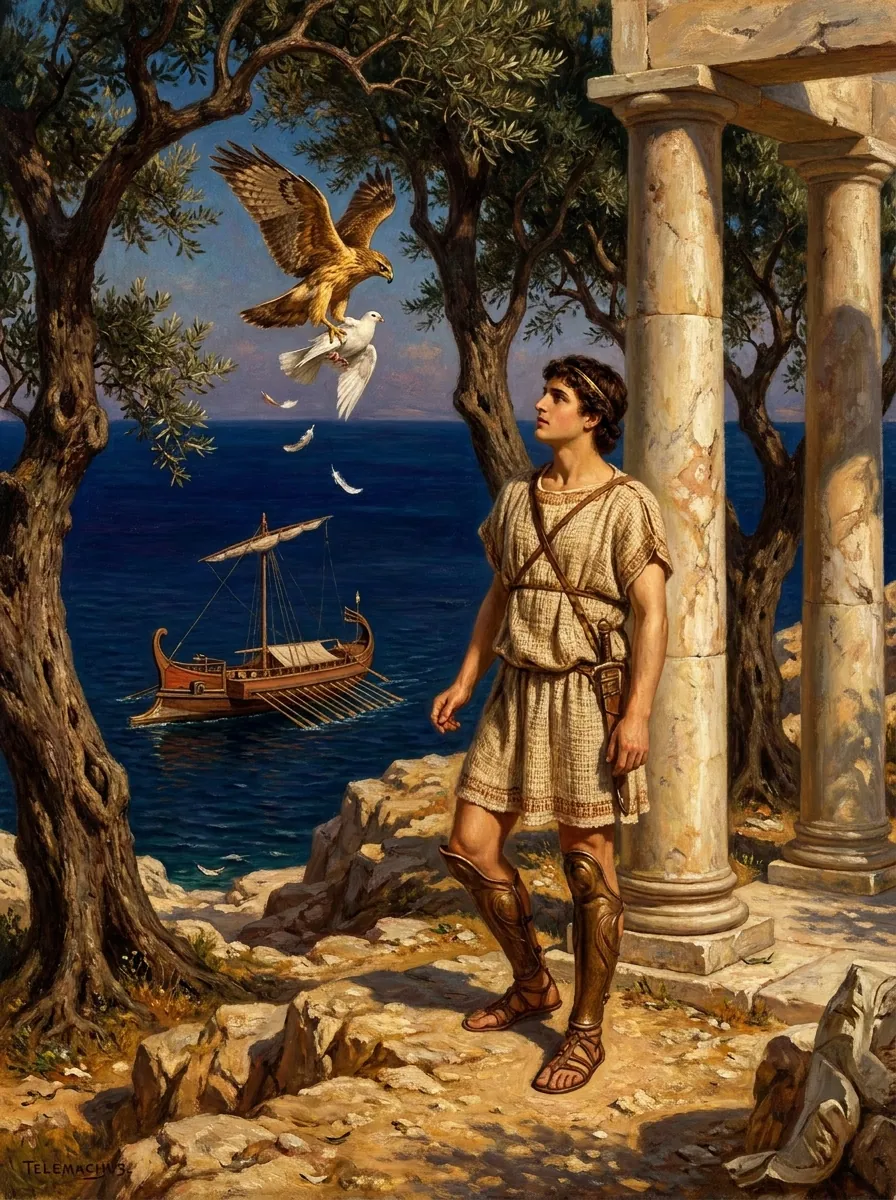
As he spoke, a bird flew by on his right — a hawk, Apollo’s messenger, holding a dove in its talons. As it tore the dove apart, feathers fell to the ground between Telemachus and the ship. Theoclymenus drew him aside and took his hand.
“Telemachus, that bird didn't fly on your right for no reason. As soon as I saw it, I knew it was an omen. It means you'll stay powerful, and no house in Ithaca will be more royal than yours.”
“I hope it proves true. If it does, I'll show you such good will and give you so many presents that everyone who meets you will congratulate you.”
Then he spoke to his friend Piraeus:
“Piraeus, son of Clytius, you've been the most willing to serve me of all who came with me to Pylos. I want you to take this stranger to your house and entertain him hospitably until I can come for him.”
“Telemachus, stay away as long as you want. I'll look after him, and he won't lack hospitality.”
As he spoke, Piraeus went on board and told the others to do the same and loose the hawsers. They took their places in the ship. Telemachus bound on his sandals and took a long, stout spear with a sharpened bronze head from the ship's deck. Then they loosed the hawsers, pushed the ship off from land, and headed toward the city as they had been told. Telemachus strode on as fast as he could until he reached the homestead where his countless herds of swine were feeding, and where the excellent swineherd lived — so devoted a servant to his master.
Translation: Samuel Butler (1900) · Public domain · SPDX: PD-1900-Butler