Meanwhile, Odysseus and the swineherd had lit a fire in the hut and were getting breakfast ready at dawn, having sent the men out with the pigs. When Telemachus came up, the dogs didn't bark but fawned on him. Odysseus, hearing the sound of feet and noticing that the dogs weren't barking, said to Eumaeus:
“Eumaeus, I hear footsteps. I suppose one of your men or someone you know is coming here, because the dogs are fawning on him and not barking.”
The words were barely out of his mouth before his son stood at the door. Eumaeus sprang to his feet, and the bowls in which he was mixing wine fell from his hands as he went toward his master. He kissed his head and both his eyes, and wept for joy. A father couldn't be more delighted at the return of an only son, the child of his old age, after ten years’ absence in a foreign country and having gone through much hardship. He embraced him, kissed him all over as though he had come back from the dead, and spoke fondly to him, saying:
“So you've come, Telemachus, light of my eyes. When I heard you had gone to Pylos, I was sure I was never going to see you anymore. Come in, my dear child, and sit down, so I can have a good look at you now you're home again. It's not very often you come into the country to see us herdsmen; you stick pretty close to the town generally. I suppose you think it better to keep an eye on what the suitors are doing.”
“So be it, old friend, but I've come now because I want to see you, and to learn whether my mother is still at her old home or whether someone else has married her, so that Odysseus's bed is without bedding and covered with cobwebs.”
“She is still at the house, grieving and breaking her heart, and doing nothing but weep, both night and day continually.”
As he spoke, he took Telemachus’ spear, crossed the stone threshold, and came inside. Odysseus rose from his seat to give him place as he entered, but Telemachus checked him:
“Sit down, stranger. I can easily find another seat, and there is one here who will set it out for me.”
Odysseus went back to his own place, and Eumaeus spread some green brushwood on the floor and threw a sheepskin on top of it for Telemachus to sit on. Then the swineherd brought them platters of cold meat, the remains from what they had eaten the day before, and he filled the bread baskets with bread as fast as he could. He mixed wine also in bowls of ivy-wood, and took his seat facing Odysseus. Then they laid their hands on the good things that were before them, and as soon as they had had enough to eat and drink Telemachus said to Eumaeus,
“Old friend, where does this stranger come from? How did his crew bring him to Ithaca, and who were they? He certainly didn't come here by land.”
To this you answered, Eumaeus:
“My son, I'll tell you the truth. He says he's a Cretan, and that he has traveled a great deal. Right now he's running away from a Thesprotian ship and has taken refuge at my station, so I'll put him into your hands. Do whatever you like with him, only remember that he is your suppliant.”
“I'm very distressed by what you've just told me. How can I take this stranger into my house? I'm still young and not strong enough to hold my own if anyone attacks me. My mother can't make up her mind whether to stay where she is and look after the house out of respect for public opinion and the memory of her husband, or whether the time has come for her to take the best man of those who are wooing her, and the one who will make her the most advantageous offer. Still, since the stranger has come to your station, I'll find him a cloak and shirt of good wear, with a sword and sandals, and will send him wherever he wants to go. Or, if you like, you can keep him here at the station, and I'll send him clothes and food so he's no burden on you and your men. But I won't have him go near the suitors, because they're very insolent and are sure to mistreat him in a way that would greatly grieve me. No matter how valiant a man may be, he can do nothing against numbers, because they'll be too strong for him.”
“Sir, it's right that I should say something myself. I'm shocked by what you've said about the insolent way the suitors are behaving, despite such a man as you are. Tell me, do you submit to such treatment tamely, or has some god set your people against you? Can't you complain to your brothers? It's to these that a man may look for support, however great his quarrel may be. I wish I were as young as you are and in my present state of mind. If I were son to Odysseus, or Odysseus himself, I'd rather someone came and cut my head off than not go to the house and be the bane of every one of these men. If they were too many for me—being single-handed—I'd rather die fighting in my own house than see such disgraceful sights day after day: strangers grossly mistreated, and men dragging the women servants about the house in an unseemly way, wine drawn recklessly, and bread wasted all to no purpose for an end that will never be accomplished.”
“I'll tell you everything truly. There's no enmity between me and my people, nor can I complain of brothers, to whom a man may look for support however great his quarrel may be. Zeus has made us a race of only sons. Laertes was the only son of Arceisius, and Odysseus only son of Laertes. I'm myself the only son of Odysseus, who left me behind him when he went away, so I've never been of any use to him. That's why my house is in the hands of numberless marauders; the chiefs from all the neighboring islands—Dulichium, Same, Zacynthus—as well as all the principal men of Ithaca itself, are eating up my house under the pretext of paying court to my mother. She'll neither say point blank that she won't marry, nor bring matters to an end, so they're making havoc of my estate, and before long will do so with myself too. The issue, however, rests with heaven. But you, old friend Eumaeus, go at once and tell Penelope that I'm safe and have returned from Pylos. Tell it to herself alone, and then come back here without letting anyone else know, because there are many who are plotting mischief against me.”
“I understand and heed you; you don't need to instruct me further. Only, as I'm going that way, say whether I shouldn't let poor Laertes know that you've returned. He used to superintend the work on his farm in spite of his bitter sorrow about Odysseus, and he would eat and drink at will along with his servants. But they tell me that from the day on which you set out for Pylos he has neither eaten nor drunk as he ought to, nor does he look after his farm, but sits weeping and wasting away.”
“More’s the pity. I feel sorry for him, but we have to leave him be for now. If I could have anything I wanted, I’d wish for my father to return. But go, give your message, then hurry back. Don’t bother telling Laertes. Tell my mother to send one of her women with the news secretly, right away, so he can hear it from her.”
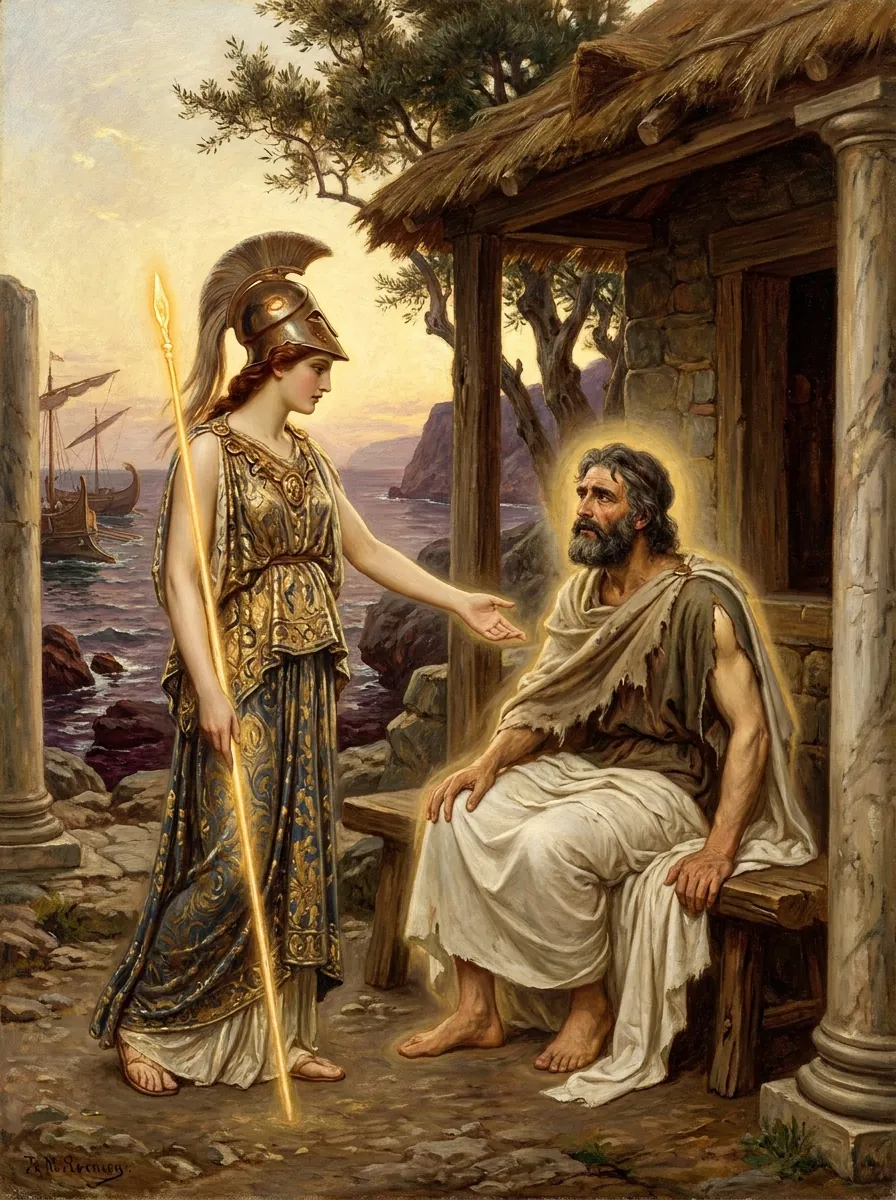
So he urged the swineherd. Eumaeus put on his sandals and headed for town. Athena watched him go, then approached the station in the form of a woman—fair, stately, and wise. She stood by the entry and revealed herself to Odysseus, but Telemachus couldn’t see her and didn’t know she was there; the gods don’t let themselves be seen by everyone. Odysseus saw her, and so did the dogs. They didn’t bark, but went scared and whining to the other side of the yard. She nodded and motioned to Odysseus with her eyebrows, so he left the hut and stood before her outside the main wall of the yards. Then she said to him:
“Odysseus, son of Laertes, it’s time to tell your son. Don’t keep him in the dark any longer. Lay your plans to destroy the suitors, then head for town. I’ll join you soon; I’m eager for the fight, too.”
As she spoke, she touched him with her golden wand. First, she threw a clean shirt and cloak around his shoulders. Then she made him younger and more imposing. She restored his color, filled out his cheeks, and darkened his beard again. Then she left, and Odysseus went back inside the hut. His son was astounded and looked away, afraid he might be looking at a god.
“Stranger, how suddenly you’ve changed. You look different, your color’s not the same. Are you one of the gods who live in heaven? If so, be kind to me until I can make you proper sacrifices and offerings of wrought gold. Have mercy on me.”
“I’m no god. Why would you think I was? I’m your father, the one you grieve for and suffer so much for at the hands of lawless men.”
As he spoke, he kissed his son, and a tear fell from his cheek to the ground. He had held back all tears until then. But Telemachus still couldn’t believe it was his father, and said:
“You’re not my father. Some god is flattering me with false hope, so I’ll grieve even more later. No mortal could do what you’ve done, making yourself old and young in a moment, unless a god was with him. A second ago, you were old and in rags. Now you look like a god come down from heaven.”
“Telemachus, you shouldn’t be so astonished that I’m really here. No other Odysseus is coming. After long wandering and much hardship, I’ve returned to my own country in the twentieth year. What you’re marveling at is the work of Athena, who does with me whatever she wants, because she can do as she pleases. One moment she makes me look like a beggar, the next I’m a young man in good clothes. It’s easy for the gods to make anyone look rich or poor.”
As he spoke, he sat down, and Telemachus threw his arms around his father and wept. They were both so moved that they cried aloud like eagles or vultures whose half-fledged young have been robbed by peasants. They wept so piteously that the sun would have set on their mourning if Telemachus hadn’t suddenly said:
“My dear father, what ship brought you to Ithaca? What nation did the crew claim to be? You couldn’t have come by land.”
“I’ll tell you the truth, my son. The Phaeacians brought me here. They’re great sailors and often escort anyone who reaches their coasts. They took me over the sea while I was fast asleep and landed me in Ithaca, after giving me many presents—bronze, gold, and clothing. By heaven’s mercy, these things are hidden in a cave. I’ve come here at Athena’s suggestion, so we can plan how to kill our enemies. First, give me a list of the suitors, with their numbers, so I can learn who and how many they are. Then I can consider whether we two can fight them all ourselves, or if we need help.”
“Father, I’ve always heard of your renown in the field and in council, but the task you describe is huge. I’m daunted just thinking about it. Two men can’t stand against so many brave ones. There aren’t just ten suitors, or two times ten, but ten many times over. I’ll tell you their numbers right away. There are fifty-two chosen youths from Dulichium, with six servants; from Same, there are twenty-four; twenty young Achaeans from Zacynthus, and twelve from Ithaca itself, all well-born. They have a servant Medon, a bard, and two men who carve at the table. If we face numbers like that, you may bitterly regret coming and seeking revenge. See if you can think of someone willing to help us.”
“Listen to me. Do Athena and her father Zeus seem sufficient, or should I try to find someone else as well?”
“Those you named are a good pair of allies. Though they live high among the clouds, they have power over gods and men.”
“Those two won’t stay out of the fight for long, when the suitors and we clash in my house. Now, return home early tomorrow morning and mingle with the suitors as before. Later, the swineherd will bring me to the city disguised as a miserable old beggar. If you see them mistreating me, steel yourself against my suffering. Even if they drag me out of the house feet first or throw things at me, watch and do nothing beyond gently trying to make them behave more reasonably. But they won’t listen, because their reckoning is near. Furthermore, listen closely: when Athena puts it in my mind, I’ll nod to you. When you see me do this, collect all the armor in the house and hide it in the storeroom. Make some excuse when the suitors ask why you’re removing it. Say you’re taking it away from the smoke, since it’s no longer what it was when Odysseus left, but has become soiled and begrimed with soot. Add that you’re afraid Zeus might set them to quarreling over their wine, and they might harm each other, which would disgrace both the banquet and the wooing, since the sight of arms sometimes tempts people to use them. But leave a sword and a spear for yourself and me, and a pair of oxhide shields, so we can grab them at any moment. Zeus and Athena will soon quiet these people. Also: if you’re truly my son and my blood runs in your veins, let no one know that Odysseus is in the house—not Laertes, not the swineherd, not any of the servants, not even Penelope. You and I will test the women alone, and also some of the men, to see who’s on our side and who’s against us.”
“Father, you’ll get to know me eventually, and when you do, you’ll see I can keep a secret. But I don’t think your plan will work out well for either of us. Think it over. It’ll take a long time to go around to all the farms and check out the men, and all that time, the suitors will be wasting your estate without a care. By all means, test the women, see who’s disloyal and who’s innocent, but I don’t think we should go around testing the men. We can deal with that later, if you really have some sign from Zeus that he’ll back you up.”
So they talked. Meanwhile, the ship that had brought Telemachus and his crew from Pylos had reached Ithaca. They came into the harbor and pulled the ship onto the land. Their servants came and took their armor, and they left all the gifts at Clytius’s house. Then they sent a servant to tell Penelope that Telemachus had gone to the countryside but had sent the ship to town so she wouldn’t be alarmed and upset. This servant and Eumaeus happened to meet while they were both on their way to tell Penelope. When they reached the house, the servant stood up and said to the queen, with the waiting women present:
“Madam, your son has returned from Pylos.”
Eumaeus went right up to Penelope and told her privately everything her son had told him to say. After giving his message, he left the house and its outbuildings and went back to his pigs.
The suitors were surprised and angry about what had happened, so they went outside the great wall around the outer court and held a meeting near the main entrance. Eurymachus, son of Polybus, spoke first.
“Friends, Telemachus’s voyage is a serious matter. We were sure it would come to nothing. Now, though, let’s launch a ship and get a crew together to send after the others, tell them to come back as fast as they can.”
He had barely finished speaking when Amphinomus turned and saw the ship inside the harbor, the crew lowering her sails and stowing their oars. He laughed and said to the others:
“We don’t need to send them any message. They’re here. Some god must have told them, or else they saw the ship go by and couldn’t catch up.”
With that, they got up and went to the water. The crew pulled the ship ashore. Their servants took their armor, and they went up together to the assembly, but they wouldn’t let anyone old or young sit with them. Antinous, son of Eupeithes, spoke first.
“Good heavens, look how the gods have saved this man from destruction. We kept scouts on the headlands all day long, and when the sun went down, we never went ashore to sleep. We waited in the ship all night until morning, hoping to capture and kill him, but some god conveyed him home despite us. We have to figure out how to finish him off. He can’t escape us. Our plan is never likely to succeed while he’s alive, because he’s very shrewd, and public feeling isn’t entirely on our side. We have to hurry, before he calls the Achaeans to assembly. He’ll do it right away, because he’ll be furious with us and will tell everyone how we plotted to kill him but failed. The people won’t like this when they find out. We have to make sure they don’t hurt us or drive us from our own country into exile. Let’s try to grab him either on his farm outside of town, or on the road here. Then we can divide up his property, and his mother and whoever marries her can have the house. If that doesn’t please you, and you want Telemachus to live and keep his father’s property, then we shouldn’t gather here and eat up his goods like this. Instead, we should make our offers to Penelope each from his own house, and she can marry the man who’ll give the most for her, the one destined to win her.”
They all remained silent until Amphinomus rose to speak. He was the son of Nisus, son of King Aretias, and he was the leading suitor from the wheat-growing, well-grassed island of Dulichium. Moreover, Penelope found his conversation more agreeable than that of any other suitor, because he was a man of good character.
“Friends, speaking plainly and honestly, I don’t want to kill Telemachus. It’s a terrible thing to kill someone of noble blood. Let’s ask the gods first. If the oracles of Zeus advise it, I’ll help kill him myself and will urge everyone else to do it. But if they advise against it, I’d have you hold back.”
He spoke, and his words pleased them. They got up and went to Odysseus’s house, where they took their usual seats.
Then Penelope decided to show herself to the suitors. She knew about the plot against Telemachus, because the servant Medon had overheard their plans and told her. So she went down to the court with her maidens. When she reached the suitors, she stood by one of the bearing-posts supporting the roof of the cloister, holding a veil before her face, and rebuked Antinous, saying:
“Antinous, you insolent, wicked schemer! They say you’re the best speaker and counselor of any man your age in Ithaca, but you’re nothing of the kind. Madman, why are you trying to kill Telemachus, ignoring suppliants, whose witness is Zeus himself? It’s not right to plot against each other like this. Don’t you remember how your father fled to this house, afraid of the people, who were angry at him for going with some Taphian pirates and plundering the Thesprotians, who were at peace with us? They wanted to tear him to pieces and eat up everything he had, but Odysseus stopped them, even though they were furious. And now you devour his property without paying for it, and break my heart by wooing his wife and trying to kill his son. Stop doing that, and stop the others, too.”
“Take heart, Queen Penelope, daughter of Icarius, and don’t worry about these things. The man isn’t born yet, and never will be, who’ll lay hands on your son Telemachus while I’m alive. I swear—and it will surely happen—my spear will be stained with his blood. Odysseus often held me on his knees, held wine to my lips, and put pieces of meat in my hands. Telemachus is my dearest friend, and has nothing to fear from us suitors. Of course, if death comes to him from the gods, he can’t escape it.”
He said this to reassure her, but he was really plotting against Telemachus.
Then Penelope went upstairs again and mourned her husband until Athena brought sleep to her eyes. In the evening, Eumaeus returned to Odysseus and his son, who had just sacrificed a year-old pig and were helping each other prepare supper. Athena came up to Odysseus, turned him into an old man with a wave of her wand, and put his old clothes on him again, fearing that the swineherd might recognize him and not keep the secret, but go and tell Penelope.
Telemachus spoke first.
“So, Eumaeus, you’re back. What’s the news from town? Have the suitors returned, or are they still waiting over there to ambush me on my way home?”
“I didn’t think to ask about that when I was in town. I wanted to deliver my message and return as soon as I could. I met a man sent by those who went with you to Pylos, and he was the first to tell your mother the news. But I can say what I saw with my own eyes: I had just reached the crest of the hill of Hermes above the town when I saw a ship coming into harbor with a number of men on board. They had many shields and spears, and I thought it was the suitors, but I can’t be sure.”
On hearing this, Telemachus smiled at his father, but so Eumaeus couldn’t see him.
Then, when they had finished their work and the meal was ready, they ate, and every man had his full share, so all were satisfied. As soon as they had had enough to eat and drink, they lay down to rest and enjoyed the gift of sleep.
Translation: Samuel Butler (1900) · Public domain · SPDX: PD-1900-Butler