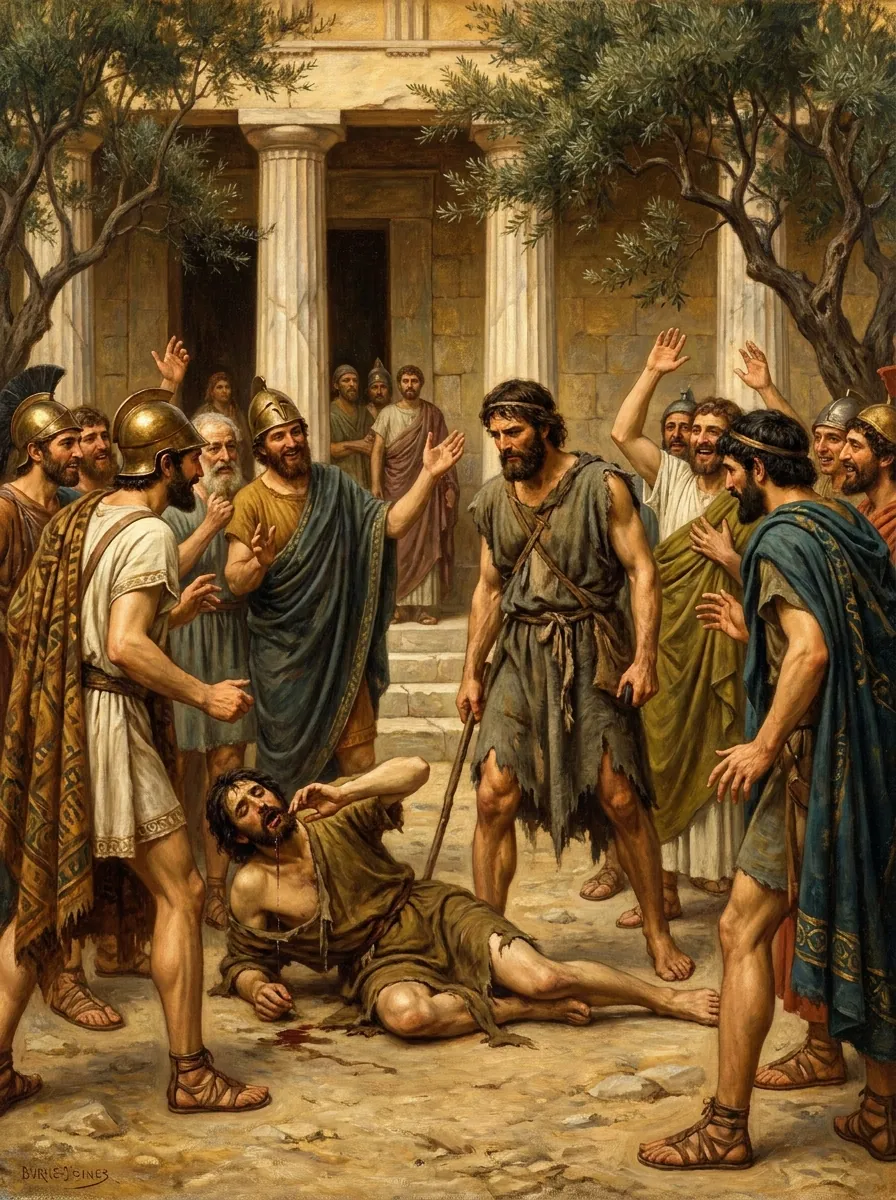
Now, there was a common tramp who used to beg all over the city of Ithaca, notorious as an incorrigible glutton and drunkard. This man had no strength or stamina, but he was a great hulking fellow to look at. His real name, the one his mother gave him, was Arnaeus, but the young men of the place called him Irus, because he used to run errands for anyone who would send him. As soon as he arrived, he began to insult Odysseus and try to drive him out of his own house.
‘Be off, old man, from the doorway, or you’ll be dragged out neck and heels. Don’t you see they’re all winking at me, wanting me to turn you out by force, only I don’t like to? Get up, then, and go yourself, or we’ll come to blows.’
‘My friend, I’m doing you no harm. People give you a great deal, but I’m not jealous. There’s room enough in this doorway for the pair of us, and you needn’t grudge me things that aren’t yours to give. You seem to be just such another tramp as myself, but perhaps the gods will give us better luck by and by. Don’t, however, talk too much about fighting or you’ll incense me, and old though I am, I’ll cover your mouth and chest with blood. I’ll have more peace tomorrow if I do, for you won’t come to the house of Odysseus any more.’
‘You filthy glutton, you run on trippingly like an old fishwife. I have a good mind to lay both hands about you and knock your teeth out of your head like so many boar’s tusks. Get ready, therefore, and let these people here stand by and look on. You’ll never be able to fight one who is so much younger than yourself.’
Thus they rated one another on the smooth pavement in front of the doorway, and when Antinous saw what was going on, he laughed heartily and said to the others,
‘This is the finest sport you ever saw. Heaven never yet sent anything like it into this house. The stranger and Irus have quarreled and are going to fight. Let’s set them on to do so at once.’
The suitors all came up laughing and gathered round the two ragged tramps.
‘Listen to me. There are some goats’ paunches down at the fire, which we’ve filled with blood and fat, and set aside for supper. He who is victorious and proves himself to be the better man will have his pick of the lot. He’ll be free of our table, and we won’t allow any other beggar about the house at all.’
The others all agreed, but Odysseus, to throw them off the scent, said,
‘Sirs, an old man like myself, worn out with suffering, cannot hold his own against a young one, but my irrepressible belly urges me on, though I know it can only end in my getting a drubbing. You must swear, however, that none of you will give me a foul blow to favor Irus and secure him the victory.’
They swore as he told them, and when they had completed their oath, Telemachus put in a word and said,
‘Stranger, if you have a mind to settle with this fellow, you needn’t be afraid of anyone here. Whoever strikes you will have to fight more than one. I am host, and the other chiefs, Antinous and Eurymachus, both of them men of understanding, are of the same mind as I am.’
Everyone assented, and Odysseus girded his old rags about his loins, thus baring his stalwart thighs, his broad chest and shoulders, and his mighty arms, but Athena came up to him and made his limbs even stronger still. The suitors were beyond measure astonished, and one would turn towards his neighbor saying,
‘The stranger has brought such a thigh out of his old rags that there will soon be nothing left of Irus.’
Irus began to be very uneasy as he heard them, but the servants girded him by force and brought him into the open part of the court in such a fright that his limbs were all of a tremble. Antinous scolded him and said,
‘You swaggering bully, you ought never to have been born at all if you’re afraid of such an old broken-down creature as this tramp is. I say, therefore—and it will surely be—if he beats you and proves himself the better man, I’ll pack you off on board ship to the mainland and send you to King Echetus, who kills everyone that comes near him. He’ll cut off your nose and ears and draw out your entrails for the dogs to eat.’
This scared Irus even more. They brought him into the middle of the courtyard, and the two men raised their hands to fight. Odysseus considered whether to hit him hard enough to finish him off right there, or just knock him down with a lighter blow. He decided it was best to give him a lighter blow, fearing the Achaeans might suspect who he was. Then they began to fight. Irus hit Odysseus on the right shoulder, but Odysseus landed a blow on Irus’s neck, under the ear, that broke the bones of his skull. Blood gushed from his mouth. He fell groaning in the dust, gnashing his teeth and kicking on the ground. The suitors threw up their hands and nearly died of laughter as Odysseus grabbed him by the foot and dragged him into the outer court as far as the gatehouse. There, he propped him up against the wall and put his staff in his hands.
“Sit here, and keep the dogs and pigs away. You’re a pitiful creature, and if you try to make yourself king of the beggars again, you’ll fare even worse.”
Then he threw his dirty old wallet, all tattered and torn, over his shoulder by its cord and went back to sit down on the threshold. The suitors went inside the cloisters, laughing and saluting him.
“May Zeus, and all the other gods, grant you whatever you want for putting an end to this insatiable tramp’s importunity. We’ll take him over to the mainland presently, to King Echetus, who kills everyone who comes near him.”
Odysseus took this as a good omen. Antinous set a great goat’s paunch before him, filled with blood and fat. Amphinomus took two loaves out of the bread-basket and brought them to him, pledging him in a golden goblet of wine.
“Good luck to you, father stranger. You’re very badly off at present, but I hope you’ll have better times by and by.”
“Amphinomus, you seem to be a man of good understanding—as you may well be, seeing whose son you are. I’ve heard your father well spoken of; he’s Nisus of Dulichium, a man both brave and wealthy. They tell me you’re his son, and you appear to be a considerable person. Listen, therefore, and take heed to what I’m saying. Man is the vainest of all creatures on earth. As long as heaven grants him health and strength, he thinks he’ll come to no harm later. Even when the blessed gods bring sorrow upon him, he bears it as he must, and makes the best of it; for God almighty gives men their daily minds day by day. I know all about it, for I was a rich man once, and did much wrong in the stubbornness of my pride, and in the confidence that my father and my brothers would support me. Therefore, let a man fear God in all things always, and take the good that heaven may see fit to send him without vain glory. Consider the infamy of what these suitors are doing; see how they’re wasting the estate and dishonoring the wife of one who is certain to return someday—and soon, too. He’ll be here soon. May heaven send you home quietly first, so you don’t meet him on the day of his coming, for once he is here, the suitors and he will not part bloodlessly.”
With these words, he made a drink-offering. When he had drunk, he put the gold cup back into Amphinomus’s hands. Amphinomus walked away serious and bowing his head, for he foreboded evil. But even so, he didn’t escape destruction, for Athena had doomed him to fall by Telemachus’s hand. So he took his seat again at the place from which he had come.
Then Athena put it into Penelope’s mind to show herself to the suitors, so she might make them even more enamored of her and win still further honor from her son and husband. So she feigned a mocking laugh and said:
“Eurynome, I’ve changed my mind and have a fancy to show myself to the suitors, although I detest them. I’d also like to give my son a hint that he’d better not have anything more to do with them. They speak fairly enough, but they mean mischief.”
“My dear child, all that you’ve said is true. Go and tell your son about it, but first wash yourself and anoint your face. Don’t go about with your cheeks all covered with tears; it’s not right that you should grieve so incessantly, for Telemachus, whom you always prayed you might live to see with a beard, is already grown up.”
“I know, Eurynome, that you mean well, but don’t try and persuade me to wash and anoint myself, for heaven robbed me of all my beauty on the day my husband sailed. Nevertheless, tell Autonoe and Hippodamia that I want them. They must be with me when I’m in the cloister; I’m not going among the men alone; it wouldn’t be proper for me to do so.”
The old woman went out of the room to bid the maids go to their mistress. In the meantime, Athena thought of another matter and sent Penelope off into a sweet slumber. She lay down on her couch, and her limbs became heavy with sleep. Then the goddess shed grace and beauty over her, so all the Achaeans might admire her. She washed her face with the ambrosial loveliness that Aphrodite wears when she goes dancing with the Graces. She made her taller and of a more commanding figure, while her complexion was whiter than sawn ivory. When Athena had done all this, she went away, and the maids came in from the women’s room and woke Penelope with the sound of their talking.
“What an exquisitely delicious sleep I’ve been having, in spite of all my misery. I wish Artemis would let me die so sweetly now, at this very moment, so I might no longer waste in despair for the loss of my dear husband, who possessed every kind of good quality and was the most distinguished man among the Achaeans.”
With these words, she came down from her upper room, not alone but attended by two of her maidens. When she reached the suitors, she stood by one of the bearing-posts supporting the roof of the cloister, holding a veil before her face, with a staid maidservant on either side of her. As they beheld her, the suitors were so overpowered and became so desperately enamored of her that each one prayed he might win her for his own bedfellow.
“Telemachus, I fear you’re no longer so discreet and well-behaved as you used to be. When you were younger, you had a greater sense of propriety. Now, however, that you’re grown up—though a stranger looking at you would take you for the son of a well-to-do father, as far as size and good looks go—your conduct is by no means what it should be. What is all this disturbance that’s been going on, and how did you allow a stranger to be so disgracefully ill-treated? What would have happened if he had suffered serious injury while a suppliant in our house? Surely this would have been very discreditable to you.”
“I’m not surprised, Mother, that you’re displeased. I understand what’s going on and know when things aren’t as they should be — something I couldn’t do when I was younger. Still, I can’t always behave perfectly. These wicked people keep driving me crazy, and I have no one to back me up. But this fight between Irus and the stranger didn’t turn out as the suitors wanted; the stranger won. I wish Zeus, Athena, and Apollo would break the necks of every one of your suitors, inside and outside the house. I wish they were all as limp as Irus over there in the outer court gate. Look how he nods his head like a drunk. He got such a thrashing that he can’t stand or get back home, wherever that is, because he has no strength left.”
So they talked. Then Eurymachus came up and said,
“Queen Penelope, daughter of Icarius, if all the Achaeans in Iasian Argos could see you right now, you’d have even more suitors here tomorrow morning. You’re the most admirable woman in the world, both for your beauty and your intelligence.”
“Eurymachus, heaven robbed me of my beauty, face and figure, when the Argives sailed for Troy with my dear husband. If he were to return and manage my affairs, I’d be more respected and present myself better to the world. As it is, I’m oppressed with worry and the afflictions heaven has seen fit to heap on me. My husband foresaw it all. When he left, he took my right wrist in his hand. ‘Wife,’ he said, ‘we won’t all come home safe from Troy. The Trojans fight well with bow and spear. They’re excellent fighting from chariots, and nothing decides a fight faster than that. I don’t know if heaven will send me back to you, or if I’ll fall there at Troy. In the meantime, look after things here. Take care of my father and mother as you do now, or even more so while I’m gone. When you see our son growing a beard, marry whomever you want, and leave this house.’ That’s what he said, and now it’s all coming true. A night will come when I have to yield to a marriage I detest, because Zeus has taken away all hope of happiness. And this further grief cuts me to the heart: you suitors aren’t wooing me as is custom in my country. When men court a woman they think will make a good wife, a woman of noble birth, each trying to win her, they usually bring oxen and sheep to feast her friends and give her magnificent presents, instead of eating up other people’s property without paying.”
That’s what she said. Odysseus was glad to hear her trying to get presents from the suitors, flattering them with words she didn’t mean.
“Queen Penelope, daughter of Icarius, take as many presents as you want from anyone who’ll give them. It’s not good to refuse a present. But we won’t go about our business or stir from here until you’ve married the best man among us, whoever he may be.”
The others applauded Antinous. Each sent his servant to bring his present. Antinous’s man returned with a large, lovely dress, exquisitely embroidered, with twelve beautifully made brooch pins of pure gold to fasten it. Eurymachus brought her a magnificent chain of gold and amber beads that gleamed like sunlight. Eurydamas’s two men returned with earrings fashioned into three brilliant pendants that glistened beautifully. King Pisander, son of Polyctor, gave her a necklace of the rarest workmanship. Everyone else brought her a beautiful present of some kind.
Then the queen went back to her room upstairs, and her maids brought the presents after her. Meanwhile, the suitors sang and danced, staying until evening. They danced and sang until it grew dark. Then they brought in three braziers to give light, piled them with chopped firewood, old and dry, and lit torches from them, which the maids held up in turns. Then Odysseus said:
“Maids, servants of Odysseus, who has been gone so long, go to the queen inside. Sit with her and amuse her, or spin and pick wool. I’ll hold the light for all these people. They can stay till morning, but they won’t beat me, because I can stand a lot.”
The maids looked at each other and laughed. Pretty Melantho began to mock him contemptuously. She was the daughter of Dolius, raised by Penelope, who used to give her toys and look after her when she was a child. But she showed no consideration for her mistress’s sorrows and misbehaved with Eurymachus, whom she loved.
“Poor wretch, have you lost your mind? Go sleep in some smithy or public gossip place, instead of chattering here. Aren’t you ashamed to open your mouth before your betters — so many of them? Has the wine gone to your head, or do you always babble like this? You seem to have lost your wits because you beat that tramp Irus. Watch out a better man doesn’t come and cudgel you about the head till he packs you bleeding out of the house.”
“Vixen, I’ll tell Telemachus what you’ve been saying, and he’ll tear you limb from limb.”
That scared the women, and they went into the house, trembling because they thought he would do as he said. Odysseus stood near the burning braziers, holding up torches and looking at the people — brooding on things that would surely happen.
Athena wouldn’t let the suitors stop their insolence for a moment, because she wanted Odysseus to become even more bitter against them. So she set Eurymachus, son of Polybus, to mock him, which made the others laugh.
“Listen, suitors of Queen Penelope, so I can speak my mind. It’s not for nothing this man has come to Odysseus’s house. I believe the light isn’t coming from the torches, but from his own head — because his hair is all gone.”
Then, turning to Odysseus, he said,
“Stranger, would you work as a servant if I sent you out to the fields and made sure you were well paid? Could you build a stone fence or plant trees? I’d feed you all year round and give you shoes and clothes. Would you do it? Of course not. You’re a lost cause and don’t want to work. You’d rather go around the country begging to fill your belly.”
“Eurymachus, if you and I were to go head-to-head in early summer when the days are longest—give me a good scythe, and take one yourself, and let’s see who lasts longer or mows stronger, from dawn till dark when the grass is at its thickest. Or if you want to plow against me, let’s each take a yoke of tawny oxen, well-matched and strong: turn me loose in a four-acre field, and see if you or I can drive the straighter furrow. Or if war broke out today, give me a shield, a couple of spears, and a helmet that fits well—you’d find me at the front of the fight, and you’d stop your insults about my belly. You’re insolent and cruel, and you think you’re a great man because you live in a small, bad world. If Odysseus comes home, his doors are wide, but you’ll find them narrow when you try to run through them.”
Eurymachus was furious. He scowled and shouted,
“You wretch, I’ll pay you back for daring to say such things to me, and in public. Has the wine gone to your head, or do you always babble like this? You seem to have lost your mind because you beat that tramp Irus.”
He grabbed a footstool, but Odysseus, afraid, went to Amphinomus of Dulichium and knelt at his knees for protection. The stool hit the cupbearer on his right hand and knocked him down. The man fell with a cry, flat on his back, and his wine jug crashed to the ground. The suitors in the covered cloister were in an uproar. One turned to his neighbor and said,
“I wish this stranger had gone somewhere else—bad luck to him, for all the trouble he’s causing. We can’t allow this kind of disturbance over a beggar. If this is how things are going to be, we won’t enjoy our banquet.”
Then Telemachus stepped forward and said,
“Gentlemen, are you mad? Can’t you handle your food and drink decently? Some evil spirit has taken hold of you. I don’t want to drive any of you away, but you’ve had your supper, and the sooner you all go home to bed, the better.”
The suitors bit their lips, marveling at his boldness. But Amphinomus, son of Nisus, who was the son of Aretias, said,
“Let’s not take offense. It’s reasonable, so let’s not answer back. And let’s not harm the stranger or any of Odysseus’s servants. Let the cupbearer pass around the drink offerings, so we can make them and go home to rest. As for the stranger, let’s leave Telemachus to deal with him, since he’s come to Telemachus’s house.”
They approved of this suggestion. Mulius of Dulichium, Amphinomus’s servant, mixed a bowl of wine and water and handed it around to each man. They made their drink offerings to the blessed gods. Then, when they had made their offerings and each had drunk as he wished, they went their separate ways, each to his own home.
Translation: Samuel Butler (1900) · Public domain · SPDX: PD-1900-Butler