As dawn came, Telemachus put on his sandals, took up a strong spear that fit his grip, and headed toward the city.
“Old friend, I’m going to town to see my mother. She won’t stop grieving until she sees me. As for this stranger, take him to town and let him beg from anyone who’ll give him a drink and a piece of bread. I have enough trouble of my own; I can’t be burdened with other people’s. If that makes him angry, too bad for him, but I like to say what I mean.”
“Sir, I don’t want to stay here. A beggar always does better in town than in the country; anyone can give him something if they like. I’m too old to care about staying here at a master’s beck and call. So let this man do as you said and take me to town after I’ve warmed myself by the fire and the day’s gotten a little warmer. My clothes are wretchedly thin, and this frosty morning I’ll be perished with cold, since you say the city is some way off.”
With that, Telemachus strode off through the yards, plotting his revenge on the suitors. When he reached home, he stood his spear against a bearing-post of the cloister, crossed the stone floor, and went inside.
Nurse Eurycleia saw him long before anyone else. She was putting the fleeces on the seats, and she burst out crying as she ran up to him. All the other maids came up too, and covered his head and shoulders with kisses. Penelope came out of her room looking like Artemis or Aphrodite, and wept as she flung her arms around her son. She kissed his forehead and his beautiful eyes.
“Light of my eyes, you’ve come home! I was sure I’d never see you again. To think of you going off to Pylos without saying anything or getting my permission. But come, tell me what you saw.”
“Don’t scold me, Mother, or upset me, not after the narrow escape I’ve had. Wash your face, change your dress, go upstairs with your maids, and promise full and sufficient hecatombs to all the gods if Zeus will only grant us revenge on the suitors. I have to go to the assembly to invite a stranger who came back with me from Pylos. I sent him on with my crew and told Piraeus to take him home and look after him until I could come for him myself.”
She heeded her son’s words, washed her face, changed her dress, and vowed full and sufficient hecatombs to all the gods if they would only grant her revenge on the suitors.
Telemachus went through, and out of, the cloisters, spear in hand—not alone, for his two swift dogs went with him. Athena gave him such divine beauty that everyone marveled as he went by. The suitors gathered around him with fair words and malice in their hearts, but he avoided them and went to sit with Mentor, Antiphus, and Halitherses, old friends of his father’s house. They made him tell them everything that had happened. Then Piraeus came up with Theoclymenus, whom he had escorted through the town to the assembly, and Telemachus joined them at once. Piraeus spoke first:
“Telemachus, I wish you’d send some of your women to my house to take away the presents Menelaus gave you.”
“We don’t know what might happen, Piraeus. If the suitors kill me in my own house and divide my property, I’d rather you had the presents than any of those people. If, on the other hand, I manage to kill them, I’ll be much obliged if you’ll kindly bring me my presents.”
With these words, he took Theoclymenus to his own house. When they got there, they laid their cloaks on the benches and seats, went into the baths, and washed themselves. When the maids had washed and anointed them and given them cloaks and shirts, they took their seats at the table. A maidservant brought them water in a beautiful golden ewer and poured it into a silver basin for them to wash their hands, and she drew a clean table beside them. An upper servant brought them bread and offered them many good things from what was in the house. Opposite them sat Penelope, reclining on a couch by one of the bearing-posts of the cloister, and spinning. Then they laid their hands on the food before them, and as soon as they had had enough to eat and drink, Penelope said:
“Telemachus, I’m going upstairs to lie down on that sad couch, which I haven’t stopped watering with my tears since Odysseus set out for Troy with the sons of Atreus. You failed to make it clear to me, before the suitors came back to the house, whether you heard anything about your father’s return.”
“I’ll tell you the truth, then. We went to Pylos and saw Nestor, who took me to his house and treated me as hospitably as if I were his own son, just returned after a long absence. So did his sons. But he said he hadn’t heard a word from anyone about Odysseus, whether he was alive or dead. So he sent me with a chariot and horses to Menelaus. There I saw Helen, for whose sake so many Argives and Trojans were, in heaven’s wisdom, doomed to suffer. Menelaus asked me what had brought me to Lacedaemon, and I told him the whole truth. Then he said, ‘So these cowards would usurp a brave man’s bed? A hind might as well lay her newborn young in the lair of a lion, and then go off to feed in the forest or some grassy dell. The lion, when he comes back to his lair, will make short work of them both, and so will Odysseus with these suitors. By Zeus, Athena, and Apollo, if Odysseus is still the man he was when he wrestled with Philomeleides in Lesbos and threw him so heavily that all the Greeks cheered—if he’s still like that and were to come near these suitors, they’d have a short shrift and a sorry wedding. As for your question, though, I won’t prevaricate or deceive you. I’ll tell you everything the old man of the sea told me. He said he could see Odysseus on an island, sorrowing bitterly in the house of the nymph Calypso, who was keeping him prisoner. He couldn’t reach his home because he had no ships or sailors to take him over the sea.’ That’s what Menelaus told me, and when I heard his story, I came away. The gods gave me a fair wind and soon brought me safe home again.”
With these words, he moved Penelope’s heart. Then Theoclymenus said to her:
“Madam, wife of Odysseus, Telemachus doesn’t understand these things. Listen to me, then, because I can divine them surely and will hide nothing from you. May Zeus, the king of heaven, be my witness, and the rites of hospitality, with that hearth of Odysseus to which I now come, that Odysseus himself is even now in Ithaca. Either going about the country or staying in one place, he’s investigating all these evil deeds and preparing a day of reckoning for the suitors. I saw an omen when I was on the ship that meant this, and I told Telemachus about it.”
“May it be so. If your words come true, you’ll have such gifts and such goodwill from me that everyone who sees you will congratulate you.”
Thus did they converse. Meanwhile, the suitors were throwing discs or aiming with spears at a mark on the leveled ground in front of the house, behaving with all their old insolence. When it was time for dinner, and the flock of sheep and goats had come into the town from all the country round—140 with their shepherds, as usual—Medon, their favorite servant, who waited on them at table, said:
“Alright, young sirs, enough fun. Let’s go inside so we can get dinner ready. Dinner’s never a bad thing, especially at dinner time.”
They stopped playing as they were told. Once inside, they laid their cloaks on the benches and seats, then sacrificed some sheep, goats, pigs, and a heifer—all fat and well-grown—to prepare for the meal. Meanwhile, Odysseus and the swineherd were starting for town. The swineherd said:
“Stranger, I guess you still want to go to town today, like my master said. I’d have liked you to stay here as a station hand, but I have to do what my master tells me, or he’ll scold me later. A scolding from your master is a serious thing. Let’s get going, then, because it’s broad daylight now, but it’ll be night again soon, and then you’ll find it colder.”
“I know, I understand. Say no more. Let’s go. If you have a stick ready, let me have it to walk with, since you say the road is rough.”
As he spoke, he slung his shabby, tattered wallet over his shoulder by its cord. Eumaeus gave him a stick he liked. The two started off, leaving the station in charge of the dogs and herdsmen who stayed behind. The swineherd led the way, and his master followed, looking like a broken-down old tramp as he leaned on his staff, his clothes all rags. When they had crossed the rough, steep ground and were nearing the city, they reached the fountain where the citizens drew water. Ithacus, Neritus, and Polyctor had built it. A grove of water-loving poplars grew in a circle around it, and the clear, cold water flowed down from a rock high above. Above the fountain was an altar to the nymphs, where all travelers used to sacrifice. Here, Melanthius, Dolius’s son, overtook them as he was driving down some goats—the best of his flock—for the suitors’ dinner. Two shepherds were with him. When he saw Eumaeus and Odysseus, he reviled them with outrageous and unseemly language, which made Odysseus very angry.
“There you go—a fine pair you are. See how heaven brings birds of a feather together. Where are you taking this miserable wretch, master swineherd? It’d make anyone sick to see such a creature at the table. A fellow like this never won a prize in his life. He’ll go around rubbing his shoulders against every man’s doorpost, begging—not for swords and cauldrons like a man, but just for scraps not worth begging for. If you gave him to me as a hand on my station, he could clean out the folds or bring sweet feed to the kids. He could fatten his thighs as much as he pleased on whey. But he’s taken to bad ways and won’t do any kind of work. He’ll do nothing but beg victuals all over town to feed his insatiable belly. So, I say—and it’ll surely happen—if he goes near Odysseus’s house, he’ll get his head broken by the stools they’ll fling at him, until they turn him out.”
As he passed, he kicked Odysseus on the hip out of pure spite. Odysseus stood firm and didn’t budge. For a moment, he wondered whether to fly at Melanthius and kill him with his staff, or fling him to the ground and beat his brains out. But he resolved to endure it and keep himself in check. The swineherd looked straight at Melanthius and rebuked him, lifting his hands and praying to heaven.
“Fountain nymphs, children of Zeus, if Odysseus ever burned you thigh bones covered with fat—lambs or kids—grant my prayer that heaven may send him home. He’d soon put an end to the swaggering threats with which men like you go around insulting people, gadding all over town while your flocks are ruined by bad shepherding.”
“You ill-conditioned cur, what are you talking about? Someday I’ll put you on board ship and take you to a foreign country, where I can sell you and pocket the money. I wish I were as sure that Apollo would strike Telemachus dead today, or that the suitors would kill him, as I am that Odysseus will never come home again.”
With that, he left them to come on at their leisure, while he went quickly ahead and soon reached his master’s house. He went in and took his seat among the suitors opposite Eurymachus, who liked him better than the others. The servants brought him a portion of meat, and a maidservant set bread before him to eat. Presently, Odysseus and the swineherd came up to the house and stood by it, amid a sound of music, because Phemius was beginning to sing for the suitors. Then Odysseus took the swineherd’s hand and said:
“Eumaeus, this house of Odysseus is a fine place. No matter how far you go, you’ll find few like it. One building follows another. The outer court has a wall with battlements all around it. The doors are double-folding and well-made. It’d be hard to take it by force. I see many people feasting inside. I smell roast meat, and I hear music, which the gods have made to go along with feasting.”
“You’ve perceived it right, as you generally do. But let’s think about our best course. Will you go inside first and join the suitors, leaving me here? Or will you wait here and let me go in first? Don’t wait long, or someone might see you loitering outside and throw something at you. Think about it.”
“I understand and heed you. Go in first and leave me here. I’m used to being beaten and having things thrown at me. I’ve been so buffeted about in war and at sea that I’m hardened. This can go with the rest. But a man can’t hide the cravings of a hungry belly. That’s an enemy that troubles all men. It’s because of that that ships are fitted out to sail the seas and make war on other people.”
As they were talking, a dog that had been sleeping raised his head and pricked up his ears. This was Argos, whom Odysseus had bred before leaving for Troy, but he’d never gotten any work out of him. In the old days, the young men used to take him out hunting wild goats, deer, or hares. But now that his master was gone, he lay neglected on the heaps of mule and cow dung in front of the stable doors, waiting for the men to come and haul it away to manure the great field. He was full of fleas. As soon as he saw Odysseus standing there, he dropped his ears and wagged his tail, but he couldn’t get close to his master. When Odysseus saw the dog on the other side of the yard, he dashed a tear from his eye without Eumaeus seeing it, and said:
“Eumaeus, what a noble hound that is over there on the manure heap. He’s splendidly built. Is he as fine as he looks, or is he just one of those dogs that beg around a table and are kept only for show?”
“That hound belonged to the man who died in a far country. If he were what he was when Odysseus left for Troy, he’d soon show you what he could do. No wild beast in the forest could get away from him once he was on its tracks. But now he’s fallen on hard times, because his master is dead and gone, and the women don’t care for him. Servants never do their work when their master’s hand isn’t over them anymore, because Zeus takes half the goodness out of a man when he makes him a slave.”
As he said this, he went into the buildings toward the cloister where the suitors were. Argos died as soon as he recognized his master.
Telemachus saw Eumaeus long before anyone else did and beckoned him to sit beside him. Eumaeus looked around and saw a seat near the carver, who was serving portions to the suitors. He picked it up, brought it to Telemachus’s table, and sat down opposite him. Then the servant brought him his portion and bread from the bread-basket.
Immediately afterward, Odysseus came inside, looking like a poor, miserable old beggar, leaning on his staff and with his clothes all in rags. He sat down on the ash-wood threshold just inside the doors leading from the outer to the inner court, against a cypress-wood bearing-post that the carpenter had skillfully planed and made to join perfectly with rule and line. Telemachus took a whole loaf from the bread-basket, with as much meat as he could hold in his two hands, and said to Eumaeus,
“Take this to the stranger and tell him to go around to the suitors and beg from them; a beggar shouldn't be shamefaced.”
So Eumaeus went up to him and said,
“Stranger, Telemachus sends you this and says you are to go around to the suitors begging, for beggars shouldn't be shamefaced.”
“May King Zeus grant all happiness to Telemachus and fulfill the desire of his heart.”
Then, with both hands, he took what Telemachus had sent him and laid it on the dirty old wallet at his feet. He went on eating it while the bard was singing and had just finished his dinner as he left off. The suitors applauded the bard, whereon Athena went up to Odysseus and prompted him to beg pieces of bread from each one of the suitors, so he might see what kind of people they were and tell the good from the bad. But, come what may, she wasn't going to save a single one of them. Odysseus, therefore, went on his round, going from left to right, and stretched out his hands to beg as though he were a real beggar. Some of them pitied him and were curious about him, asking one another who he was and where he came from. Then the goatherd Melanthius said,
“Suitors of my noble mistress, I can tell you something about him, for I have seen him before. The swineherd brought him here, but I know nothing about the man himself, nor where he comes from.”
On this, Antinous began to abuse the swineherd.
“You precious idiot, what did you bring this man to town for? Don't we have enough tramps and beggars already pestering us as we sit at meat? Do you think it a small thing that such people gather here to waste your master’s property—and you had to bring this man as well?”
“Antinous, your birth is good, but your words are evil. It was no doing of mine that he came here. Who is likely to invite a stranger from a foreign country, unless it's one of those who can do public service as a seer, a healer of hurts, a carpenter, or a bard who can charm us with his singing? Such men are welcome all the world over, but no one is likely to ask a beggar who will only worry him. You are always harder on Odysseus’ servants than any of the other suitors are, and above all on me, but I do not care so long as Telemachus and Penelope are alive and here.”
“Hush, don't answer him; Antinous has the bitterest tongue of all the suitors, and he makes the others worse.”
Then, turning to Antinous, he said,
“Antinous, you take as much care of my interests as though I were your son. Why should you want to see this stranger turned out of the house? Heaven forbid; take something and give it to him yourself; I don't grudge it; I bid you take it. Never mind my mother, nor any of the other servants in the house; but I know you won't do what I say, for you are more fond of eating things yourself than of giving them to other people.”
“What do you mean, Telemachus, by this swaggering talk? If all the suitors were to give him as much as I will, he wouldn't come here again for another three months.”
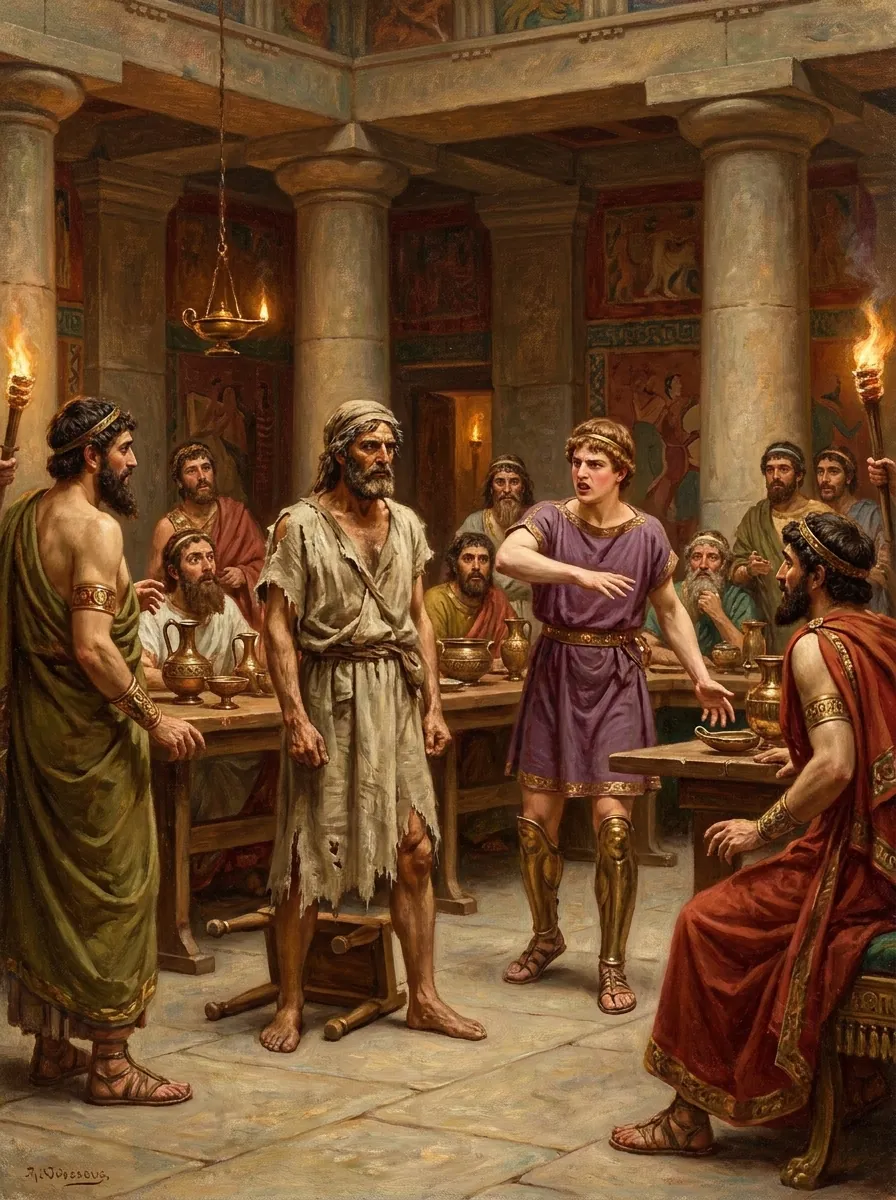
As he spoke, he drew the stool on which he rested his dainty feet from under the table and made as though he would throw it at Odysseus, but the other suitors all gave him something and filled his wallet with bread and meat. He was about, therefore, to go back to the threshold and eat what the suitors had given him, but he first went up to Antinous and said:
“Sir, give me something; you aren't, surely, the poorest man here; you seem to be a chief, foremost among them all; therefore you should be the better giver, and I will tell far and wide of your bounty. I too was a rich man once and had a fine house of my own; in those days I gave to many a tramp such as I now am, no matter who he might be nor what he wanted. I had any number of servants and all the other things which people have who live well and are accounted wealthy, but it pleased Zeus to take all away from me. He sent me with a band of roving robbers to Aegyptus; it was a long voyage, and I was undone by it. I stationed my ships in the river Aegyptus and bade my men stay by them and keep guard over them, while I sent out scouts to reconnoiter from every point of vantage.
“But the men disobeyed my orders, took to their own devices, and ravaged the land of the Egyptians, killing the men and taking their wives and children captives. The alarm was soon carried to the city, and when they heard the war-cry, the people came out at daybreak till the plain was filled with soldiers, horse and foot, and with the gleam of armor. Then Zeus spread panic among my men, and they would no longer face the enemy, for they found themselves surrounded. The Egyptians killed many of us and took the rest alive to do forced labor for them; as for myself, they gave me to a friend who met them, to take to Cyprus, Dmetor by name, son of Iasus, who was a great man in Cyprus. Thence I have come here in a state of great misery.”
“What god sent this plague to ruin our dinner? Get out into the courtyard, or I’ll send you back to Aegyptus and Cyprus for your nerve and your begging. You’ve asked everyone else, and they’ve given freely, because they have plenty to spare, and it’s easy to be generous with other people’s property when you have so much.”
With that, Odysseus began to move off, and said:
“You look better than you act, my fine sir. If you were in your own house, you wouldn’t spare a poor man a pinch of salt. Even here, in another man’s house, surrounded by plenty, you can’t bring yourself to give him even a piece of bread.”
This made Antinous very angry, and he scowled at him, saying:
“You’ll pay for that before you leave this court.”
With these words, he threw a footstool at Odysseus, hitting him on the right shoulder blade near the top of his back. Odysseus stood firm as a rock; the blow didn’t even stagger him. He shook his head in silence, brooding on his revenge. Then he went back to the threshold, sat down, and placed his well-filled wallet at his feet.
“Listen to me, you suitors of Queen Penelope, so I can speak my mind. A man feels no ache or pain if he’s hit while fighting for his money, his sheep, or his cattle. Antinous hit me while I’m in the service of my miserable belly, which is always getting people into trouble. Still, if the poor have gods and avenging deities, I pray they give Antinous a bad end before his marriage.”
“Sit there and eat your food in silence, or get out of here. If you say more, I’ll have you dragged hand and foot through the courts, and the servants will flay you alive.”
The other suitors were much displeased at this, and one of the young men said:
“Antinous, you did wrong to strike that poor wretch of a tramp. It’ll be worse for you if he turns out to be some god—and we know the gods go about disguised in all sorts of ways as people from foreign countries, traveling the world to see who does wrong and who does righteously.”
Thus said the suitors, but Antinous paid them no heed. Meanwhile, Telemachus was furious about the blow to his father. Though no tear fell, he shook his head in silence and brooded on his revenge.
Now, when Penelope heard that the beggar had been struck in the banqueting-cloister, she said to her maids:
“Would that Apollo would strike you the same way, Antinous.”
And her waiting woman Eurynome answered:
“If our prayers were answered, not one of the suitors would ever see the sun rise again.”
Then Penelope said:
“Nurse, I hate every single one of them, for they mean nothing but mischief, but I hate Antinous like the darkness of death itself. A poor unfortunate tramp came begging about the house because he's in want. Everyone else has given him something for his wallet, but Antinous hit him on the right shoulder-blade with a footstool.”
So she spoke with her maids as she sat in her room, while Odysseus ate his dinner. Then she called for the swineherd and said:
“Eumaeus, go tell the stranger to come here. I want to see him and ask him some questions. He seems to have traveled a lot, and he may have seen or heard something of my unhappy husband.”
And so you answered, Eumaeus the swineherd:
“If these Achaeans would only keep quiet, Madam, you'd be charmed by his adventures. I had him three days and three nights in my hut — the first place he reached after running away from his ship — and he hasn't finished the story of his misfortunes. If he were the most heaven-taught minstrel in the world, on whose lips all hearers hang entranced, I couldn't have been more charmed as I sat in my hut and listened. He says there's an old friendship between his house and Odysseus's, and that he comes from Crete where the descendants of Minos live, after being driven here and there by every kind of misfortune. He also declares that he has heard of Odysseus as being alive and near at hand among the Thesprotians, and that he is bringing great wealth home with him.”
“Call him here, then, so I can hear his story too. As for the suitors, let them take their pleasure indoors or out as they will; they have nothing to fret about. Their corn and wine remain unwasted in their houses with none but servants to consume them, while they keep hanging about our house day after day, sacrificing our oxen, sheep, and fat goats for their banquets, never giving a thought to the quantity of wine they drink. No estate can stand such recklessness, for we now have no Odysseus to protect us. If he were to come again, he and his son would soon have their revenge.”
As she spoke, Telemachus sneezed so loudly that the whole house resounded. Penelope laughed when she heard this, and said to Eumaeus:
“Go and call the stranger. Didn't you hear how my son sneezed just as I was speaking? This can only mean that all the suitors are going to be killed, and that not one of them will escape. Furthermore, I say — and take this to heart — if I'm satisfied that the stranger is speaking the truth, I'll give him a shirt and cloak of good wear.”
When Eumaeus heard this, he went straight to Odysseus and said:
“Father stranger, my mistress Penelope, Telemachus's mother, has sent for you. She is in great grief, but she wants to hear anything you can tell her about her husband. If she's satisfied that you're speaking the truth, she'll give you a shirt and cloak, which are the very things you need. As for bread, you can get enough to fill your belly by begging about the town, letting those give who will.”
“I'll tell Penelope nothing but what is strictly true. I know all about her husband and have been partner with him in affliction, but I'm afraid of passing through this crowd of cruel suitors, for their pride and insolence reach heaven. Just now, as I was going about the house without doing any harm, a man gave me a blow that hurt me very much, but neither Telemachus nor anyone else defended me. Tell Penelope, therefore, to be patient and wait till sundown. Let her give me a seat close to the fire, for my clothes are worn very thin — you know they are, since you've seen them ever since I first asked you to help me — she can then ask me about her husband's return.”
The swineherd went back when he heard this, and Penelope said as she saw him cross the threshold:
“Why don't you bring him here, Eumaeus? Is he afraid someone will mistreat him, or is he shy about coming inside the house at all? Beggars shouldn't be shamefaced.”
And so you answered, Eumaeus the swineherd:
“The stranger is quite reasonable. He's avoiding the suitors, doing what anyone else would do. He asks you to wait till sundown, and it'll be much better, madam, for you to have him all to yourself, when you can hear him and talk to him as you wish.”
“The man is no fool. It would very likely be as he says, for there are no such abominable people in the world as these men are.”
When she had finished speaking, Eumaeus went back to the suitors, having explained everything. Then he went up to Telemachus and spoke in his ear so that none could overhear him:
“My dear sir, I’ll head back to the pigs now, to look after your property and my own business. Keep an eye on what’s happening here, but above all, be careful to stay out of danger. There are many who bear you ill will. May Zeus bring them to a bad end before they cause us any trouble.”
“Very well, go home after you’ve had your dinner, and in the morning, come back here with the animals we’re sacrificing today. Leave the rest to heaven and me.”
Eumaeus then took his seat again, and when he had finished dinner, he left the courtyard and the cloister, leaving the men at the table, and went back to his pigs. The suitors soon began to amuse themselves with singing and dancing, as it was getting toward evening.
Translation: Samuel Butler (1900) · Public domain · SPDX: PD-1900-Butler