Then Odysseus tore off his rags and sprang onto the broad pavement with his bow and quiver full of arrows. He shed the arrows on the ground at his feet and said:
“The mighty contest is at an end. I will now see whether Apollo will grant me the chance to hit another mark that no man has yet hit.”
With that, he aimed a deadly arrow at Antinous, who was about to take up a two-handled gold cup to drink his wine and already had it in his hands. He had no thought of death—who among all the revelers would think that one man, however brave, would stand alone among so many and kill him? The arrow struck Antinous in the throat, and the point went clean through his neck, so that he fell over and the cup dropped from his hand, while a thick stream of blood gushed from his nostrils. He kicked the table from him and upset the things on it, so that the bread and roasted meats were all soiled as they fell onto the ground. The suitors were in an uproar when they saw that a man had been hit; they sprang in dismay from their seats and looked everywhere towards the walls, but there was neither shield nor spear, and they rebuked Odysseus very angrily.
“Stranger, you will pay for shooting people in this way. You will see no other contest; you are a doomed man. The one you have slain was the foremost youth in Ithaca, and the vultures will devour you for having killed him.”
Thus they spoke, for they thought that he had killed Antinous by mistake, and did not perceive that death was hanging over the head of every one of them. But Odysseus glared at them and said:
“Dogs, did you think that I would not come back from Troy? You have wasted my substance, have forced my women servants to sleep with you, and have wooed my wife while I was still living. You have feared neither god nor man, and now you will die.”
They turned pale with fear as he spoke, and every man looked around to see where he might fly for safety, but Eurymachus alone spoke.
“If you are Odysseus, then what you have said is just. We have done much wrong on your lands and in your house. But Antinous, who was the head and front of the offending, lies dead already. It was all his doing. It was not that he wanted to marry Penelope; he did not care so much about that; what he wanted was something quite different, and Zeus has not granted it to him. He wanted to kill your son and to be chief man in Ithaca. Now, therefore, that he has met the death which was his due, spare the lives of your people. We will make everything good among ourselves and pay you in full for all that we have eaten and drunk. Each one of us will pay you a fine worth twenty oxen, and we will keep giving you gold and bronze till your heart is softened. Until we have done this, no one can complain of your being enraged against us.”
Odysseus again glared at him and said:
“Though you should give me all that you have in the world, both now and all that you ever will have, I will not stay my hand till I have paid all of you in full. You must fight, or fly for your lives; and fly, not a man of you will.”
Their hearts sank as they heard him, but Eurymachus again spoke, saying:
“My friends, this man will give us no quarter. He will stand where he is and shoot us down till he has killed every man among us. Let us then show fight; draw your swords, and hold up the tables to shield you from his arrows. Let us have at him with a rush, to drive him from the pavement and doorway. We can then get through into the town and raise such an alarm as will soon stop his shooting.”
As he spoke, he drew his keen blade of bronze, sharpened on both sides, and with a loud cry sprang towards Odysseus, but Odysseus instantly shot an arrow into his breast that caught him by the nipple and fixed itself in his liver. He dropped his sword and fell doubled up over his table. The cup and all the meats went over onto the ground as he struck the earth with his forehead in the agonies of death, and he kicked the stool with his feet until his eyes were closed in darkness.
Then Amphinomus drew his sword and made straight at Odysseus to try and get him away from the door, but Telemachus was too quick for him and struck him from behind. The spear caught him between the shoulders and went right through his chest, so that he fell heavily to the ground and struck the earth with his forehead. Then Telemachus sprang away from him, leaving his spear still in the body, for he feared that if he stayed to draw it out, some one of the Achaeans might come up and hack at him with his sword, or knock him down, so he set off at a run and immediately was at his father’s side. Then he said:
“Father, let me bring you a shield, two spears, and a brass helmet for your temples. I will arm myself as well, and will bring other armor for the swineherd and the stockman, for we had better be armed.”
“Run and fetch them, while my arrows hold out, or when I am alone they may get me away from the door.”
Telemachus did as his father said and went off to the store room where the armor was kept. He chose four shields, eight spears, and four brass helmets with horse-hair plumes. He brought them with all speed to his father and armed himself first, while the stockman and the swineherd also put on their armor and took their places near Odysseus. Meanwhile Odysseus, as long as his arrows lasted, had been shooting the suitors one by one, and they fell thick on one another. When his arrows gave out, he set the bow to stand against the end wall of the house by the door post and hung a shield four hides thick about his shoulders; on his head he set his helmet, well wrought with a crest of horse-hair that nodded menacingly above it, and he grasped two redoubtable bronze-shod spears.
Now there was a trap door on the wall, while at one end of the pavement there was an exit leading to a narrow passage, and this exit was closed by a well-made door. Odysseus told Philoetius to stand by this door and guard it, for only one person could attack it at a time. But Agelaus shouted out,
“Can't someone go up to the trap door and tell the people what's going on? Help would come at once, and we'd soon make an end of this man and his shooting.”
“That won't work, Agelaus. The mouth of the narrow passage is dangerously near the entrance to the outer court. One brave man could prevent any number from getting in. But I know what I'll do: I'll bring you arms from the storeroom. I'm sure that's where Odysseus and his son have put them.”
The goatherd Melanthius went through the back passages to Odysseus’s storeroom. He chose twelve shields, with helmets and spears to match, and brought them back as fast as he could to give to the suitors. Odysseus’s heart sank when he saw the suitors putting on their armor and brandishing their spears. He saw how great the danger was, and said to Telemachus:
“One of the women inside is helping the suitors against us, or maybe it's Melanthius.”
“Father, the fault is mine, and mine only. I left the storeroom door open, and they've kept a sharper lookout than I have. Eumaeus, go shut the door, and see if it's one of the women who is doing this, or if, as I suspect, it's Melanthius, Dolius's son.”
So they spoke. Meanwhile, Melanthius was going to the storeroom again to fetch more armor, but the swineherd saw him and said to Odysseus, who was beside him:
“Odysseus, son of Laertes, it's that scoundrel Melanthius, just as we suspected, going to the storeroom. Should I kill him, if I can get the better of him, or should I bring him here so you can take your own revenge for all the many wrongs he has done in your house?”
“Telemachus and I will hold these suitors in check, no matter what they do. Both of you, go back and bind Melanthius’s hands and feet behind him. Throw him into the storeroom and lock the door behind you. Then fasten a noose around his body, and string him up to the rafters from a high bearing-post, so he can linger on in agony.”
He spoke, and they did as he said. They went to the storeroom and entered before Melanthius saw them; he was busy searching for arms in the innermost part of the room. The two took their stand on either side of the door and waited. Soon Melanthius came out with a helmet in one hand, and an old, dry-rotted shield in the other, which Laertes had carried when he was young, but which had long since been thrown aside; the straps had come unsewn. The two seized him, dragged him back by the hair, and threw him, struggling, to the ground. They bent his hands and feet well behind his back, and bound them tight with a painful bond, as Odysseus had told them. Then they fastened a noose around his body and strung him up from a high pillar until he was close to the rafters. Then you taunted him, Eumaeus, saying:
“Melanthius, you'll spend the night on a soft bed, as you deserve. You'll know very well when morning comes from the streams of Oceanus, and it's time for you to be driving in your goats for the suitors to feast on.”
They left him there in cruel bondage. Having put on their armor, they closed the door behind them and went back to take their places by Odysseus's side. The four men stood in the cloister, fierce and full of fury. Nevertheless, those in the court were still brave and many. Then Zeus’s daughter Athena came to them, having assumed the voice and form of Mentor. Odysseus was glad when he saw her and said:
“Mentor, lend me your help, and don't forget your old comrade, nor the many good turns he has done you. Besides, you are my age-mate.”
All the time he felt sure it was Athena, and the suitors raised an uproar when they saw her. Agelaus was the first to reproach her:
“Mentor, don't let Odysseus beguile you into siding with him and fighting the suitors. Here's what we'll do: when we've killed these people, father and son, we'll kill you too. You'll pay for it with your head. After we've killed you, we'll take all you have, indoors or out, and lump it together with Odysseus’s property. We won't let your sons live in your house, nor your daughters, nor will your widow continue to live in the city of Ithaca.”
This made Athena even more furious, so she scolded Odysseus angrily:
“Odysseus, your strength and prowess are not what they were when you fought for nine long years among the Trojans for Helen. You killed many men in those days, and it was through your stratagem that Priam’s city was taken. How is it that you are so much less valiant now that you are on your own ground, face to face with the suitors in your own house? Come on, stand by my side and see how Mentor, son of Alcimus, will fight your foes and repay your kindnesses to him.”
But Athena wouldn't grant Odysseus full victory yet. She wanted to further test his prowess and that of his brave son. So she flew up to a rafter in the hall's roof and perched there as a swallow.
Meanwhile, Agelaus son of Damastor, Eurynomus, Amphimedon, Demoptolemus, Pisander, and Polybus son of Polyctor bore the brunt of the fighting on the suitors’ side. Of all those still fighting for their lives, they were by far the most valiant, for the others had already fallen to Odysseus's arrows. Agelaus shouted to them:
“Friends, he'll soon have to stop, now that Mentor's gone away after doing nothing but brag. They're standing at the doors unsupported. Don't all aim at him at once. Six of you throw your spears first, and see if you can't cover yourselves in glory by killing him. Once he's down, we don't have to worry about the others.”
They threw their spears as he ordered, but Athena made them all miss. One hit the doorpost; another struck the door; the pointed shaft of another hit the wall. Once Odysseus and his men had dodged all the suitors' spears, Odysseus said to his own men:
“Friends, I'd say we'd better let drive into the middle of them, or they'll finish us off after all the harm they've already done.”
So they aimed straight ahead and threw their spears. Odysseus killed Demoptolemus, Telemachus killed Euryades, Eumaeus killed Elatus, and the stockman killed Pisander. These all bit the dust. As the others retreated into a corner, Odysseus and his men rushed forward and retrieved their spears from the dead.
The suitors now aimed a second time, but again Athena mostly foiled their weapons. One hit a bearing-post of the hall; another struck the door; while the pointed shaft of another hit the wall. Still, Amphimedon just grazed the top skin from Telemachus’s wrist, and Ctesippus managed to graze Eumaeus’s shoulder above his shield, but the spear went on and fell to the ground. Then Odysseus and his men let drive into the crowd of suitors. Odysseus hit Eurydamas, Telemachus hit Amphimedon, and Eumaeus hit Polybus. After this, the stockman hit Ctesippus in the chest and taunted him:
“Foul-mouthed son of Polytherses, don't be so foolish as to talk wickedly again. Let heaven guide your speech, for the gods are far stronger than men. I'm giving you this advice to repay you for the foot you gave Odysseus when he was begging in his own house.”
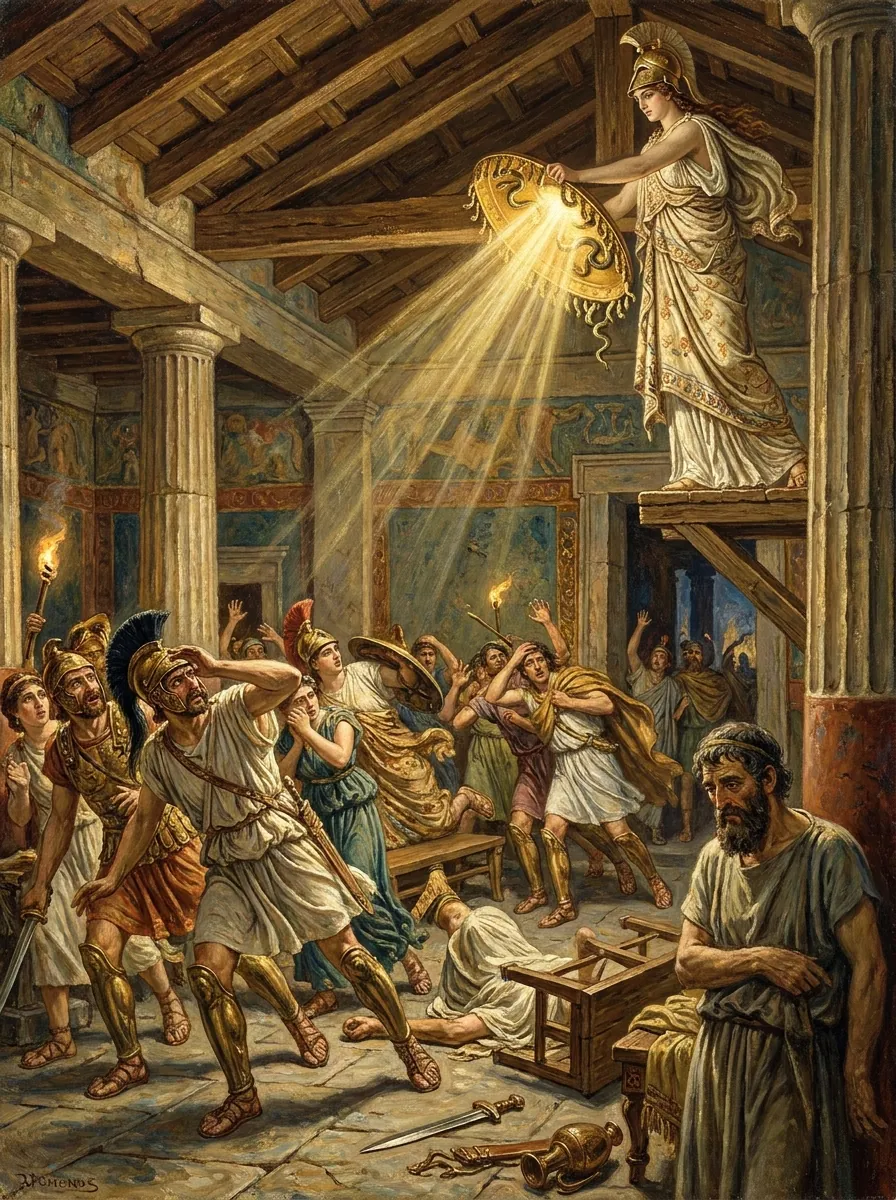
So spoke the stockman. Odysseus struck the son of Damastor with a spear in close fight, while Telemachus hit Leocritus son of Evenor in the belly. The dart went clean through him, so he fell forward full on his face. Then Athena, from her seat on the rafter, held up her deadly aegis, and the hearts of the suitors quailed. They fled to the other end of the court like a herd of cattle maddened by the gadfly in early summer when the days are at their longest. As eagle-beaked, crook-taloned vultures from the mountains swoop down on the smaller birds that huddle in flocks on the ground, and kill them (for they cannot either fight or fly, and lookers-on enjoy the sport), so Odysseus and his men fell upon the suitors and struck them on every side. They groaned horribly as their brains were battered in, and the ground seethed with their blood.
Leiodes then caught Odysseus's knees:
“Odysseus, I beg you, have mercy on me and spare me. I never wronged any of the women in your house, not in word or deed, and I tried to stop the others. I saw what they did, but they wouldn't listen, and now they're paying for their folly. I was their sacrificing priest. If you kill me, I'll die without having done anything to deserve it, and I'll have gotten no thanks for all the good I did.”
Odysseus looked sternly at him:
“If you were their sacrificing priest, you must have prayed many times that I'd never get home, so you could marry my wife and have children by her. Therefore, you're going to die.”
With these words, he picked up the sword that Agelaus had dropped when he was killed, which was lying on the ground. Then he struck Leiodes on the back of his neck, so his head fell rolling in the dust while he was still speaking.
The minstrel Phemius son of Terpes—who had been forced by the suitors to sing for them—now tried to save his life. He was standing near the trap door, holding his lyre. He didn't know whether to fly out of the hall and sit down by the altar of Zeus in the outer court, where both Laertes and Odysseus had offered up the thigh bones of many oxen, or whether to go straight to Odysseus and embrace his knees. But in the end, he thought it best to embrace Odysseus’ knees. So he laid his lyre on the ground between the mixing bowl and the silver-studded seat. Then, going to Odysseus, he caught hold of his knees:
“Odysseus, I beg you, have mercy on me and spare me. You'll be sorry if you kill a bard who can sing for gods and men as I can. I make all my lays myself, and heaven visits me with every kind of inspiration. I would sing to you as though you were a god. Don't be in such a hurry to cut my head off. Your own son Telemachus will tell you that I didn't want to frequent your house and sing to the suitors after their meals, but they were too many and too strong for me, so they made me.”
Telemachus heard him and went at once to his father.
“Hold! The man is guiltless; don't hurt him. And we'll spare Medon too, who was always good to me when I was a boy, unless Philoetius or Eumaeus has already killed him, or he has fallen in your way while you were raging about the court.”
Medon caught these words of Telemachus, for he was crouching under a seat where he had hidden by covering himself with a freshly flayed heifer’s hide. So he threw off the hide, went to Telemachus, and took hold of his knees.
“Here I am, sir. Stay your hand, and tell your father, or he'll kill me in his rage against the suitors for wasting his substance and being so foolishly disrespectful to you.”
Odysseus smiled and answered,
“Don't be afraid. Telemachus has saved you, so you'll know in the future — and can tell others — that good deeds pay better than evil ones. Now, go outside, into the outer court, and stay out of the way of the slaughter, you and the bard, while I finish up in here.”
The two went as fast as they could into the outer court and sat down by the great altar to Zeus, looking around fearfully, still expecting to be killed. Odysseus searched the whole court carefully to see if anyone had managed to hide and was still alive, but he found them all lying in the dust, weltering in blood. They were like fish that fishermen net from the sea and throw on the beach, gasping for water until the sun's heat finishes them off. Just so the suitors lay huddled together.
Then Odysseus said to Telemachus,
“Call Euryclea. I have something to say to her.”
Telemachus went and knocked on the women’s room door.
“Hurry, old woman, you who are in charge of all the other women in the house. Come outside; my father wants to speak with you.”
When Euryclea heard this, she unfastened the women’s room door and came out, following Telemachus. She found Odysseus among the corpses, spattered with blood and filth like a lion fresh from devouring an ox, its chest and cheeks bloody, a fearful sight. Odysseus was just as besmirched from head to foot with gore. Seeing all the corpses and so much blood, she started to cry out for joy, seeing that a great deed had been done, but Odysseus checked her:
“Old woman, rejoice silently. Hold yourself back; don't make any noise about it. It's unholy to gloat over dead men. The gods’ doom and their own evil deeds brought these men to destruction. They respected no one in the world, rich or poor, who came near them, and they've come to a bad end as punishment for their wickedness and folly. Now, tell me which of the women in the house have misbehaved, and which are innocent.”
“I'll tell you the truth, son. There are fifty women in the house whom we teach to do things, like carding wool and all kinds of household work. Of these, twelve in all have misbehaved and disrespected me and Penelope. They showed no disrespect to Telemachus, because he has only recently grown, and his mother never permitted him to give orders to the female servants. But let me go upstairs and tell your wife all that has happened; some god has sent her to sleep.”
“Don't wake her yet. Tell the women who have misbehaved to come to me.”
Euryclea left to tell the women to come to Odysseus. Meanwhile, he called Telemachus, the stockman, and the swineherd.
“Start removing the dead, and have the women help you. Then get sponges and clean water to wash down the tables and seats. When you've thoroughly cleansed the whole cloister, take the women into the space between the domed room and the outer court wall, and run them through with your swords until they're quite dead and have forgotten all about love and how they used to lie in secret with the suitors.”
The women came down in a group, weeping and wailing bitterly. First, they carried the dead bodies out and propped them against one another in the gatehouse. Odysseus ordered them about and made them work quickly, so they had to carry the bodies out. When they had done this, they cleaned all the tables and seats with sponges and water, while Telemachus and the other two shoveled up the blood and dirt from the ground. The women carried it all away and put it outside. When they had made the whole place clean and orderly, they took the women out and hemmed them into the narrow space between the wall of the domed room and that of the yard, so they couldn't get away. Telemachus said to the other two:
“I won't let these women die a clean death. They were insolent to me and my mother, and used to sleep with the suitors.”
With that, he made a ship’s cable fast to one of the bearing-posts supporting the domed room's roof, and secured it all around the building, high enough so none of the women's feet would touch the ground. As thrushes or doves beat against a net set for them in a thicket just as they were getting to their nest, and a terrible fate awaits them, so the women had to put their heads in nooses, one after the other, and die miserably. Their feet moved convulsively for a while, but not for long.
As for Melanthius, they took him through the cloister into the inner court. There, they cut off his nose and ears. They drew out his vitals and gave them raw to the dogs, and then in their fury, they cut off his hands and feet.
When they had done this, they washed their hands and feet and went back into the house, because it was all over. Odysseus said to the dear old nurse Euryclea,
“Bring me sulphur, which cleanses all pollution, and fetch fire so I can burn it and purify the cloisters. Go, and tell Penelope to come here with her attendants, and all the maidservants in the house.”
“Everything you've said is true, but let me bring you some clean clothes—a shirt and cloak. Don't keep those rags on any longer. It isn't right.”
“First, light me a fire.”
She brought the fire and sulfur, as he had asked, and Odysseus thoroughly purified the cloisters and both the inner and outer courts. Then she went inside to call the women and tell them what had happened. They came from their rooms with torches and crowded around Odysseus, embracing him, kissing his head and shoulders, and taking hold of his hands. It made him want to weep, remembering each one of them.
Translation: Samuel Butler (1900) · Public domain · SPDX: PD-1900-Butler