“Wake up, Penelope, my dear girl, and see for yourself what you've been waiting so long to see. Odysseus has finally come home and killed the suitors who were causing so much trouble in his house, eating up his estate and mistreating his son.”
“My good nurse, you must be mad. The gods sometimes drive sensible people out of their minds and make foolish people sensible. That must be what they've done to you; you used to be reasonable. Why mock me when I already have enough trouble? Why wake me up out of a sweet sleep that had taken hold of me? I haven't slept so soundly since my poor husband went to that city with the ill-omened name. Go back to the women's room. If anyone else had woken me up with such absurd news, I'd have sent her away with a severe scolding. As it is, your age will protect you.”
“My dear girl, I'm not mocking you. It's true: Odysseus has come home. He was the stranger they all kept mistreating in the cloister. Telemachus knew all along that he'd come back, but he kept his father's secret so he could get revenge on all those wicked people.”
Then Penelope sprang from her couch, threw her arms around Eurycleia, and wept for joy.
“But, my dear nurse, explain this to me: if he really has come home, how did he manage to overcome the wicked suitors single-handed, seeing how many of them there always were?”
“I wasn't there; I don't know. I only heard them groaning as they were being killed. We sat crouching in a corner of the women's room with the doors closed, until your son came to fetch me because his father sent him. Then I found Odysseus standing over the corpses that were lying on the ground all around him, one on top of the other. You would have enjoyed seeing him standing there, covered in blood and filth, looking like a lion. But the corpses are all piled up in the gatehouse in the outer court, and Odysseus has lit a great fire to purify the house with sulfur. He sent me to call you, so come with me, so you can both be happy together. Now, at last, the desire of your heart has been fulfilled: your husband has come home to find both wife and son alive and well, and to take his revenge in his own house on the suitors who behaved so badly to him.”
“My dear nurse, don't exult too confidently over all this. You know how delighted everyone would be to see Odysseus come home—especially me, and the son who was born to us. But what you tell me can't be true. It's some god who is angry with the suitors for their great wickedness and has made an end of them; they respected no one in the world, neither rich nor poor, who came near them, and they've come to a bad end because of their iniquity. Odysseus is dead far away from the Achaean land; he will never return home.”
“My child, what are you talking about? You're all hard of belief and have decided that your husband is never coming, even though he's in the house, by his own fireside, at this very moment. Besides, I can give you another proof: when I was washing him, I saw the scar the wild boar gave him, and I wanted to tell you about it, but he wouldn't let me; he clapped his hands over my mouth. So come with me, and I'll make you a bargain: if I'm deceiving you, you can have me killed by the most cruel death you can think of.”
“My dear nurse, however wise you may be, you can hardly fathom the counsels of the gods. Nevertheless, we'll go in search of my son, so I can see the corpses of the suitors and the man who killed them.”
She came down from her upper room, considering whether she should keep her distance from her husband and question him, or go up to him at once and embrace him. When she had crossed the stone floor of the cloister, she sat down opposite Odysseus by the fire, against the wall, while Odysseus sat near one of the bearing-posts, looking at the ground, waiting to see what his brave wife would say to him when she saw him. For a long time, she sat silent, lost in amazement. At one moment she looked him full in the face, but then again, she was misled by his shabby clothes and failed to recognize him, until Telemachus began to reproach her and said:
“Mother—but you're so hard that I can't call you by such a name—why do you keep away from my father like this? Why don't you sit by his side and start talking to him and asking him questions? No other woman could bear to keep away from her husband when he'd come back to her after twenty years of absence, after having gone through so much; but your heart always was as hard as a stone.”
“My son, I'm so lost in astonishment that I can find no words to ask questions or answer them. I can't even look him straight in the face. Still, if he really is Odysseus come back to his own home, we'll get to understand one another better by and by, for there are tokens that we two alone know, hidden from everyone else.”
“Let your mother test me however she likes; she'll make up her mind about it presently. She rejects me for the moment and believes me to be someone else because I'm covered with dirt and have such bad clothes on. Let's consider what we should do next. When one man has killed another—even if he wasn't someone who would leave many friends to take up his quarrel—the man who killed him still has to say goodbye to his friends and flee the country. We've been killing the stay of a whole town, all the picked youth of Ithaca. I'd have you consider this matter.”
“See to it yourself, father, since they say you're the wisest counselor in the world, and no other mortal man can compare with you. We'll follow you willingly, and you won't find us failing you as far as our strength holds out.”
“I'll say what I think is best. First, wash and put on your shirts. Tell the maids to go to their own room and dress. Then Phemius shall strike up a dance tune on his lyre, so that if people outside hear, or any of the neighbors, or someone going along the street happens to notice it, they may think there's a wedding in the house, and no rumors about the death of the suitors will get about in the town before we can escape to the woods on my own land. Once there, we'll decide which of the courses heaven grants us seems wisest.”
He spoke, and they did as he said. First, they washed and put their shirts on, while the women got ready. Then Phemius took his lyre and set them all longing for sweet song and stately dance. The house re-echoed with the sound of men and women dancing, and the people outside said,
“I guess the queen finally got married. She should be ashamed for not protecting her husband’s property until he came home.”
That's what the townsfolk said, not knowing what had really happened. The housekeeper Eurynome washed and anointed Odysseus in his own house and gave him a shirt and cloak, while Athena made him look taller and stronger than before. She thickened the hair on his head, letting it flow down in curls like hyacinth blossoms. She glorified him about the head and shoulders, just as a skilled craftsman—trained in all kinds of art by Hephaestus or Athena—enriches a piece of silver plate by gilding it, making his work beautiful. He came from the bath looking like one of the immortals and sat down opposite his wife on the seat he had left.
“My dear, the gods have given you a heart more unyielding than any other woman. No other woman could bear to keep away from her husband when he'd come back after twenty years of absence and so much suffering. But come, nurse, get a bed ready for me. I'll sleep alone, because this woman has a heart as hard as iron.”
“My dear, I don't want to act superior or put you down, but I'm not impressed by your appearance. I remember very well what you looked like when you sailed from Ithaca. Still, Eurycleia, take his bed outside the bed chamber that he himself built. Bring the bed outside this room, and put bedding on it with fleeces, good coverlets, and blankets.”
She said this to test him, and Odysseus was very angry.
“Wife, I'm very displeased by what you've just said. Who has moved my bed from its place? It would have been a hard task, no matter how skilled the workman, unless a god came and helped. No man living, however strong and in his prime, could move it, because it's a marvel I made with my own hands. There was a young olive tree growing within the house grounds, full of life, and about as thick as a support post. I built my room around this, with strong stone walls and a roof. I made the doors strong and well-fitting. Then I cut off the top boughs of the olive tree, leaving the stump. I trimmed it roughly from the root up, then worked it carefully with carpenter’s tools, straightening my work by drawing a line on the wood and making it into a bed-prop. I bored a hole down the middle and made it the center-post of my bed, working until I finished it, inlaying it with gold and silver. After that, I stretched a hide of crimson leather from one side to the other. So I know all about it, and I want to know if it's still there, or if anyone has removed it by cutting down the olive tree at its roots.”
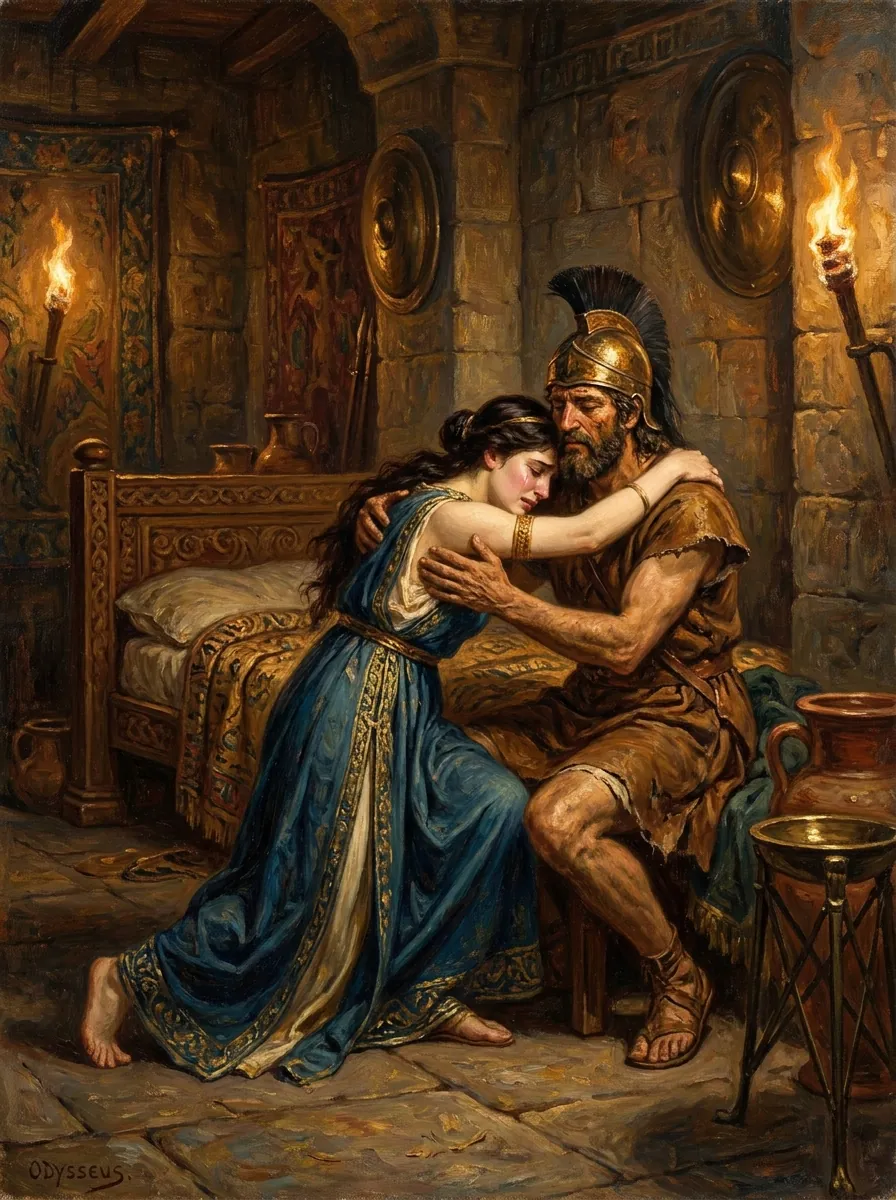
Hearing this undeniable proof, she broke down. Weeping, she flew to his side, flung her arms around his neck, and kissed him.
“Don't be angry with me, Odysseus, wisest of men. We've both suffered. The gods have denied us the happiness of spending our youth, and growing old, together. Don't be upset or take it badly that I didn't embrace you as soon as I saw you. I've been shuddering the whole time, afraid someone might come here and deceive me with a lying story, because there are so many wicked people going around. Zeus’s daughter Helen would never have yielded to a man from a foreign country if she had known that the sons of the Achaeans would come after her and bring her back. The gods put it in her heart to do wrong, and she gave no thought to that sin, which has been the source of all our sorrows. But now that you've convinced me by showing you know all about our bed (which no human being has ever seen but you and I and a single maidservant, the daughter of Actor, who was given to me by my father at our wedding, and who keeps the doors of our room), hard to convince as I am, I can mistrust no longer.”
Then Odysseus, in turn, melted and wept as he clasped his dear and faithful wife to his chest. As land is welcome to men swimming toward shore when Poseidon has wrecked their ship with furious winds and waves—a few alone reach the land, and these, covered with brine, are thankful to find themselves on firm ground and out of danger—so her husband was welcome to her as she looked at him, and she couldn't tear her arms from around his neck. They would have gone on indulging their sorrow until dawn, but Athena decided otherwise. She held night back in the far west, not letting dawn leave Oceanus or yoke the two steeds Lampus and Phaethon that carry her to break the day upon mankind.
At last, Odysseus said,
“Wife, we haven't reached the end of our troubles yet. I still have an unknown amount of toil ahead. It's long and difficult, but I have to go through with it, because the ghost of Tiresias prophesied it to me when I went down into Hades to ask about my return and that of my companions. But now let's go to bed, so we can lie down and enjoy the blessed gift of sleep.”
“You can go to bed whenever you want, now that the gods have sent you home to your own good house and country. But since the gods have put it in your mind to speak of it, tell me about the task ahead. I'll have to hear about it later, so I should be told at once.”
“My dear, why do you press me to tell you? Still, I won't hide it, though you won't like it. I don't like it myself. Tiresias told me to travel far and wide, carrying an oar, until I came to a country where the people have never heard of the sea and don't even mix salt with their food. They know nothing about ships or oars that are like the wings of a ship. He gave me a certain token, which I won't hide from you. He said a traveler should meet me and ask if it was a winnowing shovel I had on my shoulder. Then I was to fix my oar in the ground and sacrifice a ram, a bull, and a boar to Poseidon. After that, I was to go home and offer hecatombs to all the gods in heaven, one after the other. As for me, he said death should come from the sea, and my life should ebb away very gently when I was full of years and peace of mind, and my people should bless me. All this, he said, would surely happen.”
“If the gods are going to grant you a happier time in your old age, you can hope to have some respite from misfortune then.”
That's how they talked. Meanwhile, Eurynome and the nurse took torches and made the bed ready with soft coverlets. Once they had laid them, the nurse went back into the house to rest, leaving the chambermaid Eurynome to show Odysseus and Penelope to bed by torchlight. When she had led them to their room, she went back, and they came joyfully to the rites of their own old bed. Telemachus, Philoetius, and the swineherd stopped dancing and made the women stop too. Then they lay down to sleep in the cloisters.
When Odysseus and Penelope had had their fill of love, they began talking. She told him how much she had had to bear, seeing the house filled with wicked suitors who had killed so many sheep and oxen on her account and drunk so many casks of wine. Odysseus, in turn, told her what he had suffered and how much trouble he had given other people. He told her everything, and she was so delighted to listen that she never went to sleep until he had finished his whole story.
He began with his victory over the Cicons, and how he then reached the fertile land of the Lotus-eaters. He told her about the Cyclops and how he had punished him for so ruthlessly eating his brave comrades; how he then went on to Aeolus, who received him hospitably and helped him on his way, but even so he was not to reach home, for to his great grief a hurricane carried him out to sea again; how he went on to the Laestrygonian city Telepylos, where the people destroyed all his ships with their crews, save himself and his own ship only. Then he told of cunning Circe and her craft, and how he sailed to the chill house of Hades, to consult the ghost of the Theban prophet Teiresias, and how he saw his old comrades in arms, and his mother who bore him and brought him up when he was a child; how he then heard the wondrous singing of the Sirens, and went on to the wandering rocks and terrible Charybdis and to Scylla, whom no man had ever yet passed in safety; how his men then ate the cattle of the sun-god, and how Zeus therefore struck the ship with his thunderbolts, so that all his men perished together, himself alone being left alive; how at last he reached the Ogygian island and the nymph Calypso, who kept him there in a cave, and fed him, and wanted him to marry her, in which case she intended making him immortal so that he should never grow old, but she could not persuade him to let her do so; and how after much suffering he had found his way to the Phaeacians, who had treated him as though he had been a god, and sent him back in a ship to his own country after having given him gold, bronze, and raiment in great abundance. This was the last thing he told her, for here a deep sleep took hold upon him and eased the burden of his sorrows.
Then Athena considered another matter. When she thought Odysseus had had his fill both of his wife and of repose, she bade dawn rise out of Oceanus so she might shed light upon mankind. Odysseus rose from his comfortable bed and said to Penelope,
“Wife, we have both had our full share of troubles — you here, lamenting my absence, and I, prevented from getting home though I was longing to do so. Now, however, that we have at last come together, take care of the property in the house. As for the sheep and goats the wicked suitors have eaten, I will take many myself by force from other people, and will compel the Achaeans to make good the rest till they have filled all my yards. I am now going to the wooded lands out in the country to see my father, who has so long been grieved on my account, and to you I will give these instructions, though you have little need of them. At sunrise it will at once get abroad that I have been killing the suitors; go upstairs, therefore, and stay there with your women. See nobody and ask no questions.”
As he spoke he girded on his armor. Then he roused Telemachus, Philoetius, and Eumaeus, and told them all to put on their armor also. This they did, and armed themselves. When they had done so, they opened the gates and sallied forth, Odysseus leading the way. It was now daylight, but Athena nevertheless concealed them in darkness and led them quickly out of the town.
Translation: Samuel Butler (1900) · Public domain · SPDX: PD-1900-Butler