Then Hermes of Cyllene summoned the ghosts of the suitors. In his hand, he held the fair golden wand with which he seals men’s eyes in sleep or wakes them as he pleases. With this, he roused the ghosts and led them, while they followed whining and gibbering behind him. As bats fly squealing in the hollow of some great cave, when one of them has fallen out of the cluster in which they hang, so did the ghosts whine and squeal as Hermes, the healer of sorrow, led them down into the dark abode of death. When they had passed the waters of Oceanus and the rock Leucas, they came to the gates of the sun and the land of dreams. From there, they reached the meadow of asphodel where dwell the souls and shadows of those who can labor no more.
Here they found the ghost of Achilles, son of Peleus, with those of Patroclus, Antilochus, and Ajax, who was the finest and handsomest man of all the Danaans after Achilles himself.
They gathered around the ghost of Achilles, and the ghost of Agamemnon joined them, sorrowing bitterly. Around him were gathered also the ghosts of those who had perished with him in the house of Aegisthus; and the ghost of Achilles spoke first.
“Son of Atreus, we used to say that Zeus had loved you better from first to last than any other hero, for you were captain over many brave men when we were all fighting together before Troy. Yet death, which no mortal can escape, was laid upon you all too early. Better for you had you fallen at Troy in the hey-day of your renown, for the Achaeans would have built a mound over your ashes, and your son would have been heir to your good name. Instead, it has now been your lot to come to a most miserable end.”
“Happy Achilles, for having died at Troy far from Argos, while the bravest of the Trojans and the Achaeans fell around you fighting for your body. There you lay in the whirling clouds of dust, all huge and hugely, heedless now of your chivalry. We fought the whole of the livelong day, nor should we ever have left off if Zeus had not sent a hurricane to stop us. Then, when we had borne you from the fray to the ships, we laid you on your bed and cleansed your skin with warm water and ointments. The Danaans tore their hair and wept bitterly around you. Your mother, when she heard, came with her immortal nymphs from out of the sea, and the sound of great wailing went forth over the waters so that the Achaeans quaked for fear. They would have fled panic-stricken to their ships had not wise old Nestor, whose counsel was ever truest, checked them, saying, ‘Hold, Argives, do not flee, sons of the Achaeans. This is his mother coming from the sea with her immortal nymphs to view the body of her son.’”
“Thus he spoke, and the Achaeans feared no more. The daughters of the old man of the sea stood around you weeping bitterly, and clothed you in immortal raiment. The nine muses also came and lifted up their sweet voices in lament—calling and answering one another; there was not an Argive who did not weep for pity at the dirge they chanted. For seventeen days and nights we mourned you, mortals and immortals, but on the eighteenth day we gave you to the flames, and we slew many fat sheep and many oxen in sacrifice around you. You were burned in raiment of the gods, with rich resins and with honey, while heroes, horse and foot, clashed their armor around the pyre as you were burning, with the tramp as of a great multitude. But when the flames had done their work, we gathered your white bones at daybreak and laid them in ointments and in pure wine. Your mother brought us a golden vase to hold them—a gift of Dionysus, and the work of Hephaestus himself. In this, we mingled your bleached bones with those of Patroclus, who had gone before you, and separately we enclosed also those of Antilochus, who had been closer to you than any other of your comrades now that Patroclus was no more.”
“Over these, the host of the Argives built a noble tomb on a point jutting out over the open Hellespont, that it might be seen from far out upon the sea by those now living and by those who will be born hereafter. Your mother begged prizes from the gods and offered them to be contended for by the noblest of the Achaeans. You must have been present at the funeral of many a hero, when the young men gird themselves and make ready to contend for prizes on the death of some great chieftain, but you never saw such prizes as silver-footed Thetis offered in your honor, for the gods loved you well. Thus, even in death your fame, Achilles, has not been lost, and your name lives evermore among all mankind. But as for me, what solace had I when the days of my fighting were done? For Zeus willed my destruction on my return, by the hands of Aegisthus and my wicked wife.”
Thus they conversed, and presently Hermes came up to them with the ghosts of the suitors who had been killed by Odysseus. The ghosts of Agamemnon and Achilles were astonished at seeing them and went up to them at once. The ghost of Agamemnon recognized Amphimedon, son of Melaneus, who lived in Ithaca and had been his host, so he began to talk to him.
“Amphimedon, what has happened to all you fine young men—all of an age, too—that you have come down here under the ground? One could pick no finer body of men from any city. Did Poseidon raise his winds and waves against you when you were at sea, or did your enemies make an end of you on the mainland when you were cattle-lifting or sheep-stealing, or while fighting in defense of their wives and city? Answer my question, for I have been your guest. Do you not remember how I came to your house with Menelaus to persuade Odysseus to join us with his ships against Troy? It was a whole month before we could resume our voyage, for we had hard work persuading Odysseus to come with us.”
“Agamemnon, son of Atreus, king of men, I remember everything that you have said, and will tell you fully and accurately about the way in which our end was brought about. Odysseus had been long gone, and we were courting his wife, who did not say point blank that she would not marry, nor yet bring matters to an end, for she meant to compass our destruction. This, then, was the trick she played us. She set up a great tambour frame in her room and began to work on an enormous piece of fine needlework. ‘Sweethearts,’ she said, ‘Odysseus is indeed dead, still, do not press me to marry again immediately; wait—for I would not have my skill in needlework perish unrecorded—until I have completed a pall for the hero Laertes, against the time when death shall take him. He is very rich, and the women of the place will talk if he is laid out without a pall.’ This is what she said, and we assented. We could see her working upon her great web all day long, but at night she would unpick the stitches again by torchlight. She fooled us in this way for three years without our finding it out, but as time wore on, and she was now in her fourth year, as many days and moons waned, one of her maids who knew what she was doing told us, and we caught her in the act of undoing her work, so she had to finish it whether she wanted to or not. When she showed us the robe she had made, after she had had it washed, its splendor was as that of the sun or moon.
“Then some malicious god conveyed Odysseus to the upland farm where his swineherd lives. There presently came also his son, returning from a voyage to Pylos, and the two came to the town when they had hatched their plot for our destruction. Telemachus came first, and then after him, accompanied by the swineherd, came Odysseus, clad in rags and leaning on a staff as though he were some miserable old beggar. He came so unexpectedly that none of us knew him, not even the older ones among us, and we reviled him and threw things at him. He endured being struck and insulted without a word, though he was in his own house. But when the will of Zeus inspired him, he and Telemachus took the armor and hid it in an inner chamber, bolting the doors behind them. Then he cunningly made his wife offer his bow and a quantity of iron to be contended for by us ill-fated suitors; and this was the beginning of our end, for not one of us could string the bow—nor nearly do so. When it was about to reach the hands of Odysseus, we all shouted out that it should not be given him, no matter what he might say, but Telemachus insisted on his having it. When he had it in his hands, he strung it with ease and sent his arrow through the iron. Then he stood on the floor of the cloister and poured his arrows on the ground, glaring fiercely about him. First, he killed Antinous, and then, aiming straight before him, he let fly his deadly darts and they fell thick on one another. It was plain that some one of the gods was helping them, for they fell upon us with might and main throughout the cloisters, and there was a hideous sound of groaning as our brains were being battered in, and the ground seethed with our blood. This, Agamemnon, is how we came by our end, and our bodies are lying still uncared for in the house of Odysseus, for our friends at home do not yet know what has happened, so that they cannot lay us out and wash the black blood from our wounds, making moan over us according to the offices due to the departed.”
“Happy Odysseus, son of Laertes, you are indeed blessed in the possession of a wife endowed with such rare excellence of understanding, and so faithful to her wedded lord as Penelope, the daughter of Icarius. The fame, therefore, of her virtue shall never die, and the immortals shall compose a song that shall be welcome to all mankind in honor of the constancy of Penelope. How far otherwise was the wickedness of the daughter of Tyndareus who killed her lawful husband; her song shall be hateful among men, for she has brought disgrace on all womankind, even on the good ones.”
Thus they conversed in the house of Hades deep down within the bowels of the earth. Meanwhile, Odysseus and the others passed out of the town and soon reached the fair and well-tilled farm of Laertes, which he had reclaimed with infinite labor. Here was his house, with a lean-to running all around it, where the slaves who worked for him slept and sat and ate, while inside the house there was an old Sicel woman who looked after him in this his country-farm. When Odysseus got there, he said to his son and to the other two:
“Go to the house, and kill the best pig that you can find for dinner. Meanwhile, I want to see whether my father will know me, or fail to recognize me after so long an absence.”
He then took off his armor and gave it to Eumaeus and Philoetius, who went straight on to the house, while he turned off into the vineyard to make a trial of his father. As he went down into the great orchard, he did not see Dolius, nor any of his sons nor of the other bondsmen, for they were all gathering thorns to make a fence for the vineyard, at the place where the old man had told them. He therefore found his father alone, hoeing a vine. He had on a dirty old shirt, patched and very shabby; his legs were bound around with thongs of oxhide to save him from the brambles, and he also wore sleeves of leather. He had a goat skin cap on his head and was looking very woe-begone. When Odysseus saw him so worn, so old and full of sorrow, he stood still under a tall pear tree and began to weep. He doubted whether to embrace him, kiss him, and tell him all about his having come home, or whether he should first question him and see what he would say. In the end, he thought it best to be crafty with him, so with this in mind, he went up to his father, who was bending down and digging about a plant.
“I see, sir, that you are an excellent gardener—what pains you take with it, to be sure. There is not a single plant, not a fig tree, vine, olive, pear, nor flower bed, that does not bear the trace of your attention. I trust, however, that you will not be offended if I say that you take better care of your garden than of yourself. You are old, unsavory, and very meanly clad. It cannot be because you are idle that your master takes such poor care of you. Indeed, your face and figure have nothing of the slave about them, and proclaim you of noble birth. I should have said that you were one of those who should wash well, eat well, and lie soft at night as old men have a right to do; but tell me, and tell me truly, whose bondman are you, and in whose garden are you working? Tell me also about another matter. Is this place that I have come to really Ithaca? I met a man just now who said so, but he was a dull fellow and did not have the patience to hear my story out when I was asking him about an old friend of mine, whether he was still living, or was already dead and in the house of Hades. Believe me when I tell you that this man came to my house once when I was in my own country, and never yet did any stranger come to me whom I liked better. He said that his family came from Ithaca and that his father was Laertes, son of Arceisius. I received him hospitably, making him welcome to all the abundance of my house, and when he went away I gave him all customary presents. I gave him seven talents of fine gold, and a cup of solid silver with flowers chased upon it. I gave him twelve light cloaks, and as many pieces of tapestry; I also gave him twelve cloaks of single fold, twelve rugs, twelve fair mantles, and an equal number of shirts. To all this I added four good looking women skilled in all useful arts, and I let him take his choice.”
“Sir, you have indeed come to the country you named, but it has fallen into the hands of wicked people. All these presents have been given for nothing. If you had found your friend alive in Ithaca, he would have entertained you hospitably and repaid your presents handsomely when you left him—as would have been only right, considering what you had already given him. But tell me, and tell me truly, how many years has it been since you entertained this guest—my unhappy son? Alas! He has perished far from his own country; the fishes of the sea have eaten him, or he has fallen prey to the birds and wild beasts of some continent. Neither his mother nor I, his father, could throw our arms about him and wrap him in his shroud. Nor could his excellent and richly dowered wife Penelope bewail her husband as was natural upon his deathbed, and close his eyes as custom requires. But now, tell me truly, for I want to know: who are you, and where are you from? Tell me of your town and parents. Where is the ship lying that brought you and your men to Ithaca? Or were you a passenger on some other man’s ship, and those who brought you here have gone on their way and left you?”
“I will tell you everything truthfully. I come from Alybas, where I have a fine house. I am the son of King Apheidas, who is the son of Polypemon. My name is Eperitus. The gods drove me off course as I was leaving Sicania, and I have been carried here against my will. My ship is lying over yonder, off the open country outside the town. This is the fifth year since Odysseus left my country. Poor fellow, yet the omens were good for him when he left. The birds all flew on our right hands, and both he and I rejoiced to see them as we parted, for we hoped we would have another friendly meeting and exchange presents.”
A dark cloud of sorrow fell upon Laertes as he listened. He filled both hands with dust from the ground and poured it over his grey head, groaning heavily. Odysseus's heart was touched, and his nostrils quivered as he looked at his father. Then he sprang towards him, flung his arms about him, and kissed him, saying,
“I am he, father, the one you're asking about. I have returned after being away for twenty years. But stop your sighing and lamentation—we have no time to lose. I should tell you that I have been killing the suitors in my house, to punish them for their insolence and crimes.”
“If you really are my son Odysseus, and have come back again, you must give me such clear proof of your identity as will convince me.”
“First, observe this scar, which I got from a boar’s tusk when I was hunting on Mt. Parnassus. You and my mother had sent me to Autolycus, my mother’s father, to receive the presents which he had promised to give me when he was over here. Furthermore, I will point out to you the trees in the vineyard which you gave me. I asked you all about them as I followed you around the garden. We went over them all, and you told me their names and what they all were. You gave me thirteen pear trees, ten apple trees, and forty fig trees. You also said you would give me fifty rows of vines. There was corn planted between each row, and they yield grapes of every kind when the heat of the sky has been heavy upon them.”
Laertes’ strength failed him when he heard the convincing proofs his son had given him. He threw his arms about him, and Odysseus had to support him, or he would have fallen into a swoon. But as soon as he came to and was beginning to recover his senses, he said,
“O Zeus, then you gods are still in Olympus after all, if the suitors have really been punished for their insolence and folly. Nevertheless, I am much afraid that I will have all the townspeople of Ithaca up here directly, and they will be sending messengers everywhere throughout the cities of the Cephallenians.”
“Take heart and do not trouble yourself about that. Let us go into the house near your garden. I have already told Telemachus, Philoetius, and Eumaeus to go on there and get dinner ready as soon as possible.”
Thus conversing, the two made their way towards the house. When they got there, they found Telemachus with the stockman and the swineherd cutting up meat and mixing wine with water. Then the old Sicel woman took Laertes inside and washed him and anointed him with oil. She put him in a good cloak, and Athena came up to him and gave him a more imposing presence, making him taller and stouter than before. When he came back, his son was surprised to see him looking so like an immortal, and said to him,
“My dear father, one of the gods has been making you much taller and better-looking.”
“Would, by Zeus, Athena, and Apollo, that I were the man I was when I ruled among the Cephallenians, and took Nericum, that strong fortress on the foreland. If I were still what I then was and had been in our house yesterday with my armor on, I should have been able to stand by you and help you against the suitors. I should have killed a great many of them, and you would have rejoiced to see it.”
Thus they spoke. The others, when they had finished their work and the feast was ready, stopped working and took their places on the benches and seats. Then they began eating. Before long, old Dolius and his sons left their work and came up, for their mother, the Sicel woman who looked after Laertes now that he was growing old, had gone to fetch them. When they saw Odysseus and were certain it was him, they stood there lost in astonishment. But Odysseus scolded them good naturedly and said,
“Sit down to your dinner, old man, and never mind about your surprise. We have been wanting to begin for some time and have been waiting for you.”
Then Dolius put out both his hands and went up to Odysseus.
“Sir, we have long been wishing you home, and now the gods have restored you to us after we had given up hoping. All hail, therefore, and may the gods prosper you. But tell me, does Penelope already know of your return, or shall we send someone to tell her?”
“Old man, she already knows, so don't worry about that.”
With that, he sat down, and Dolius's sons gathered around Odysseus to greet and embrace him one after the other; then they sat down in their proper order near Dolius, their father.
While they were busy getting dinner ready, Rumor spread through the town, announcing the terrible fate that had befallen the suitors. As soon as the people heard, they gathered from every direction, groaning and hooting in front of Odysseus's house. They took the dead away; each man buried his own, and put the bodies of those who came from elsewhere on board the fishing vessels, for the fishermen to take each to his own place. Then they met angrily in the assembly, and when they had gathered, Eupeithes rose to speak. He was overwhelmed with grief for the death of his son Antinous, who Odysseus had killed first, so he said, weeping bitterly:
“My friends, this man has done the Achaeans great wrong. He took many of our best men away with him in his fleet, and he has lost both ships and men. Now, moreover, on his return he has been killing all the foremost men among the Cephallenians. Let's be up and doing before he can get away to Pylos or to Elis where the Epeans rule, or we'll be ashamed of ourselves forever after. It will be an everlasting disgrace to us if we do not avenge the murder of our sons and brothers. For my own part I should have no more pleasure in life, but would rather die at once. Let's be up, then, and after them, before they can cross over to the mainland.”
He wept as he spoke, and everyone pitied him. But Medon and the bard Phemius had now woken up and came to them from Odysseus's house. Everyone was astonished to see them, but they stood in the middle of the assembly, and Medon said:
“Hear me, men of Ithaca. Odysseus did not do these things against the will of heaven. I myself saw an immortal god take the form of Mentor and stand beside him. This god appeared, now in front of him encouraging him, and now going furiously about the court and attacking the suitors, whereon they fell thick on one another.”
At this, pale fear gripped them, and old Halitherses, son of Mastor, rose to speak, for he was the only man among them who knew both past and future. He spoke to them plainly and honestly, saying:
“Men of Ithaca, it is all your own fault that things have turned out as they have. You would not listen to me, nor yet to Mentor, when we told you to check the folly of your sons, who were doing much wrong in the wantonness of their hearts—wasting the substance and dishonoring the wife of a chieftain who they thought would not return. Now, however, let it be as I say, and do as I tell you. Do not go out against Odysseus, or you may find that you have been drawing down evil on your own heads.”
That's what he said, and more than half raised a loud shout and at once left the assembly. But the rest stayed where they were, for Halitherses's speech displeased them, and they sided with Eupeithes. They hurried off for their armor, and when they had armed themselves, they met together in front of the city, and Eupeithes led them on in their folly. He thought he was going to avenge the murder of his son, whereas in truth he was never to return, but was himself to perish in his attempt.
Then Athena said to Zeus:
“Father, son of Kronos, king of kings, answer me this question—What do you propose to do? Will you set them fighting still further, or will you make peace between them?”
“My child, why ask me? Wasn't it by your own arrangement that Odysseus came home and took his revenge on the suitors? Do whatever you like, but I'll tell you what I think would be most reasonable. Now that Odysseus is avenged, let them swear to a solemn covenant, in virtue of which he shall continue to rule, while we cause the others to forgive and forget the massacre of their sons and brothers. Let them then all become friends as before, and let peace and plenty reign.”
This was what Athena was already eager to bring about, so she darted down from off the topmost summits of Olympus.
Now when Laertes and the others had finished dinner, Odysseus began by saying:
“Some of you go out and see if they aren't getting close to us.”
So one of Dolius’s sons went as he was told. Standing on the threshold, he could see them all quite near, and said to Odysseus,
**Dolius's son:** “Here they are. Let's put on our armor at once.”
They put on their armor as fast as they could—Odysseus, his three men, and the six sons of Dolius. Laertes and Dolius did the same, warriors by necessity despite their grey hair. When they had all put on their armor, they opened the gate and sallied forth, Odysseus leading the way.
Then Athena, daughter of Zeus, came up to them, having assumed the form and voice of Mentor. Odysseus was glad when he saw her, and said to his son Telemachus,
“Telemachus, now that you are about to fight in an engagement that will show every man’s mettle, be sure not to disgrace your ancestors, who were eminent for their strength and courage all the world over.”
“You speak truly, my dear father, and you will see, if you wish, that I have no intention of disgracing your family.”
“Good heavens, what a day I am enjoying! I do indeed rejoice at it. My son and grandson are vying with one another in valor.”
At this, Athena came close up to him and said,
“Son of Arceisius—best friend I have in the world—pray to the grey-eyed goddess, and to Zeus her father; then poise your spear and hurl it.”
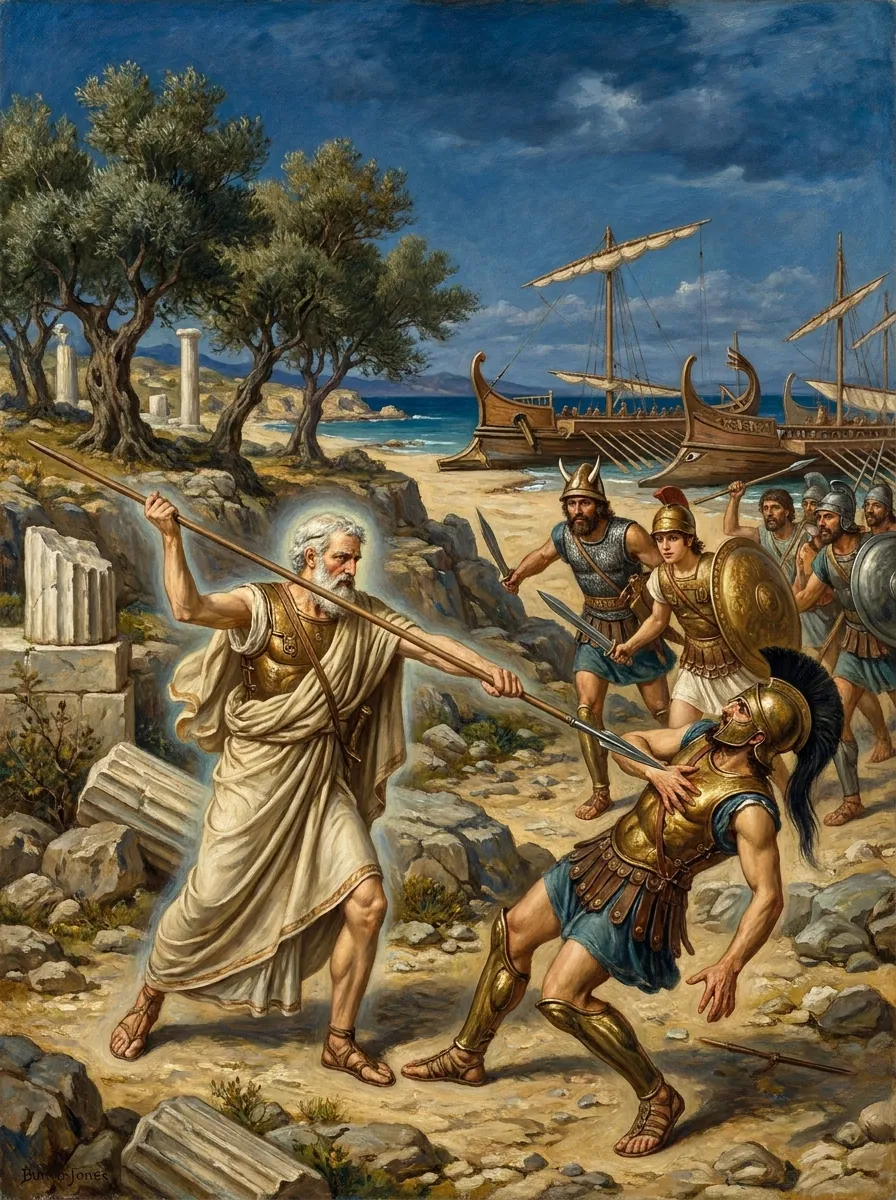
As she spoke, she infused fresh vigor into him, and when he had prayed to her, he poised his spear and hurled it. He hit Eupeithes’ helmet, and the spear went right through it, for the helmet stopped it not, and his armor rang rattling around him as he fell heavily to the ground. Meanwhile, Odysseus and his son fell upon the front line of the foe and struck them with their swords and spears; indeed, they would have killed every one of them, and prevented them from ever getting home again, only Athena raised her voice aloud and made everyone pause.
“Men of Ithaca, cease this dreadful war, and settle the matter at once without further bloodshed.”
On this, pale fear seized everyone; they were so frightened that their arms dropped from their hands and fell upon the ground at the sound of the goddess’ voice, and they fled back to the city for their lives. But Odysseus gave a great cry, and gathering himself together swooped down like a soaring eagle. Then Zeus sent a thunderbolt of fire that fell just in front of Athena, so she said to Odysseus,
“Odysseus, noble son of Laertes, stop this warful strife, or Zeus will be angry with you.”
Thus spoke Athena, and Odysseus obeyed her gladly. Then Athena assumed the form and voice of Mentor, and presently made a covenant of peace between the two contending parties.
Translation: Samuel Butler (1900) · Public domain · SPDX: PD-1900-Butler