When dawn came, Telemachus got up and dressed. He bound his sandals on his feet, girded his sword about his shoulder, and left his room looking like a god. He at once sent the criers to call the people to assembly. They called them, and the people gathered. When they were together, he went to the place of assembly, spear in hand—not alone, for his two hounds went with him. Athena gave him such divine comeliness that all marveled at him as he went by, and when he took his place in his father’s seat, even the oldest councilors made way for him.
Aegyptius, a man bent double with age and vast experience, was the first to speak. His son Antiphus had gone with Odysseus to Troy, land of noble steeds, but the savage Cyclops had killed him when they were all shut up in the cave, and had cooked him for his last dinner. He had three sons left, of whom two still worked on their father’s land, while the third, Eurynomus, was one of the suitors. Nevertheless, their father could not get over the loss of Antiphus, and was still weeping for him when he began his speech.
“Men of Ithaca, hear my words. From the day Odysseus left us, there has been no meeting of our councilors until now. Who then can it be, whether old or young, that finds it so necessary to convene us? Has he heard of some host approaching, and does he wish to warn us, or would he speak upon some other matter of public moment? I am sure he is an excellent person, and I hope Zeus will grant him his heart’s desire.”
Telemachus took this speech as a good omen and rose at once, for he was bursting with what he had to say. He stood in the middle of the assembly, and the good herald Pisenor brought him his staff. Then, turning to Aegyptius,
“Sir, it is I, as you will shortly learn, who have convened you, for it is I who am the most aggrieved. I have not heard of any host approaching about which I would warn you, nor is there any matter of public moment on which I would speak. My grievance is purely personal, and turns on two great misfortunes which have fallen upon my house. The first of these is the loss of my excellent father, who was chief among all you here present, and was like a father to every one of you. The second is much more serious, and before long will be the utter ruin of my estate. The sons of all the chief men among you are pestering my mother to marry them against her will. They are afraid to go to her father Icarius, asking him to choose the one he likes best, and to provide marriage gifts for his daughter, but day by day they keep hanging about my father’s house, sacrificing our oxen, sheep, and fat goats for their banquets, and never giving so much as a thought to the quantity of wine they drink. No estate can stand such recklessness. We have now no Odysseus to ward off harm from our doors, and I cannot hold my own against them. I shall never all my days be as good a man as he was, still I would indeed defend myself if I had power to do so, for I cannot stand such treatment any longer; my house is being disgraced and ruined. Have respect, therefore, to your own consciences and to public opinion. Fear, too, the wrath of heaven, lest the gods should be displeased and turn upon you. I beg you by Zeus and Themis, who is the beginning and the end of councils, do not hold back, my friends, and leave me singlehanded—unless it be that my brave father Odysseus did some wrong to the Achaeans which you would now avenge on me, by aiding and abetting these suitors. Moreover, if I am to be eaten out of house and home at all, I had rather you did the eating yourselves, for I could then take action against you to some purpose, and serve you with notices from house to house till I got paid in full, whereas now I have no remedy.”
With this Telemachus dashed his staff to the ground and burst into tears. Everyone was very sorry for him, but they all sat still and no one ventured to make him an angry answer, save only Antinous, who spoke thus:
“Telemachus, insolent braggart that you are, how dare you try to throw the blame upon us suitors? It is your mother’s fault, not ours, for she is a very artful woman. These three years past, and close on four, she has been driving us out of our minds by encouraging each one of us, and sending him messages without meaning one word of what she says. And then there was that other trick she played us. She set up a great tambour frame in her room, and began to work on an enormous piece of fine needlework. ‘Sweet hearts,’ she said, ‘Odysseus is indeed dead, still do not press me to marry again immediately, wait—for I would not have skill in needlework perish unrecorded—till I have completed a pall for the hero Laertes, to be in readiness against the time when death shall take him. He is very rich, and the women of the place will talk if he is laid out without a pall.’
“This was what she said, and we assented. We could see her working on her great web all day long, but at night she would unpick the stitches again by torchlight. She fooled us in this way for three years and we never found her out, but as time wore on and she was now in her fourth year, one of her maids who knew what she was doing told us, and we caught her in the act of undoing her work, so she had to finish it whether she wanted to or not. The suitors, therefore, make you this answer, that both you and the Achaeans may understand—‘Send your mother away, and bid her marry the man of her own and of her father’s choice’; for I do not know what will happen if she goes on plaguing us much longer with the airs she gives herself on the score of the accomplishments Athena has taught her, and because she is so clever. We never yet heard of such a woman. We know all about Tyro, Alcmena, Mycene, and the famous women of old, but they were nothing to your mother, any one of them. It was not fair of her to treat us in that way, and as long as she continues in the mind with which heaven has now endowed her, so long shall we go on eating up your estate; and I do not see why she should change, for she gets all the honor and glory, and it is you who pay for it, not she. Understand, then, that we will not go back to our lands, neither here nor elsewhere, till she has made her choice and married some one or other of us.”
“Antinous, how can I drive the mother who bore me from my father’s house? My father is abroad and we do not know whether he is alive or dead. It will be hard on me if I have to pay Icarius the large sum which I must give him if I insist on sending his daughter back to him. Not only will he deal rigorously with me, but heaven will also punish me, for my mother when she leaves the house will call on the Erinyes to avenge her. Besides, it would not be a creditable thing to do, and I will have nothing to say to it. If you choose to take offense at this, leave the house and feast elsewhere at one another’s houses at your own cost, turn and turn about. If, on the other hand, you elect to persist in sponging upon one man, heaven help me, but Zeus shall reckon with you in full, and when you fall in my father’s house there shall be no man to avenge you.”
As he spoke, Zeus sent two eagles from the top of the mountain, and they flew on and on with the wind, sailing side by side in their own lordly flight. When they were right over the middle of the assembly they wheeled and circled about, beating the air with their wings and glaring death into the eyes of them that were below. Then, fighting fiercely and tearing at one another, they flew off towards the right over the town. The people wondered as they saw them, and asked each other what all this might be. Then Halitherses, who was the best prophet and reader of omens among them, spoke to them plainly and in all honesty, saying:
“Hear me, men of Ithaca, and I speak more particularly to the suitors, for I see mischief brewing for them. Odysseus is not going to be away much longer; indeed he is close at hand to deal out death and destruction, not on them alone, but on many another of us who live in Ithaca. Let us then be wise in time, and put a stop to this wickedness before he comes. Let the suitors do so of their own accord; it will be better for them, for I am not prophesying without due knowledge. Everything has happened to Odysseus as I foretold when the Argives set out for Troy, and he with them. I said that after going through much hardship and losing all his men he should come home again in the twentieth year and that no one would know him; and now all this is coming true.”
“Go home, old man, and prophesy to your own children, or it may be worse for them. I can read these omens myself much better than you can; birds are always flying about in the sunshine somewhere or other, but they seldom mean anything. Odysseus has died in a far country, and it is a pity you are not dead along with him, instead of prating here about omens and adding fuel to the anger of Telemachus which is fierce enough as it is. I suppose you think he will give you something for your family, but I tell you—and it shall surely be—when an old man like you, who should know better, talks a young one over till he becomes troublesome, in the first place his young friend will only fare so much the worse—he will take nothing by it, for the suitors will prevent this—and in the next, we will lay a heavier fine, sir, upon yourself than you will at all like paying, for it will bear hardly upon you. As for Telemachus, I warn him in the presence of you all to send his mother back to her father, who will find her a husband and provide her with all the marriage gifts so dear a daughter may expect. Till then we shall go on harassing him with our suit, for we fear no man, and care neither for him, with all his fine speeches, nor for any fortune-telling of yours. You may preach as much as you please, but we shall only hate you the more. We shall go back and continue to eat up Telemachus’s estate without paying him, until such time as his mother leaves off tormenting us by keeping us day after day on the tiptoe of expectation, each vying with the other in his suit for a prize of such rare perfection. Besides we cannot go after the other women whom we should marry in due course, but for the way in which she treats us.”
“Eurymachus, and you other suitors, I shall say nothing more, and beg you no further, for the gods and the people of Ithaca now know my story. Give me, then, a ship and a crew of twenty men to take me here and there, and I will go to Sparta and to Pylos in quest of my father who has so long been missing. Someone may tell me something, or (and people often hear things in this way) some heaven-sent message may direct me. If I can hear of him as alive and on his way home I will put up with the waste you suitors will make for yet another twelve months. If on the other hand I hear of his death, I will return at once, celebrate his funeral rites with all due pomp, build a barrow to his memory, and make my mother marry again.”
With these words he sat down, and Mentor, who had been a friend of Odysseus and had been left in charge of everything with full authority over the servants, rose to speak. He plainly and in all honesty addressed them thus:
“Hear me, men of Ithaca, I hope that you may never have a kind and well-disposed ruler any more, nor one who will govern you equitably. I hope that all your chiefs from now on may be cruel and unjust, for there is not one of you but has forgotten Odysseus, who ruled you as though he were your father. I am not half so angry with the suitors, for if they choose to do violence in the naughtiness of their hearts, and wager their heads that Odysseus will not return, they can take the high hand and eat up his estate. But as for you others, I am shocked at the way in which you all sit still without even trying to stop such scandalous goings on—which you could do if you chose, for you are many and they are few.”
“Mentor, what folly is all this, that you should set the people to stop us? It is a hard thing for one man to fight with many about his victuals. Even though Odysseus himself were to set upon us while we are feasting in his house, and do his best to oust us, his wife, who wants him back so very badly, would have small cause for rejoicing, and his blood would be upon his own head if he fought against such great odds. There is no sense in what you have been saying. Now, therefore, do you people go about your business, and let his father’s old friends, Mentor and Halitherses, speed this boy on his journey, if he goes at all—which I do not think he will, for he is more likely to stay where he is till someone comes and tells him something.”
On this he broke up the assembly, and every man went back to his own abode, while the suitors returned to the house of Odysseus.
Then Telemachus went alone to the sea, washed his hands in the grey waves, and prayed to Athena.
“Hear me, god, you who visited me yesterday and told me to sail the seas in search of my long-lost father. I want to obey you, but the Achaeans, especially the wicked suitors, are preventing me.”
As he prayed, Athena came close to him, looking and sounding like Mentor.
“Telemachus, if you're anything like your father, you'll be neither a fool nor a coward. Odysseus never broke his word or left a job unfinished. If you take after him, your voyage won't be fruitless. But unless you have Odysseus's and Penelope's blood in your veins, I don't see you succeeding. Sons are seldom as good as their fathers; they're generally worse, not better. Still, since you're not going to be a fool or a coward, and you have some of your father’s discernment, I'm hopeful about your undertaking. But don't make common cause with those foolish suitors. They have neither sense nor virtue, and they give no thought to death or the doom that will soon fall on them, so they'll all perish on the same day. As for your voyage, it won't be long delayed. Your father was such an old friend of mine that I'll find you a ship and come with you myself. Now, go home and move among the suitors. Start getting provisions ready for your voyage. See everything well stowed—the wine in jars, the barley meal (the staff of life) in leather bags—while I go around town and drum up volunteers. There are many ships in Ithaca, old and new. I'll look them over for you and choose the best. We'll get her ready and put out to sea without delay.”
So spoke Athena, daughter of Zeus, and Telemachus wasted no time in doing as she told him. He went home, feeling down, and found the suitors flaying goats and singeing pigs in the outer court. Antinous came up to him and laughed as he took his hand, saying:
“Telemachus, my fine fire-eater, don't hold any more grudges, in word or deed. Eat and drink with us as you used to. The Achaeans will provide everything—a ship and a picked crew—so you can set sail for Pylos and get news of your noble father.”
“Antinous, I can't eat in peace or enjoy anything with men like you. Wasn't it enough that you wasted so much of my property while I was still a boy? Now that I'm older and know more, I'm also stronger. Whether here among my people, or by going to Pylos, I'll do you all the harm I can. I'm going, and it won't be for nothing—though, thanks to you suitors, I have neither ship nor crew and must be a passenger, not a captain.”
As he spoke, he snatched his hand from Antinous's. Meanwhile, the others went on getting dinner ready, jeering at him tauntingly.
“Telemachus means to be the death of us. I suppose he thinks he can bring friends to help him from Pylos, or from Sparta, where he seems bent on going. Or will he go to Ephyra for poison to put in our wine and kill us?”
“Maybe if Telemachus goes on board ship, he'll be like his father and perish far from his friends. Then we'd have plenty to do, because we could divide up his property. As for the house, we can let his mother and whoever marries her have that.”
That's how they talked. But Telemachus went down into the lofty and spacious storeroom where his father’s treasure of gold and bronze lay heaped on the floor, and where the linen and spare clothes were kept in open chests. There was also a store of fragrant olive oil, and casks of old, well-ripened wine, unblended and fit for a god to drink, were ranged against the wall in case Odysseus should come home after all. The room was closed with well-made doors opening in the middle. The faithful old housekeeper Eurycleia, daughter of Ops, son of Pisenor, was in charge of everything, night and day. Telemachus called her to the storeroom and said:
“Nurse, draw me off some of the best wine you have, after what you're keeping for my father’s own drinking, in case he escapes death and finds his way home. Let me have twelve jars, and see that they all have lids. Also, fill some well-sewn leather bags with barley meal—about twenty measures in all. Get these things together at once, and say nothing about it. I'll take everything away this evening as soon as my mother has gone upstairs for the night. I'm going to Sparta and Pylos to see if I can hear anything about my dear father's return.”
When Eurycleia heard this, she began to cry and spoke fondly to him, saying:
“My dear child, what could have put such an idea into your head? Where in the world do you want to go—you, who are the one hope of the house? Your poor father is dead and gone in some foreign country, nobody knows where. As soon as your back is turned, these wicked men will be scheming to get you out of the way and share all your possessions. Stay here among your own people, and don't go wandering and worrying your life out on the barren ocean.”
“Don't worry, Nurse. My plan has heaven's blessing. But swear you'll say nothing about this to my mother until I've been gone for ten or twelve days, unless she hears I've gone and asks you. I don't want her to spoil her beauty by crying.”
The old woman swore most solemnly that she would not. When she had completed her oath, she began drawing off the wine into jars and getting the barley meal into the bags, while Telemachus went back to the suitors.
Then Athena considered another matter. She took his shape and went around town to each member of the crew, telling them to meet at the ship by sundown. She also went to Noemon, son of Phronius, and asked to borrow a ship — which he readily agreed to. When the sun had set and darkness covered the land, she got the ship into the water, put all the tackle on board that ships usually carry, and stationed it at the harbor's edge. Presently the crew arrived, and the goddess spoke encouragingly to each of them.
Furthermore, she went to Odysseus's house and cast the suitors into a deep slumber. She made their drinks strong, so they dropped their cups. Instead of sitting over their wine, they went back into town to sleep, their eyes heavy with drowsiness. Then she took the form and voice of Mentor and called Telemachus outside.
“Telemachus, the men are on board, at their oars, waiting for your orders. Hurry, let’s get going.”
With this, she led the way, and Telemachus followed. When they reached the ship, they found the crew waiting by the water, and Telemachus said,
“Now, men, help me get the stores on board. They’re all together in the cloister, and my mother knows nothing about it, nor do any of the maidservants except one.”
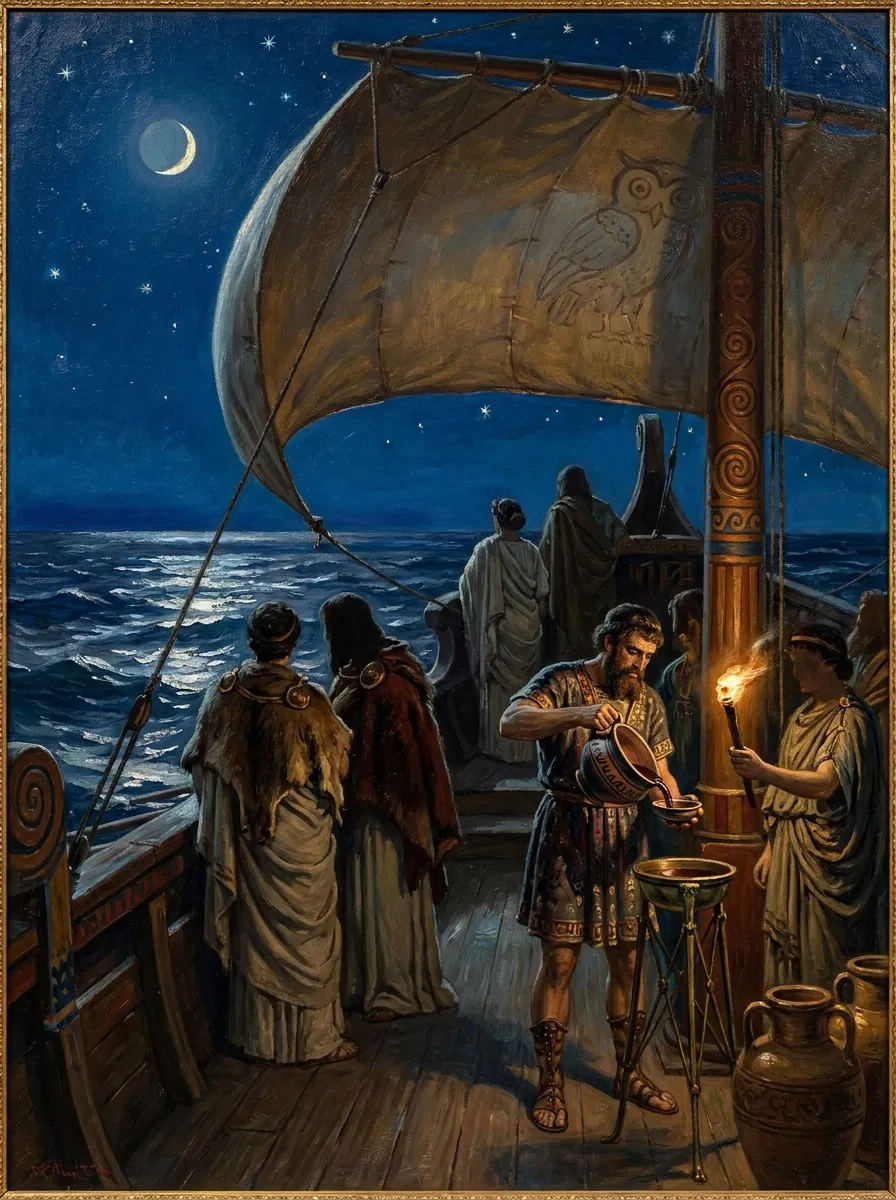
With these words, he led the way, and the others followed. After they had brought the things as he directed, Telemachus boarded the ship, with Athena going before him and taking her seat in the stern. Telemachus sat beside her. Then the men loosed the hawsers and took their places on the benches. Athena sent a fair West wind that whistled over the dark waves. Telemachus told them to catch hold of the ropes and hoist sail, and they did as he instructed. They set the mast in its socket in the cross plank, raised it, and secured it with the forestays. Then they hoisted their white sails aloft with ropes of twisted ox hide. As the sail bellied out with the wind, the ship flew through the dark water, and the foam hissed against her bows as she sped onward. Then they secured everything on the ship, filled the mixing bowls to the brim, and made drink offerings to the immortal gods, but especially to the grey-eyed daughter of Zeus.
Thus the ship sped on her way through the watches of the night, from dark until dawn.
Translation: Samuel Butler (1900) · Public domain · SPDX: PD-1900-Butler