As the sun rose from the sea into the sky, shedding light on mortals and immortals, they reached Pylos, the city of Neleus. The people of Pylos were gathered on the seashore to sacrifice black bulls to Poseidon, lord of the Earthquake. There were nine guilds with five hundred men in each, and nine bulls for each guild. As they were eating the inward meats and burning the thigh bones in Poseidon's name, Telemachus and his crew arrived, furled their sails, anchored, and went ashore.
Athena led the way, and Telemachus followed. She said:
“Telemachus, don't be shy or nervous. You've taken this voyage to find out where your father is buried and how he died. Go straight to Nestor so we can hear what he has to say. Ask him to speak the truth; he won't lie, because he's an excellent person.”
“But Mentor, how can I approach Nestor? How should I address him? I'm not used to long conversations and am ashamed to question someone so much older than I am.”
“Some things, Telemachus, will come to you by instinct, and heaven will guide you further. I'm sure the gods have been with you since birth.”
She went on quickly, and Telemachus followed until they reached the Pylian people. Nestor was sitting with his sons, and the company around him were preparing dinner, putting meat on the spits while other pieces cooked. Seeing the strangers, they crowded around, took their hands, and invited them to sit. Nestor’s son Pisistratus offered his hand to each, seating them on soft sheepskins on the sand near his father and brother Thrasymedes. He gave them portions of the inward meats and poured wine into a golden cup, handing it to Athena first, and greeting her.
“Offer a prayer to King Poseidon, sir, for you're joining his feast. After you've prayed and made your drink offering, pass the cup to your friend so he can do the same. I'm sure he prays too, for no one can live without God. Still, he's younger than you, about my age, so I'll give you precedence.”
As he spoke, he handed her the cup. Athena thought it right that he gave it to her first, so she began praying to Poseidon.
“O you who encircle the earth, grant the prayers of your servants who call on you. Send your grace on Nestor and his sons; reward the Pylian people for the goodly hecatomb they offer you. Lastly, grant Telemachus and myself a happy outcome in the matter that brought us to Pylos.”
When she finished praying, she handed the cup to Telemachus, and he prayed. When the outer meats were roasted and taken off the spits, the carvers gave everyone a portion, and they all had an excellent dinner. Once they had eaten and drunk enough, Nestor, knight of Gerene, began to speak.
“Now that our guests have finished dinner, we should ask who they are. Who are you, strangers, and from what port did you sail? Are you traders, or do you sail as rovers, your hand against every man, and every man’s hand against you?”
Telemachus answered boldly, because Athena had given him courage to ask about his father and make a good name for himself.
“Nestor, son of Neleus, honor to the Achaean name, you ask where we come from, and I'll tell you. We're from Ithaca under Neritum, and my matter is private, not public. I seek news of my unhappy father Odysseus, who supposedly sacked Troy with you. We know what happened to the other heroes who fought at Troy, but heaven has hidden from us whether Odysseus is even dead. No one can say where he perished, whether he fell in battle on the mainland or was lost at sea. I beg you to tell me of his end, if you saw it or heard it from another traveler, for he was born to trouble. Don't soften things out of pity, but tell me plainly what you saw. If my brave father Odysseus ever served you loyally, remember it now and tell me truly all.”
“My friend, you remind me of a time of sorrow, for the Achaeans suffered at sea while privateering under Achilles, and when fighting before the great city of King Priam. Our best men fell there—Ajax, Achilles, Patroclus, and my own dear son Antilochus, fleet of foot and valiant in fight. What mortal could tell the whole story? If you stayed here asking questions for five or six years, I couldn't tell you all the Achaeans suffered, and you'd turn homeward weary before it ended. For nine years we tried every stratagem, but heaven was against us. No one could compare with your father in subtlety—if you are his son—I can hardly believe it—you talk just like him. He and I never had any difference, but advised the Argives how to order things for the best.
“When we had sacked the city of Priam and were sailing in our ships, Zeus vexed the Argives on their homeward voyage, for they weren't all wise, and many came to a bad end through the displeasure of Zeus’s daughter Athena, who caused a quarrel between the sons of Atreus.
“The sons of Atreus called a meeting that was not as it should have been, for it was sunset and the Achaeans were heavy with wine. When they explained why they had called the people together, Menelaus wanted to sail homeward at once, which displeased Agamemnon, who thought we should wait to offer hecatombs to appease Athena's anger. Fool, he should have known he wouldn't prevail, for when the gods decide, they don't change their minds lightly. The two argued, and the Achaeans sprang to their feet with a cry, divided on what to do.
“That night we rested and nursed our anger, for Zeus was hatching mischief. In the morning, some of us drew our ships into the water and put our goods with our women on board, while the rest, about half, stayed with Agamemnon. We embarked and sailed; the ships went well, for heaven had smoothed the sea. When we reached Tenedos, we offered sacrifices to the gods, longing to get home. But cruel Zeus didn't want that yet and raised a second quarrel, during which some turned their ships back and sailed under Odysseus to make peace with Agamemnon. But I and the ships with me pressed forward, seeing mischief brewing. The son of Tydeus went with me. Later, Menelaus joined us at Lesbos, finding us deciding our course—whether to go outside Chios by the island of Psyra, keeping it to our left, or inside Chios, over against the stormy headland of Mimas. We asked heaven for a sign and were shown that we'd be safest heading our ships across the open sea to Euboea. We did this, and a fair wind sprang up, giving us a quick passage to Geraestus, where we offered sacrifices to Poseidon for helping us. Four days later, Diomed and his men stationed their ships in Argos, but I held on for Pylos, and the wind never fell from the day heaven made it fair for me.
“Therefore, my dear young friend, I returned without hearing about the others. I don't know who got home safely or who was lost, but I'll give you the reports that have reached me since I've been here. They say the Myrmidons returned home safely under Achilles’ son Neoptolemus; so did the valiant son of Poias, Philoctetes. Idomeneus lost no men at sea, and all his followers who escaped death got home to Crete. You've heard of Agamemnon and his bad end at the hands of Aegisthus—and Aegisthus paid a fearful reckoning. It's good for a man to leave a son to do as Orestes did, who killed Aegisthus, the murderer of his father. You too—you're a tall, smart-looking fellow—show your mettle and make a name for yourself.”
“Nestor, son of Neleus, honor to the Achaean name, the Achaeans applaud Orestes, and his name will live forever because he avenged his father nobly. I wish heaven would grant me vengeance on the insolent suitors who mistreat me and plot my ruin, but the gods have no such happiness for me and my father, so we must bear it.”
“My friend, now that you remind me, I remember hearing that your mother has many suitors who are ill-disposed toward you and are ruining your estate. Do you submit tamely, or is public feeling and the voice of heaven against you? Who knows but Odysseus may come back and pay these scoundrels in full, either alone or with Achaeans behind him? If Athena liked you as much as she did Odysseus when we were fighting before Troy—I never saw the gods so openly fond of anyone as Athena was of your father—if she took as good care of you as she did of him, these wooers would forget their wooing.”
“I can't expect anything like that; it would be too much to hope for. I don't dare think about it. Even if the gods willed it, such good fortune couldn't befall me.”
“Telemachus, what are you talking about? Heaven has a long arm if it wants to save someone. If it were me, I wouldn't care how much I suffered before getting home, as long as I was safe once I got there. I'd rather that than get home quickly and then be killed in my own house, like Agamemnon was by the treachery of Aegisthus and his wife. Still, death is certain, and when a man's time comes, not even the gods can save him, no matter how fond they are of him.”
“Mentor, let's not talk about it anymore. There's no chance of my father ever coming back; the gods decided to destroy him long ago. But there's something else I'd like to ask Nestor about, because he knows more than anyone else. They say he's reigned for three generations, so it's like talking to an immortal. Tell me, Nestor, and tell me truly: how did Agamemnon die like that? What was Menelaus doing? And how did that false Aegisthus kill a man so much better than himself? Was Menelaus away from Achaean Argos, traveling somewhere else among mankind, that Aegisthus took heart and killed Agamemnon?”
“I'll tell you truly; you've already guessed how it all happened. If Menelaus had found Aegisthus alive in his house when he got back from Troy, there wouldn't have been a burial mound for him, not even when he was dead. He would have been thrown outside the city to the dogs and vultures, and no woman would have mourned him, because he did a very wicked thing. But we were over there, fighting hard at Troy, and Aegisthus, who was taking it easy in Argos, coaxed Agamemnon's wife Clytemnestra with constant flattery.
“At first, she wanted nothing to do with his wicked scheme, because she was naturally good. Plus, there was a bard with her, whom Agamemnon had strictly ordered to guard his wife when he left for Troy. But when heaven decided to destroy her, Aegisthus carried the bard off to a desert island and left him there for crows and seagulls to feed on—after which she went willingly enough to Aegisthus's house. Then he offered many burnt sacrifices to the gods and decorated many temples with tapestries and gilding, because he had succeeded far beyond his expectations.
“Meanwhile, Menelaus and I were on our way home from Troy, on good terms. When we got to Sunium, near Athens, Apollo killed Phrontis, the steersman of Menelaus's ship, with his painless arrows (and no one knew better how to handle a vessel in rough weather). He died right there with the helm in his hand, and Menelaus, though eager to press on, had to wait to bury his comrade and give him proper funeral rites. Later, when he could put to sea again, and had sailed as far as the Malean headlands, Zeus planned evil against him and made it blow hard until the waves rose like mountains. There, he divided his fleet and took half toward Crete, where the Cydonians live around the river Iardanus. There's a high headland stretching out into the sea from Gortyn, and all along that coast as far as Phaestus the sea runs high when a south wind blows. But after Phaestus, the coast is more protected, because a small headland can make a great shelter. That part of the fleet was driven onto the rocks and wrecked, but the crews managed to save themselves. As for the other five ships, they were taken by winds and seas to Aegyptus, where Menelaus gathered much gold and substance among people who spoke a foreign language. Meanwhile, Aegisthus plotted his evil deed back home. For seven years after he killed Agamemnon, he ruled in Mycene, and the people obeyed him. But in the eighth year, Orestes came back from Athens to be his downfall and killed his father's murderer. Then he celebrated the funeral rites of his mother and that false Aegisthus with a banquet for the people of Argos, and that very day Menelaus came home with as much treasure as his ships could carry.
“So, take my advice: don't travel far from home for too long, and don't leave your property with such dangerous people in your house. They'll eat up everything you have, and you'll have been on a fool's errand. Still, I advise you to go and visit Menelaus, who has recently returned from a voyage among such distant peoples that no one could ever hope to get back from, once the winds had carried him so far off course. Even birds can't fly that distance in a year, the seas are so vast and terrible. Go to him by sea, and take your own men with you. Or, if you'd rather travel by land, you can have a chariot and horses, and my sons can escort you to Lacedaemon, where Menelaus lives. Beg him to speak the truth, and he won't lie to you, because he's an excellent person.”
As he spoke, the sun set and darkness fell. Then Athena said,
“Sir, all that you've said is good. Now, order the tongues of the sacrificial animals to be cut, and mix wine so we can make drink offerings to Poseidon and the other immortals. Then go to bed, because it's bedtime. People should leave early and not stay up late at a religious festival.”
Thus spoke the daughter of Zeus, and they obeyed her. Servants poured water over the guests' hands, while pages filled the mixing bowls with wine and water and handed it around after giving everyone his drink offering. Then they threw the tongues of the sacrificial animals into the fire and stood up to make their drink offerings. When they had made their offerings and had drunk as much as they wanted, Athena and Telemachus were about to go on board their ship, but Nestor stopped them immediately and made them stay.
“Heaven and the immortal gods forbid that you should leave my house to go on board a ship. Do you think I'm so poor and short of clothes, or that I have so few cloaks and blankets that I can't find comfortable beds for myself and my guests? I have plenty of rugs and cloaks, and I won't let the son of my old friend Odysseus camp out on the deck of a ship—not while I live—nor will my sons after me. They'll keep open house as I have.”
Then Athena answered,
“Sir, you've spoken well, and it'll be much better for Telemachus to do as you've said. He'll return with you and sleep at your house, but I have to go back to give orders to my crew and keep them in good spirits. I'm the only older person among them; the rest are all young men Telemachus's age, who have taken this voyage out of friendship. So, I must return to the ship and sleep there. Also, tomorrow I have to go to the Cauconians, where I'm owed a large sum of money. Now that Telemachus is your guest, send him to Lacedaemon in a chariot, and let one of your sons go with him. Please also provide him with your best and fastest horses.”
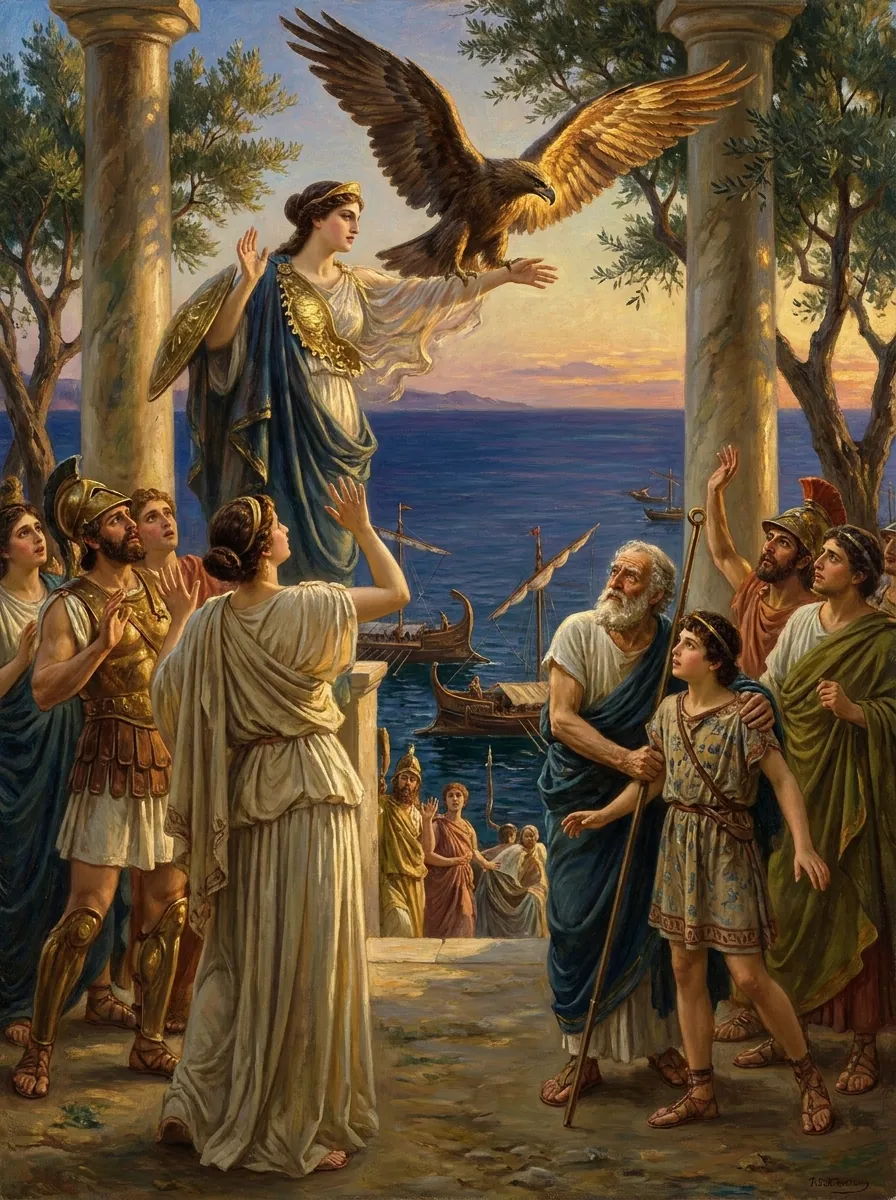
When she had spoken, she flew away in the form of an eagle, and everyone marveled as they watched. Nestor was astonished and took Telemachus by the hand.
“My friend, I see that you're going to be a great hero someday, since the gods attend to you like this while you're still so young. This must have been none other than Zeus's formidable daughter, Athena, who showed such favor toward your brave father among the Argives. Holy queen, grant your grace to me, my good wife, and my children. In return, I'll offer you a broad-browed heifer of a year old, unbroken, and never yet brought under the yoke by man. I'll gild her horns and offer her up to you in sacrifice.”
Thus he prayed, and Athena heard his prayer. Then he led the way to his own house, followed by his sons and sons-in-law. When they had arrived and taken their places on the benches and seats, he mixed them a bowl of sweet wine that was eleven years old when the housekeeper took the lid off the jar that held it. As he mixed the wine, he prayed and made drink offerings to Athena, daughter of Aegis-bearing Zeus. Then, when they had made their drink offerings and had drunk as much as they wanted, the others went home to bed, each in his own abode. But Nestor put Telemachus to sleep in the room over the gateway, along with Pisistratus, his only unmarried son left. Nestor himself slept in an inner room of the house, with the queen his wife by his side.
When dawn came, Nestor left his couch and sat on the benches of white and polished marble that stood in front of his house. Neleus, peer of gods in counsel, used to sit here, but he was now dead and had gone to the house of Hades. So Nestor sat in his seat, scepter in hand, as guardian of the public good. His sons gathered around him as they left their rooms: Echephron, Stratius, Perseus, Aretus, and Thrasymedes. The sixth son was Pisistratus, and when Telemachus joined them, they made him sit with them. Then Nestor addressed them.
“My sons, hurry and do as I tell you. First, I want to propitiate the great goddess Athena, who appeared visibly to me during yesterday's festivities. Go, one of you, to the plain, tell the stockman to find me a heifer, and bring it here at once. Another must go to Telemachus's ship and invite the entire crew, leaving only two men in charge of the vessel. Someone else will run and fetch Laerceus the goldsmith to gild the heifer's horns. The rest of you, stay here. Tell the maids in the house to prepare an excellent dinner and to fetch seats and logs of wood for a burnt offering. Tell them also to bring me some clear spring water.”
They hurried off on their errands. The heifer was brought in from the plain, and Telemachus's crew came from the ship. The goldsmith brought the anvil, hammer, and tongs he used to work his gold, and Athena herself came to accept the sacrifice. Nestor gave out the gold, and the smith gilded the heifer's horns so the goddess would enjoy their beauty. Then Stratius and Echephron brought her in by the horns. Aretus fetched water from the house in a ewer with a flower pattern on it, and in his other hand, he held a basket of barley meal. Sturdy Thrasymedes stood by with a sharp axe, ready to strike the heifer, while Perseus held a bucket. Then Nestor began by washing his hands and sprinkling the barley meal, and he offered many prayers to Athena as he threw a lock from the heifer's head upon the fire.
When they had finished praying and sprinkling the barley meal, Thrasymedes dealt his blow, bringing the heifer down with a stroke that cut through the tendons at the base of her neck. Nestor's daughters and daughters-in-law, and his venerable wife Eurydice (eldest daughter of Clymenus) screamed with delight. Then they lifted the heifer’s head from the ground, and Pisistratus cut her throat. When she had finished bleeding and was quite dead, they cut her up. They cut out the thigh bones in due course, wrapped them in two layers of fat, and set some pieces of raw meat on top. Then Nestor laid them on the wood fire and poured wine over them, while the young men stood near him with five-pronged spits in their hands. When the thighs were burned and they had tasted the inward meats, they cut the rest of the meat up small, put the pieces on the spits, and toasted them over the fire.
Meanwhile, lovely Polycaste, Nestor’s youngest daughter, washed Telemachus. After washing him and anointing him with oil, she brought him a fair mantle and shirt, and he looked like a god as he came from the bath and took his seat beside Nestor. When the outer meats were done, they drew them off the spits and sat down to dinner, where some worthy henchmen waited on them, pouring out their wine in cups of gold. As soon as they had had enough to eat and drink, Nestor said,
“Sons, put Telemachus’s horses to the chariot so he can start at once.”
They did as he said and yoked the swift horses to the chariot. The housekeeper packed them a provision of bread, wine, and sweetmeats fit for the sons of princes. Then Telemachus got into the chariot, while Pisistratus gathered up the reins and took his seat beside him. He lashed the horses, and they flew forward willingly into the open country, leaving the high citadel of Pylos behind them. All that day they traveled, swaying the yoke upon their necks, until the sun went down and darkness covered the land. Then they reached Pherae, where Diocles lived, son of Ortilochus and grandson of Alpheus. Here they spent the night, and Diocles entertained them hospitably. When dawn came, they again yoked their horses and drove out through the gateway under the echoing gatehouse. Pisistratus lashed the horses, and they flew forward willingly; presently they came to the corn lands of the open country and, in time, completed their journey, so well did their steeds carry them.
Now, when the sun had set and darkness covered the land,
Translation: Samuel Butler (1900) · Public domain · SPDX: PD-1900-Butler