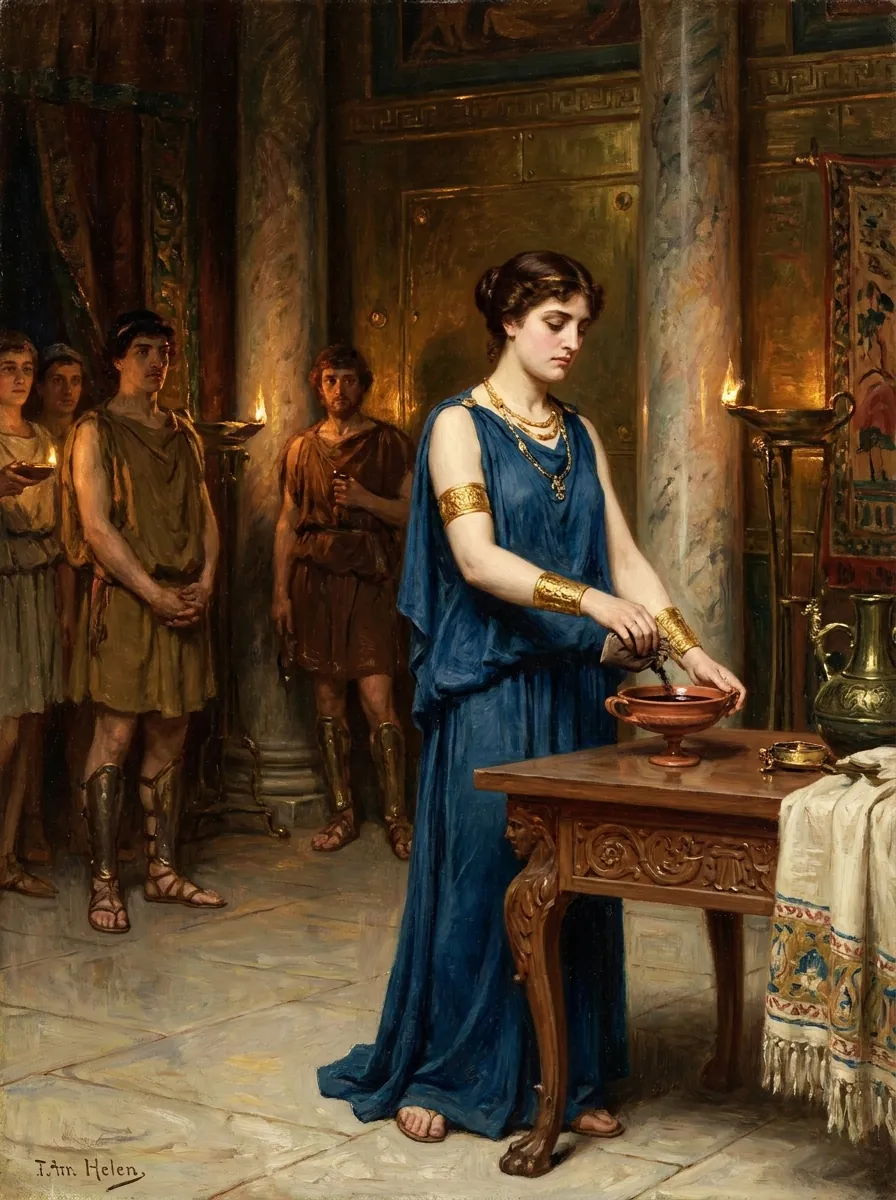
They reached the low-lying city of Lacedaemon and drove straight to Menelaus’s house, finding him there, feasting with his many clansmen in honor of his son’s wedding and his daughter’s, whom he was marrying to the son of that warrior Achilles. He had agreed to this and promised her to him while still at Troy, and now the gods were bringing the marriage about. He was sending her with chariots and horses to the city of the Myrmidons, over whom Achilles’ son was reigning. For his only son, he had found a bride from Sparta, the daughter of Alector. This son, Megapenthes, was born to him of a bondwoman, for heaven granted Helen no more children after she had borne Hermione, who was as fair as golden Aphrodite herself.
So the neighbors and kinsmen of Menelaus were feasting and making merry in his house. There was a bard to sing to them and play his lyre, while two tumblers performed in their midst when the man struck up his tune.
Telemachus and the son of Nestor stopped their horses at the gate, where Eteoneus, Menelaus’s servant, came out. As soon as he saw them, he ran hurrying back into the house to tell his master. He went close up to him and said:
“Menelaus, there are some strangers here, two men who look like sons of Zeus. What should we do? Should we take their horses out, or tell them to find friends elsewhere as best they can?”
Menelaus was very angry and said:
“Eteoneus, son of Boethous, you never used to be a fool, but now you talk like a simpleton. Take their horses out, of course, and show the strangers in so they can have supper. You and I have stayed often enough at other people’s houses before we got back here, where heaven grant that we may rest in peace from now on.”
So Eteoneus bustled back and told the other servants to come with him. They took their sweating steeds from under the yoke, made them fast to the mangers, and gave them a feed of oats and barley mixed. Then they leaned the chariot against the end wall of the courtyard and led the way into the house. Telemachus and Pisistratus were astonished when they saw it, for its splendor was like that of the sun and moon. After admiring everything to their heart’s content, they went into the bathroom and washed themselves.
When the servants had washed them and anointed them with oil, they brought them woolen cloaks and shirts, and the two took their seats by Menelaus’s side. A maidservant brought them water in a beautiful golden ewer and poured it into a silver basin for them to wash their hands. She drew a clean table beside them. An upper servant brought them bread and offered them many good things of what there was in the house, while the carver fetched them plates of all manner of meats and set cups of gold by their side.
Menelaus then greeted them, saying:
“Fall to, and welcome. When you have finished supper, I’ll ask who you are, for the lineage of such men as you cannot have been lost. You must be descended from a line of scepter-bearing kings, for poor people do not have such sons as you are.”
On this, he handed them a piece of fat roast loin, which had been set near him as a prime part, and they laid their hands on the good things before them. As soon as they had had enough to eat and drink, Telemachus said to the son of Nestor, with his head so close that no one might hear:
“Look, Pisistratus, man after my own heart, see the gleam of bronze and gold—of amber, ivory, and silver. Everything is so splendid that it’s like seeing the palace of Olympian Zeus. I’m lost in admiration.”
Menelaus overheard him and said:
“No one, my sons, can compete with Zeus, for his house and everything about him is immortal. But among mortal men—well, there may be another who has as much wealth as I have, or there may not. At all events, I have traveled much and have undergone much hardship, for it was nearly eight years before I could get home with my fleet. I went to Cyprus, Phoenicia, and Aegyptus; I went also to the Ethiopians, the Sidonians, the Erembians, and to Libya, where the lambs have horns as soon as they are born, and the sheep lamb down three times a year. Everyone in that country, whether master or man, has plenty of cheese, meat, and good milk, for the ewes yield all year round. But while I was traveling and getting great riches among these people, my brother was secretly and shockingly murdered through the perfidy of his wicked wife, so I have no pleasure in being lord of all this wealth. Whoever your parents may be, they must have told you about all this, and of my heavy loss in the ruin of a stately mansion fully and magnificently furnished. I wish I had only a third of what I have now, so I had stayed at home, and all those were living who perished on the plain of Troy, far from Argos. I often grieve, as I sit here in my house, for one and all of them. At times I cry aloud for sorrow, but presently I stop again, for crying is cold comfort, and one soon tires of it. Yet grieve for these as I may, I do so for one man more than for them all. I cannot even think of him without loathing both food and sleep, so miserable does he make me, for no one of all the Achaeans worked so hard or risked so much as he did. He took nothing by it and has left a legacy of sorrow to myself, for he has been gone a long time, and we know not whether he is alive or dead. His old father, his long-suffering wife Penelope, and his son Telemachus, whom he left behind him an infant in arms, are plunged in grief on his account.”
Thus spoke Menelaus, and the heart of Telemachus yearned as he thought of his father. Tears fell from his eyes as he heard him mentioned, so he held his cloak before his face with both hands. When Menelaus saw this, he wondered whether to let him choose his own time for speaking or to ask him at once and find what it was all about.
While he was thus in two minds, Helen came down from her high-vaulted and perfumed room, looking as lovely as Artemis herself. Adraste brought her a seat, Alcippe a soft woolen rug, while Phylo fetched her the silver work-box which Alcandra, wife of Polybus, had given her. Polybus lived in Egyptian Thebes, which is the richest city in the whole world. He gave Menelaus two baths, both of pure silver, two tripods, and ten talents of gold. Besides all this, his wife gave Helen some beautiful presents: a golden distaff and a silver work box that ran on wheels, with a gold band around the top of it. Phylo now placed this by her side, full of fine spun yarn, and a distaff charged with violet colored wool was laid upon the top of it. Then Helen took her seat, put her feet upon the footstool, and began to question her husband.
“Menelaus,” she said, “do we know the names of these strangers visiting us? I could guess—right or wrong—but I have to say what I think. I've never seen anyone so like someone else. When I look at him, I hardly know what to think; this young man is so like Telemachus, the baby Odysseus left behind when you Achaeans sailed to Troy, hearts full of battle, all because of my shameless self.”
“My dear wife,” Menelaus replied,
“I see the likeness too. His hands and feet are just like Odysseus's. So is his hair, the shape of his head, and the look in his eyes. Besides, when I was talking about Odysseus, about how much he suffered for me, tears came to his eyes, and he hid his face in his cloak.”
Then Pisistratus said,
“Menelaus, son of Atreus, you're right—this young man is Telemachus. But he's modest and ashamed to start a conversation with someone whose words are as fascinating as yours. My father, Nestor, sent me to escort him here; he wanted to know if you could offer any advice. A son always has trouble at home when his father's gone, leaving him without support. That's Telemachus's situation now: his father's away, and no one among his own people will stand by him.”
“Bless my heart,” Menelaus replied,
“so I'm hosting the son of a dear friend, a man who suffered greatly for me. I'd always hoped to give him a grand welcome when the gods granted us a safe return from overseas. I would have founded a city for him in Argos and built him a house. I would have had him move from Ithaca with his goods, his son, and all his people. I would have sacked one of the neighboring cities subject to me for them. We would have seen each other all the time, and nothing but death could have broken up such a close, happy friendship. But I suppose the gods begrudged us such good fortune, because they kept the poor fellow from ever getting home.”
His words made them all weep. Helen wept, Telemachus wept, and so did Menelaus. Even Pisistratus couldn't stop his eyes from filling when he remembered his dear brother Antilochus, whom the son of dawn had killed. Then he said to Menelaus,
“Sir, my father Nestor used to tell me, when we talked about you at home, that you were a person of rare understanding. So, if you can, please do as I ask. I don't like crying while I'm eating supper. Morning will come soon enough, and in the morning I don't care how much I cry for those who are dead and gone. That's all we can do for them: shave our heads and let the tears flow. I had a brother who died at Troy; he wasn't the worst man there. You must have known him—Antilochus was his name. I never saw him myself, but they say he was remarkably fast and a valiant fighter.”
“Your discretion, my friend,” Menelaus answered,
“is beyond your years. You clearly take after your father. You can always tell when a man is the son of someone the gods have blessed with a good wife and children. They've blessed Nestor from start to finish, letting him grow old in his own house, surrounded by well-disposed and valiant sons. So, we'll stop this weeping and get back to supper. Let someone pour water over our hands. Telemachus and I can talk more in the morning.”
Asphalion, one of the servants, poured water over their hands, and they reached for the food before them.
Then Helen, daughter of Zeus, thought of something else. She drugged the wine with an herb that banished all care, sorrow, and bad temper. Anyone who drank this drugged wine couldn't shed a single tear for the rest of the day, not even if his own parents dropped down dead, or he saw a brother or son cut to pieces before his eyes. Polydamna, wife of Thon, gave Helen this powerful drug. She was an Egyptian woman, and Egypt is where all sorts of herbs grow—some good for mixing in bowls, others poisonous. Everyone in that country is a skilled physician, descended from Paeeon. After Helen put the drug in the bowl and told the servants to pour the wine, she said:
“Menelaus, son of Atreus, and you, my good friends, sons of honorable men—as Zeus wills, since he gives both good and evil and can do as he chooses—feast as you like, and listen to a story. I can't name every single one of Odysseus's exploits, but I can tell you what he did before Troy, when you Achaeans were in all sorts of trouble. He covered himself with wounds and bruises, dressed in rags, and entered the enemy city looking like a servant or beggar, completely different from how he looked among his own people. He entered Troy in disguise, and no one said a thing to him. I was the only one who recognized him, and I started questioning him, but he was too cunning for me. Only after I washed and anointed him, gave him clothes, and swore a solemn oath not to betray him to the Trojans until he got safely back to the ships, did he tell me what the Achaeans planned to do. He killed many Trojans and gathered a lot of information before returning to the Argive camp. The Trojan women mourned all this, but I was glad, because my heart was beginning to yearn for home. I was unhappy about the wrong Aphrodite had done me, taking me away from my country, my girl, and my lawful wedded husband, who is certainly not lacking in looks or intelligence.”
Then Menelaus said,
“My dear wife, everything you've said is true. I've traveled a lot and met many heroes, but I've never seen another man like Odysseus. What endurance, what courage he showed inside the wooden horse, where all the bravest Argives were waiting to bring death and destruction to the Trojans! At that moment, you came up to us. Some god who wished the Trojans well must have sent you, and you had Deiphobus with you. Three times you went around our hiding place, patting it and calling out each of our chiefs by name, mimicking all our wives. Diomedes, Odysseus, and I heard the noise you made from inside. Diomedes and I couldn't decide whether to spring out then and there or answer you from inside, but Odysseus held us all in check. We sat still, all except Anticlus, who was starting to answer you, when Odysseus clapped his strong hands over his mouth and held them there. That's what saved us all; he muzzled Anticlus until Athena took you away again.”
“How sad,” Telemachus exclaimed.
“All that effort didn't save him, nor did his own iron courage. But now, sir, please send us all to bed, so we can lie down and enjoy the blessed gift of sleep.”
Helen told the maids to set up beds in the gatehouse room, making them with good red rugs and spreading coverlets topped with woollen cloaks for the guests. The maids went out with a torch and made the beds, and a servant led the strangers to them. Telemachus and Pisistratus slept there in the forecourt, while the son of Atreus lay in an inner room with lovely Helen by his side.
When dawn came, Menelaus rose and dressed. He bound his sandals to his feet, girded his sword over his shoulder, and left his room looking like an immortal god. Then, sitting near Telemachus, he said:
“Telemachus, what led you to take this long sea voyage to Lacedaemon? Is it public or private business? Tell me everything.”
“I have come, sir,” Telemachus replied,
“to see if you can tell me anything about my father. I'm being eaten out of house and home; my estate is being wasted, and my house is full of scoundrels who keep killing great numbers of my sheep and oxen, pretending to court my mother. Therefore, I beg you to tell me about my father’s sad end, whether you saw it yourself or heard it from some other traveler; for he was a man born to trouble. Don't soften things out of pity for me, but tell me plainly exactly what you saw. If my brave father Odysseus ever did you loyal service by word or deed when you Achaeans were harassed by the Trojans, remember it now in my favor and tell me truly everything.”
Hearing this, Menelaus was very shocked.
“So,” he exclaimed, “these cowards would usurp a brave man’s bed? A doe might as well lay her newborn young in a lion's lair, and then go off to feed in the forest or some grassy dell: when the lion comes back, he'll make short work of them both—and so will Odysseus with these suitors. By Zeus, Athena, and Apollo, if Odysseus is still the man he was when he wrestled with Philomeleides in Lesbos, and threw him so heavily that all the Achaeans cheered—if he's still that strong and came near these suitors, they'd have a short shrift and a sorry wedding. As for your questions, though, I won't prevaricate or deceive you. I'll tell you without hiding anything that the old man of the sea told me.
“I was trying to come here, but the gods detained me in Aegyptus, because my sacrifices hadn't fully satisfied them, and the gods are very strict about getting their dues. Off Aegyptus, about as far as a ship can sail in a day with a good stiff breeze, there's an island called Pharos—it has a good harbor where vessels can get out into the open sea after taking on water—and there the gods becalmed me for twenty days without even a breath of fair wind to help me forward. We would have run clean out of provisions, and my men would have starved if a goddess hadn't pitied me and saved me in the person of Idothea, daughter of Proteus, the old man of the sea, because she had taken a great fancy to me.”
“She came to me one day when I was by myself, as I often was, because the men used to go all over the island with their barbed hooks, hoping to catch a fish or two to save them from starving.”
‘Stranger,’ she said, ‘it seems to me you like starving this way—at least, it doesn't trouble you much, because you stick here day after day without even trying to get away, even though your men are dying by inches.’
“‘Let me tell you,’ I said, ‘whichever goddess you may be, I'm not staying here by choice, but must have offended the gods in heaven. Tell me, then, because the gods know everything, which immortal is hindering me this way, and also tell me how I can sail the sea to reach my home.’”
‘Stranger,’ she replied, ‘I'll make it all clear to you. There's an old immortal who lives under the sea hereabouts named Proteus. He's an Egyptian, and people say he's my father; he's Poseidon’s head man and knows every inch of the seabed. If you can snare him and hold him tight, he'll tell you about your voyage, what courses to take, and how to sail the sea to reach your home. He'll also tell you, if you want, everything that's been going on at your house, good and bad, while you've been away on your long and dangerous journey.’
“‘Can you show me,’ I asked, ‘some trick to catch this old god without him suspecting it and finding me out? A god isn't easily caught—not by a mortal man.’”
‘Stranger,’ she said, ‘I'll make it all clear to you. Around the time when the sun reaches mid-heaven, the old man of the sea comes up from under the waves, heralded by the West wind that ruffles the water over his head. As soon as he comes up, he lies down and goes to sleep in a great sea cave, where the seals—Halosydne’s chickens, as they call them—also come up from the dark sea and go to sleep in droves all around him; and they bring a very strong, fishy smell with them. Early tomorrow morning, I'll take you to this place and lay you in ambush. Pick out the three best men you have in your fleet, and I'll tell you all the tricks the old man will play on you.
‘First, he’ll look over all his seals and count them. When he’s seen them and tallied them on his fingers, he’ll go to sleep among them, like a shepherd with his sheep. The moment you see he’s asleep, seize him. Put forth all your strength and hold him fast, because he’ll do his utmost to get away. He’ll turn himself into every kind of creature that walks the earth. He’ll become both fire and water. But you must hold him fast and grip him tighter and tighter, until he begins to talk to you and turns back into what he was when you saw him go to sleep. Then you can slacken your hold and let him go. And you can ask him which of the gods is angry with you, and what you must do to reach your home across the seas.’
Having said this, she dove under the waves. I turned back to where my ships were drawn up on the shore, my heart heavy with care as I went. When I reached my ship, we got supper ready, because night was falling, and camped on the beach.
When dawn came, I took the three men on whose prowess I could most rely, and went along the sea-side, praying to the gods. Meanwhile, the goddess fetched me four seal skins from the bottom of the sea, all freshly skinned, planning a trick on her father. Then she dug four pits for us to lie in, and sat down to wait until we came up. When we were close to her, she made us lie down in the pits, one after the other, and threw a seal skin over each of us. Our ambush would have been intolerable, because the stench of the fishy seals was awful—who would go to bed with a sea monster if he could help it?—but here, too, the goddess helped us, and thought of something that gave us great relief. She put some ambrosia under each man’s nostrils, which was so fragrant that it killed the smell of the seals.
We waited the whole morning, watching the seals come up in hundreds to bask on the sea shore, until at noon the old man of the sea came up too. When he had found his fat seals, he went over them and counted them. We were among the first he counted, and he never suspected any trickery. He laid himself down to sleep as soon as he had finished counting. Then we rushed upon him with a shout and seized him. At once he began with his old tricks, and changed himself first into a lion with a great mane; then, suddenly, he became a dragon, a leopard, a wild boar. The next moment he was running water, and then again directly he was a tree. But we stuck to him and never lost hold, until at last the cunning old creature grew distressed, and said:
‘Son of Atreus, which of the gods hatched this plot with you to snare me and seize me against my will? What do you want?’
‘You know that yourself, old man,’ I answered. ‘You’ll gain nothing by trying to put me off. It’s because I’ve been kept so long on this island, and see no sign of being able to get away. I’m losing all heart. Tell me, then—because you gods know everything—which of the immortals is hindering me, and tell me also how I may sail the sea to reach my home?’
‘Then,’ he said, ‘if you want to finish your voyage and get home quickly, you must offer sacrifices to Zeus and to the rest of the gods before embarking. It’s decreed that you won’t get back to your friends and to your own house until you’ve returned to the heaven-fed stream of Aegyptus, and offered holy hecatombs to the immortal gods that reign in heaven. When you’ve done this, they’ll let you finish your voyage.’
I was heartbroken when I heard that I had to go back all that long and terrible voyage to Aegyptus. Nevertheless, I answered, ‘I’ll do all that you’ve laid upon me, old man. But now tell me, and tell me truly, whether all the Achaeans whom Nestor and I left behind us when we set sail from Troy have gotten home safely, or whether any of them came to a bad end either on board his own ship or among his friends when the days of his fighting were done.’
‘Son of Atreus,’ he answered, ‘why ask me? You’d better not know what I can tell you, because your eyes will surely fill when you’ve heard my story. Many of those about whom you ask are dead and gone, but many still remain, and only two of the chief men among the Achaeans perished during their return home. As for what happened on the field of battle—you were there yourself. A third Achaean leader is still at sea, alive, but hindered from returning. Ajax was wrecked, because Poseidon drove him onto the great rocks of Gyrae. Nevertheless, he let him get safe out of the water, and in spite of all Athena’s hatred, he would have escaped death if he hadn’t ruined himself by boasting. He said the gods couldn’t drown him even if they had tried to do so, and when Poseidon heard this boasting, he seized his trident in his two brawny hands, and split the rock of Gyrae in two pieces. The base remained where it was, but the part on which Ajax was sitting fell headlong into the sea and carried Ajax with it, so he drank salt water and drowned.’
‘Your brother and his ships escaped, because Hera protected him, but when he was just about to reach the high promontory of Malea, he was caught by a heavy gale which carried him out to sea again sorely against his will, and drove him to the foreland where Thyestes used to dwell, but where Aegisthus was then living. By and by, however, it seemed as though he was to return safely after all, because the gods backed the wind into its old quarter and they reached home. There, Agamemnon kissed his native soil, and shed tears of joy at finding himself in his own country.
‘Now, there was a watchman whom Aegisthus kept always on the watch, and to whom he had promised two talents of gold. This man had been looking out for a whole year to make sure that Agamemnon didn’t give him the slip and prepare for war. When, therefore, this man saw Agamemnon go by, he went and told Aegisthus, who at once began to lay a plot for him. He picked twenty of his bravest warriors and placed them in ambuscade on one side of the cloister, while on the opposite side he prepared a banquet. Then he sent his chariots and horsemen to Agamemnon, and invited him to the feast, but he meant foul play. He got him there, all unsuspecting of the doom that was awaiting him, and killed him when the banquet was over as though he were butchering an ox in the shambles. Not one of Agamemnon’s followers was left alive, nor yet one of Aegisthus’, but they were all killed there in the cloisters.’
Thus spoke Proteus, and I was heartbroken as I heard him. I sat down on the sands and wept. I felt as though I could no longer bear to live or look upon the light of the sun. Presently, when I had had my fill of weeping and writhing on the ground, the old man of the sea said:
‘Son of Atreus, don’t waste any more time crying so bitterly. It can do nothing. Find your way home as fast as you can, because Aegisthus may be still alive, and even though Orestes has been beforehand with you in killing him, you may yet come in for his funeral.’
On this, I took comfort in spite of all my sorrow, and said, ‘I know, then, about these two. Tell me, therefore, about the third man of whom you spoke. Is he still alive, but at sea, and unable to get home? Or is he dead? Tell me, no matter how much it may grieve me.’
‘The third man,’ he answered, ‘is Odysseus, who dwells in Ithaca. I can see him on an island, sorrowing bitterly in the house of the nymph Calypso, who is keeping him prisoner. He can’t reach his home because he has no ships or sailors to take him over the sea. As for your own end, Menelaus, you won’t die in Argos, but the gods will take you to the Elysian plain, which is at the ends of the world. There fair-haired Rhadamanthus reigns, and men lead an easier life than anywhere else in the world, because in Elysium there falls no rain, no hail, no snow, but Oceanus breathes ever with a West wind that sings softly from the sea, and gives fresh life to all men. This will happen to you because you’ve married Helen, and are Zeus’s son-in-law.’
As he spoke, he dove under the waves. I turned back to the ships with my companions, my heart heavy with care as I went. When we reached the ships, we got supper ready, because night was falling, and camped on the beach. When dawn appeared, we drew our ships into the water, and put our masts and sails within them. Then we went on board ourselves, took our seats on the benches, and struck the dark sea with our oars. I again stationed my ships in the heaven-fed stream of Aegyptus, and offered hecatombs that were full and sufficient. When I had thus appeased heaven’s anger, I raised a barrow to the memory of Agamemnon so that his name might live forever, after which I had a quick passage home, because the gods sent me a fair wind.
“As for you—stay here another ten or twelve days, and I'll send you on your way. I'll give you a fine chariot and three horses as a gift. I'll also give you a beautiful chalice, so that as long as you live, you can think of me whenever you make a drink offering to the immortal gods.”
Telemachus replied, “Son of Atreus,”
“don't press me to stay any longer. I'd be happy to stay with you for another year. I find your conversation so delightful that I wouldn't miss being at home with my parents at all. But my crew, whom I left at Pylos, are already impatient, and you're keeping me from them. As for any gift you might want to give me, I'd rather it be a piece of plate. I won't take any horses back with me to Ithaca. I'll leave them to adorn your own stables, because you have plenty of flat ground in your kingdom where lotus thrives, as well as meadowsweet, wheat, barley, and oats with their white and spreading ears. But in Ithaca, we have neither open fields nor racecourses. The country is better suited for goats than horses, and I like it better that way. None of our islands have much level ground suitable for horses, and Ithaca least of all.”
Menelaus smiled and took Telemachus’s hand.
“What you say shows you come from a good family. I can and will make this exchange for you by giving you the finest and most precious piece of plate in my house. It's a mixing bowl made by Hephaestus himself, of pure silver, except for the rim, which is inlaid with gold. Phaedimus, king of the Sidonians, gave it to me during a visit I paid him when I returned there on my way home. I'll give it to you as a gift.”
They talked, and guests kept arriving at the king’s house, bringing sheep and wine, while their wives prepared bread for them to take along. They were busy cooking dinner in the courtyards.
Meanwhile, the suitors were throwing discs or aiming spears at a mark on the leveled ground in front of Odysseus’ house, behaving with all their old insolence. Antinous and Eurymachus, their ringleaders and the most prominent among them, were sitting together when Noemon, son of Phronius, came up and said to Antinous,
“Do we know when Telemachus is coming back from Pylos, Antinous? He has one of my ships, and I need it to cross over to Elis. I have twelve brood mares there with yearling mule foals by their side, not yet broken in, and I want to bring one over here and break him.”
They were shocked to hear this, because they were sure Telemachus hadn't gone to the city of Neleus. They thought he was just away somewhere on the farms, with the sheep or the swineherd. So Antinous said,
“When did he go? Tell me the truth. What young men did he take with him? Were they freemen or his own slaves—because he might manage that too? Also, did you let him have the ship willingly because he asked, or did he take it without your permission?”
“I lent it to him,” Noemon answered. “What else could I do when a man of his position said he was in a bind and asked me to help him out? I couldn't possibly refuse. As for who went with him, they were the best young men we have, and I saw Mentor go on board as captain—or some god who looked exactly like him. I don't understand it, because I saw Mentor here myself yesterday morning, and yet he was setting out for Pylos.”
Noemon went back to his father’s house, but Antinous and Eurymachus were very angry. They told the others to stop playing and come sit down with them. When they came, Antinous, son of Eupeithes, spoke angrily, his heart black with rage, his eyes flashing fire:
“Good heavens, Telemachus's voyage is a serious matter. We were sure it would come to nothing, but the young fellow got away in spite of us, and with a picked crew, too. He'll be giving us trouble soon. May Zeus take him before he's fully grown. Find me a ship with a crew of twenty men. I'll lie in wait for him in the straits between Ithaca and Samos. He'll regret the day he set out to try and get news of his father.”
He spoke, and the others applauded. Then they all went inside.
Penelope soon learned what the suitors were plotting. A manservant, Medon, overheard them from outside the outer court as they were making their plans inside, and went to tell his mistress. As he crossed the threshold of her room, Penelope said:
“Medon, why have the suitors sent you here? Is it to tell the maids to stop their master’s work and cook dinner for them? I hope they neither woo nor dine from now on, not here or anywhere else. Let this be the last time, for the way you all waste my son’s estate. Didn't your fathers tell you, when you were children, how good Odysseus had been to them—never acting high-handedly or speaking harshly to anyone? Kings may say things sometimes, and they may favor one man and dislike another, but Odysseus never did an unjust thing to anyone—which shows how bad your hearts are, and that there's no such thing as gratitude left in this world.”
“I wish that were all, Madam, but they're plotting something far worse now—may the gods frustrate them. They're going to try and murder Telemachus as he comes home from Pylos and Lacedaemon, where he's gone to get news of his father.”
Penelope’s heart sank, and for a long time she was speechless; her eyes filled with tears, and she could find no words. At last, however, she said,
“Why did my son leave me? What business did he have sailing off in ships that make long voyages over the sea like sea-horses? Does he want to die without leaving anyone behind to keep up his name?”
“I don't know,” Medon answered, “whether some god set him up to it, or whether he went on his own to see if he could find out if his father was dead, or alive and on his way home.”
Then he went downstairs again, leaving Penelope in an agony of grief. There were plenty of seats in the house, but she couldn't bring herself to sit on any of them; she flung herself on the floor of her own room and cried. All the maids in the house, both old and young, gathered round her and began to cry too, till at last in a transport of sorrow she exclaimed,
“My dears, the gods have seen fit to try me with more affliction than any other woman of my age and country. First I lost my brave and lion-hearted husband, who had every good quality, and whose name was great over all Hellas and middle Argos. Now my darling son is at the mercy of the winds and waves, without my having heard one word about his leaving home. You hussies—not one of you even thought of giving me a call out of my bed, though you all knew very well when he was starting. If I had known he meant taking this voyage, he would have had to give it up, no matter how much he was bent upon it, or leave me a corpse behind him—one or the other. Now, however, some of you go and call old Dolius, who was given me by my father on my marriage, and who is my gardener. Tell him to go at once and tell everything to Laertes, who may be able to find some way to enlist public sympathy on our side, as against those who are trying to exterminate his own race and that of Odysseus.”
Then the dear old nurse Eurycleia said,
“You can kill me, Madam, or let me live on in your house, whichever you please, but I'll tell you the truth. I knew all about it, and gave him everything he wanted in the way of bread and wine, but he made me swear a solemn oath that I wouldn't tell you anything for some ten or twelve days, unless you asked or happened to hear of his having gone. He didn't want you to spoil your beauty by crying. Now, Madam, wash your face, change your dress, and go upstairs with your maids to offer prayers to Athena, daughter of Zeus who bears the Aegis, for she can save him even if he's in the jaws of death. Don't trouble Laertes; he has trouble enough already. Besides, I don't think the gods hate the race of Arceisius's son so much; there will be a son left to come up after him, and inherit both the house and the fair fields that lie all around it.”
With these words she made her mistress stop crying, and dried the tears from her eyes. Penelope washed her face, changed her dress, and went upstairs with her maids. She then put some bruised barley into a basket and began praying to Athena.
“Hear me,” she cried, “Daughter of Zeus who bears the Aegis, unweariable. If ever Odysseus burned you fat thigh bones of sheep or heifer while he was here, bear it in mind now as in my favor, and save my darling son from the villainy of the suitors.”
She cried aloud as she spoke, and the goddess heard her prayer. Meanwhile the suitors were clamorous throughout the covered cloister, and one of them said:
“The queen is preparing for her marriage with one or another of us. Little does she dream that her son has now been doomed to die.”
That's what they said, but they didn't know what was going to happen. Then Antinous said,
“Comrades, let's not talk so loud, lest some of it gets carried inside. Let's get up and do in silence what we're all agreed on.”
He then chose twenty men, and they went down to their ship and to the sea side. They drew the vessel into the water and got her mast and sails inside her. They bound the oars to the thole-pins with twisted leather thongs, all in due course, and spread the white sails aloft, while their fine servants brought them their armor. Then they made the ship fast a little way out, came on shore again, got their suppers, and waited till night fell.
But Penelope lay in her own room upstairs unable to eat or drink, and wondering whether her brave son would escape, or be overpowered by the wicked suitors. Like a lioness caught in the toils with huntsmen hemming her in on every side, she thought and thought till she sank into a slumber, and lay on her bed bereft of thought and motion.
Then Athena considered another matter. She made a vision in the likeness of Penelope’s sister, Iphthime, daughter of Icarius, who had married Eumelus and lived in Pherae. She told the vision to go to Odysseus's house and make Penelope stop crying. It came into her room through the hole where the door-thong went, hovered over her head, and said:
“You're asleep, Penelope. The gods who live at ease won't let you weep and be so sad. Your son has done them no wrong, so he will come back to you.”
Penelope, who was sleeping sweetly at the gates of dreamland, answered:
“Sister, why have you come? You don't come very often, probably because you live so far away. Am I supposed to stop crying and stop all the sad thoughts that torture me? I've lost my brave, lion-hearted husband, who had every good quality, and whose name was great over all Hellas and middle Argos. Now my darling son has gone off on a ship—a foolish fellow who's never been used to roughing it or going among gatherings of men. I'm even more anxious about him than about my husband. I tremble when I think of him, afraid something will happen to him, either from the people he's gone among, or at sea, because he has many enemies plotting against him, bent on killing him before he can return home.”
Then the vision said:
“Take heart, and don't be so dismayed. There's someone with him whom many would be glad to have at their side—I mean Athena. She has compassion on you and has sent me to bring you this message.”
“Then,” Penelope said, “if you are a god or have been sent by divine commission, tell me about that other unhappy one—is he still alive, or is he already dead and in the house of Hades?”
And the vision said:
“I won't tell you for certain whether he's alive or dead. There's no use in idle conversation.”
Then it vanished through the door's thong-hole and dissipated into thin air. Penelope rose from her sleep refreshed and comforted, her dream had been so vivid.
Meanwhile, the suitors went on board and sailed over the sea, intent on murdering Telemachus. Now, there's a rocky islet called Asteris, not very large, in the middle of the channel between Ithaca and Samos, with a harbor on either side where a ship can lie. Here the Achaeans placed themselves in ambush.
Translation: Samuel Butler (1900) · Public domain · SPDX: PD-1900-Butler