As dawn rose from her couch beside Tithonus—bringing light to mortals and immortals alike—the gods met in council with Zeus, lord of thunder, their king. Then Athena began to tell them of Odysseus's many sufferings, for she pitied him far off in the house of the nymph Calypso.
“Father Zeus, and all you other gods who live in everlasting bliss, I hope there may never be a kind and well-disposed ruler again, nor one who will govern equitably. I hope they will all be cruel and unjust from now on, for not one of his subjects has remembered Odysseus, who ruled them as though he were their father. There he is, suffering greatly on an island where the nymph Calypso dwells, and she will not let him go. He cannot get back to his own country, for he can find neither ships nor sailors to take him over the sea. Furthermore, wicked people are now trying to murder his only son Telemachus, who is coming home from Pylos and Lacedaemon, where he has been to get news of his father.”
“What are you talking about, my dear? Didn't you send him there yourself, because you thought it would help Odysseus get home and punish the suitors? Besides, you are perfectly able to protect Telemachus, and see him safely home again, while the suitors have to hurry back without killing him.”
When he had spoken, he said to his son Hermes,
“Hermes, you are our messenger. Go and tell Calypso we have decreed that poor Odysseus is to return home. He is to be convoyed neither by gods nor men, but after a perilous voyage of twenty days on a raft, he is to reach fertile Scheria, the land of the Phaeacians, who are near kin to the gods and will honor him as though he were one of ourselves. They will send him in a ship to his own country, and will give him more bronze and gold and raiment than he would have brought back from Troy if he had had all his prize money and had gotten home without disaster. This is how we have settled that he shall return to his country and his friends.”
Hermes, guide and guardian, slayer of Argus, did as he was told. He bound on his glittering golden sandals with which he could fly like the wind over land and sea. He took the wand with which he seals men’s eyes in sleep or wakes them as he pleases, and flew holding it in his hand over Pieria. Then he swooped down through the firmament till he reached the level of the sea, whose waves he skimmed like a cormorant that flies fishing every hole and corner of the ocean, and drenching its thick plumage in the spray. He flew over many a weary wave, but when he finally reached the island which was his journey’s end, he left the sea and went on by land till he came to the cave where the nymph Calypso lived.
He found her at home. There was a large fire burning on the hearth, and one could smell from far the fragrant reek of burning cedar and sandalwood. She was busy at her loom, shooting her golden shuttle through the warp and singing beautifully. Round her cave there was a thick wood of alder, poplar, and sweet smelling cypress trees, wherein all kinds of great birds had built their nests—owls, hawks, and chattering sea-crows that make their living in the waters. A vine loaded with grapes was trained and grew luxuriantly about the mouth of the cave; there were also four running rills of water in channels cut pretty close together, and turned this way and that to irrigate the beds of violets and luscious herbage over which they flowed. Even a god could not help being charmed with such a lovely spot, so Hermes stood still and looked at it. When he had admired it sufficiently, he went inside the cave.
Calypso knew him at once—for the gods all know each other, no matter how far they live from one another—but Odysseus was not within. He was on the sea-shore as usual, looking out upon the barren ocean with tears in his eyes, groaning and breaking his heart for sorrow. Calypso gave Hermes a seat and said:
“Why have you come to see me, Hermes—honored, and ever welcome—for you do not visit me often? Say what you want. I will do it for you at once if I can, and if it can be done at all; but come inside, and let me set refreshment before you.”
As she spoke she drew a table loaded with ambrosia beside him and mixed him some red nectar. Hermes ate and drank till he had had enough, and then said:
“We are speaking god and goddess to one another, and you ask me why I have come here. I will tell you truly, as you would have me do. Zeus sent me; it was not my idea. Who could possibly want to come all this way over the sea where there are no cities full of people to offer me sacrifices or choice hecatombs? Nevertheless, I had to come, for none of us other gods can cross Zeus, nor transgress his orders. He says that you have here the most ill-starred of all those who fought nine years before the city of King Priam and sailed home in the tenth year after sacking it. On their way home they sinned against Athena, who raised both wind and waves against them, so that all his brave companions perished, and he alone was carried here by wind and tide. Zeus says that you are to let this man go at once, for it is decreed that he shall not perish here, far from his own people, but shall return to his house and country and see his friends again.”
“You gods ought to be ashamed of yourselves. You are always jealous and hate seeing a goddess take a fancy to a mortal man, and live with him in open matrimony. When dawn made love to Orion, you precious gods were all furious until Artemis went and killed him in Ortygia. Again, when Ceres fell in love with Iasion, and yielded to him in a three-times-ploughed fallow field, Zeus soon heard of it and killed Iasion with his thunderbolts. Now you are angry with me too because I have a man here. I found the poor creature sitting all alone astride of a keel, for Zeus had struck his ship with lightning and sunk it in mid ocean, so that all his crew were drowned, while he himself was driven by wind and waves onto my island. I got fond of him and cherished him, and had set my heart on making him immortal, so that he should never grow old all his days. Still, I cannot cross Zeus, nor bring his counsels to nothing. Therefore, if he insists upon it, let the man go beyond the seas again, but I cannot send him anywhere myself for I have neither ships nor men who can take him. Nevertheless, I will readily give him such advice, in all good faith, as will be likely to bring him safely to his own country.”
“Then send him away, or Zeus will be angry with you and punish you.”
On this he took his leave, and Calypso went out to look for Odysseus, for she had heard Zeus’ message. She found him sitting upon the beach with his eyes always filled with tears, dying of homesickness. He had grown tired of Calypso, and though he was forced to sleep with her in the cave at night, it was she, not he, that wanted it so. As for the daytime, he spent it on the rocks and on the sea shore, weeping, crying aloud in his despair, and always looking out upon the sea. Calypso then went close up to him and said:
“My poor fellow, you shall not stay here grieving and fretting your life out any longer. I am going to send you away of my own free will. Go, cut some beams of wood, and make yourself a large raft with an upper deck so it can carry you safely over the sea. I will put bread, wine, and water on board to save you from starving. I will also give you clothes, and will send you a fair wind to take you home, if the gods in heaven want it so—for they know more about these things, and can settle them better than I can.”
“Now goddess, there is something behind all this. You cannot be really meaning to help me home when you bid me do such a dreadful thing as put to sea on a raft. Not even a well-found ship with a fair wind could venture on such a distant voyage: nothing that you can say or do shall make me go on board a raft unless you first solemnly swear that you mean me no mischief.”
“You know a great deal, but you’re quite wrong here. May heaven above and earth below be my witnesses, with the waters of the river Styx—and this is the most solemn oath a blessed god can take—that I mean you no harm. I’m only advising you to do exactly what I would do myself in your place. I am dealing with you straightforwardly; my heart isn’t made of iron, and I am very sorry for you.”
When she had spoken, she led the way rapidly, and Odysseus followed. The pair, goddess and man, went on until they came to Calypso’s cave, where Odysseus took the seat that Hermes had just left. Calypso set meat and drink before him—the food that mortals eat—but her maids brought ambrosia and nectar for herself, and they laid their hands on the good things before them. When they had eaten and drunk their fill, Calypso said:
“Odysseus, noble son of Laertes, so you want to start home to your own land at once? Good luck to you. But if you only knew how much suffering is in store for you before you get back, you would stay here with me, and let me make you immortal. I know how anxious you are to see this wife of yours, of whom you are thinking all the time, day after day. Yet I flatter myself that I am no less tall or good-looking than she is. It’s not to be expected that a mortal woman should compare in beauty with an immortal.”
“Goddess, don’t be angry with me about this. I am quite aware that my wife Penelope is nothing like as tall or as beautiful as you are. She’s only a woman, whereas you are an immortal. Nevertheless, I want to get home, and can think of nothing else. If some god shipwrecks me on the sea, I will bear it and make the best of it. I have had endless trouble both by land and sea already, so let this go with the rest.”
Presently the sun set and darkness fell. The pair retired to the inner part of the cave and went to bed.
When dawn came, Odysseus put on his shirt and cloak, while the goddess wore a dress of light gossamer fabric, very fine and graceful, with a beautiful golden girdle about her waist and a veil to cover her head. She thought about how she could speed Odysseus on his way. She gave him a great bronze axe that suited his hands; it was sharpened on both sides, and had a beautiful olive-wood handle fitted firmly to it. She also gave him a sharp adze, and then led the way to the far end of the island where the largest trees grew—alder, poplar and pine, that reached the sky—very dry and well-seasoned, so they would sail light in the water. Then, when she had shown him where the best trees grew, Calypso went home, leaving him to cut them, which he soon finished. He cut down twenty trees and adzed them smooth, squaring them by rule in good workmanlike fashion. Meanwhile, Calypso came back with some augers, so he bored holes and fitted the timbers together with bolts and rivets. He made the raft as broad as a skilled shipwright makes the beam of a large vessel, and he fixed a deck on top of the ribs, and ran a gunwale all around it. He also made a mast with a yard arm, and a rudder to steer with. He fenced the raft all around with wicker hurdles as a protection against the waves, and then he threw on a quantity of wood. Soon Calypso brought him some linen to make the sails, and he made these too, excellently, fastening them with braces and sheets. Last of all, with the help of levers, he drew the raft down into the water.
In four days he had completed the whole work, and on the fifth Calypso sent him from the island after washing him and giving him some clean clothes. She gave him a goat skin full of black wine, and another larger one of water. She also gave him a wallet full of provisions, and found him in much good meat. Moreover, she made the wind fair and warm, and Odysseus gladly spread his sail before it, while he sat and guided the raft skillfully with the rudder. He never closed his eyes, but kept them fixed on the Pleiades, on late-setting Bootes, and on the Bear—which men also call the wain, and which turns around and round where it is, facing Orion, and alone never dipping into the stream of Oceanus—for Calypso had told him to keep this to his left. For seventeen days he sailed over the sea, and on the eighteenth the dim outlines of the mountains on the nearest part of the Phaeacian coast appeared, rising like a shield on the horizon.
But King Poseidon, who was returning from the Ethiopians, caught sight of Odysseus a long way off, from the mountains of the Solymi. He could see him sailing upon the sea, and it made him very angry. He wagged his head and muttered to himself:
“Good heavens, so the gods have been changing their minds about Odysseus while I was away in Ethiopia. Now he’s close to the land of the Phaeacians, where it is decreed that he will escape from the calamities that have befallen him. Still, he’ll have plenty of hardship yet before he’s done.”
Then he gathered his clouds, grasped his trident, stirred it around in the sea, and roused the rage of every wind that blows until earth, sea, and sky were hidden in cloud, and night sprang from the heavens. Winds from East, South, North, and West fell upon him all at once, and a tremendous sea rose, so that Odysseus’ heart began to fail him.
“Alas, what will become of me? I am afraid Calypso was right when she said I should have trouble at sea before I got back home. It’s all coming true. How black Zeus is making heaven with his clouds, and what a sea the winds are raising from every quarter at once. I am sure to perish now. Blessed and blessed were those Danaans who fell before Troy in the cause of the sons of Atreus. Would that I had been killed on the day when the Trojans were pressing me so sorely about the dead body of Achilles, for then I should have had due burial and the Achaeans would have honored my name; but now it seems that I will come to a most pitiable end.”
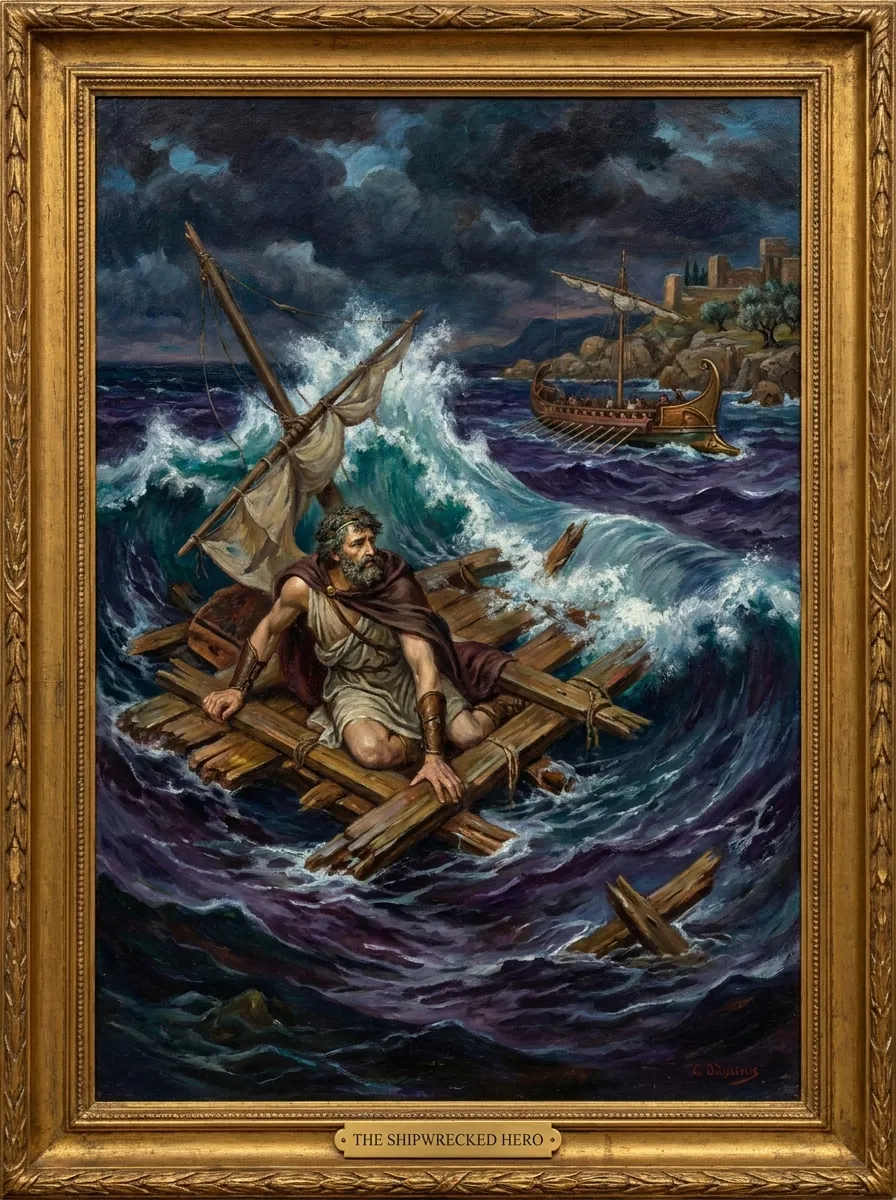
As he spoke, a sea broke over him with such terrific fury that the raft reeled, and he was carried overboard a long way off. He let go of the helm, and the force of the hurricane was so great that it broke the mast halfway up, and both sail and yard went into the sea. For a long time Odysseus was underwater, and it was all he could do to rise to the surface again, for the clothes Calypso had given him weighed him down. But at last he got his head above water and spat out the bitter brine that was running down his face. In spite of all this, however, he did not lose sight of his raft. He swam as fast as he could toward it, got hold of it, and climbed on board again to escape drowning. The sea took the raft and tossed it about as autumn winds whirl thistledown around on a road. It was as though the South, North, East, and West winds were all playing battledore and shuttlecock with it at once.
When he was in this plight, Ino, daughter of Cadmus, also called Leucothea, saw him. She had formerly been a mortal, but had since been raised to the rank of a marine goddess. Seeing Odysseus in such great distress, she had compassion on him, and, rising like a sea-gull from the waves, took her seat upon the raft.
“My poor man, why is Poseidon so furiously angry with you? He’s giving you a great deal of trouble, but for all his bluster he won’t kill you. You seem to be a sensible person, so do as I bid you. Strip, leave your raft to drive before the wind, and swim to the Phaeacian coast where better luck awaits you. And here, take my veil and put it around your chest; it’s enchanted, and you can come to no harm as long as you wear it. As soon as you touch land, take it off, throw it back as far as you can into the sea, and then go away again.”
With these words she took off her veil and gave it to him. Then she dove down again like a sea-gull and vanished beneath the dark blue waters.
“Alas, this is only some god or other who is luring me to ruin by advising me to quit my raft. At any rate, I won’t do so now, for the land where she said I would be quit of all troubles seems to be still a good way off. I know what I’ll do—I’m sure it will be best—no matter what happens, I will stick to the raft as long as her timbers hold together, but when the sea breaks her up I will swim for it. I don’t see how I can do any better than this.”
While he was trying to decide, Poseidon sent a terrible wave that seemed to rear up over his head until it broke right over the raft. The raft went to pieces as though it were dry chaff tossed by a whirlwind. Odysseus climbed onto one plank and rode it like a horse. Then he took off the clothes Calypso had given him, bound Ino’s veil under his arms, and plunged into the sea, intending to swim ashore. King Poseidon watched him, wagged his head, and muttered,
“There now, swim up and down as best you can until you run into some well-to-do people. I don’t think you’ll be able to say I let you off too lightly.”
With that, he lashed his horses and drove to Aegae, where his palace is.
But Athena decided to help Odysseus. She bound all the winds except one and made them lie still. She roused a stiff breeze from the North to calm the waters until Odysseus reached the land of the Phaeacians, where he would be safe.
He floated for two nights and two days in the water, with a heavy swell on the sea and death staring him in the face. But when the third day dawned, the wind fell, and there was a dead calm, without even a breath of air. As he rose on a swell, he looked ahead eagerly and could see land quite near. As children rejoice when their dear father begins to recover after a long illness inflicted by some angry spirit, but the gods deliver him from evil, so Odysseus was thankful when he saw land and trees again. He swam on with all his strength, hoping to set foot on dry ground once more. But when he got within earshot, he began to hear the surf thundering against the rocks. The swell still broke against them with a terrific roar. Everything was enveloped in spray. There were no harbors where a ship could anchor, no shelter of any kind, only headlands, low-lying rocks, and mountain tops.
“Zeus has let me see land after I swam so far that I’d given up hope, but I can find no landing place. The coast is rocky and surf-beaten. The rocks are smooth and rise sheer from the sea, with deep water close under them, so I can’t climb out for lack of a foothold. I’m afraid some great wave will lift me off my feet and dash me against the rocks as I leave the water—which would be a sorry landing. If, on the other hand, I swim further in search of some shelving beach or harbor, a hurricane may carry me out to sea again against my will, or heaven may send some great monster of the deep to attack me. Amphitrite breeds many such, and I know that Poseidon is very angry with me.”
While he was trying to decide, a wave caught him and slammed him against the rocks with such force that he would have been smashed to pieces if Athena hadn’t shown him what to do. He grabbed the rock with both hands and clung to it, groaning with pain, until the wave receded. He was saved that time, but presently the wave came again and carried him back far into the sea, tearing his hands as the suckers of a polyp tear when someone plucks it from its bed, and the stones come up along with it. The rocks tore the skin from his strong hands, and then the wave drew him deep down under the water.
Here poor Odysseus would certainly have perished, even in spite of his destiny, if Athena hadn’t helped him keep his wits about him. He swam seaward again, beyond the surf beating against the land, while looking toward the shore to see if he could find some haven or a spit that would take the waves at an angle. Eventually, as he swam on, he came to the mouth of a river, and he thought this would be the best place, for there were no rocks, and it offered shelter from the wind. He felt a current, so he prayed inwardly and said:
“Hear me, O King, whoever you may be, and save me from the anger of the sea-god Poseidon, for I approach you prayerfully. Anyone who has lost his way always has a claim even upon the gods. Therefore, in my distress, I draw near to your stream and cling to the knees of your riverhood. Have mercy on me, O king, for I declare myself your suppliant.”
Then the god stopped his stream and stilled the waves, making all calm before him and bringing Odysseus safely into the mouth of the river. Here at last Odysseus’ knees and strong hands failed him, for the sea had completely broken him. His body was swollen, and seawater ran from his mouth and nostrils like a river, so he could neither breathe nor speak. He lay swooning from exhaustion. Presently, when he caught his breath and came to himself again, he took off the scarf that Ino had given him and threw it back into the salt stream of the river. Ino received it into her hands from the wave that bore it toward her. Then he left the river, laid himself down among the rushes, and kissed the bounteous earth.
“What will become of me, and how is this all to end? If I stay here on the riverbed through the long night, I’m so exhausted that the bitter cold and damp may finish me off—for toward sunrise there will be a keen wind blowing from off the river. If, on the other hand, I climb the hillside, find shelter in the woods, and sleep in some thicket, I may escape the cold and have a good night’s rest, but some savage beast may take advantage of me and devour me.”
In the end, he thought it best to head for the woods. He found some on high ground not far from the water. There he crept beneath two shoots of olive that grew from a single trunk—one an ungrafted sucker, the other grafted. No wind, however strong, could break through their cover, nor could the sun’s rays pierce them, nor the rain get through, so closely did they grow together. Odysseus crept under these and began to make himself a bed to lie on, for there was a great litter of dead leaves lying about—enough to cover two or three men even in hard winter weather. He was glad to see this, so he laid himself down and heaped the leaves all around him. Then, like someone who lives alone in the country, far from any neighbor, hides a brand as fire-seed in the ashes to save himself from having to get a light elsewhere, Odysseus covered himself up with leaves. Athena shed a sweet sleep upon his eyes, closed his eyelids, and made him lose all memories of his sorrows.
Translation: Samuel Butler (1900) · Public domain · SPDX: PD-1900-Butler