So Odysseus slept, lost in sleep and exhaustion. Athena, meanwhile, went to the land and city of the Phaeacians — a people who used to live in the town of Hypereia, near the lawless Cyclopes. The Cyclopes were stronger and plundered them, so their king Nausithous moved them to Scheria, far from other people. He walled the city, built houses and temples, and divided the land. Now he was dead, gone to the house of Hades. King Alcinous, divinely inspired, was reigning. Athena went to his house to further Odysseus's return.
She went to the beautifully decorated bedroom where Nausicaa, King Alcinous’s daughter, slept. She was as lovely as a goddess. Two pretty maidservants were sleeping near her, one on each side of the doorway, which was closed with well-made folding doors. Athena took the form of Dymas’s daughter, a famous sea captain and Nausicaa’s close friend, just her age. Like a breath of wind, she hovered over the girl’s head and said:
“Nausicaa, what’s your mother thinking, to have such a lazy daughter? Your clothes are a mess, and you’re getting married soon. You should be well-dressed and find good clothes for your attendants. That’s how you get a good name and make your parents proud. Let’s make tomorrow a washing day and start at daybreak. I’ll help you get everything ready quickly. All the best young men are courting you, and you won’t be a maid much longer. Ask your father to have a wagon and mules ready for us at daybreak to take the rugs, robes, and girdles. You can ride, too, which will be nicer than walking, since the washing cisterns are some way from town.”
Having said this, Athena went to Olympus, the gods’ everlasting home. No wind beats roughly there, and neither rain nor snow falls. It abides in everlasting sunshine and peaceful light, where the blessed gods are illumined forever. This was where the goddess went after instructing the girl.
Morning came and woke Nausicaa, who wondered about her dream. She went to her parents' room to tell them about it. Her mother was by the fireside, spinning purple yarn with her maids. Nausicaa caught her father as he was going out to a meeting of the town council, which the Phaeacian aldermen had convened. She stopped him and said:
“Papa, could I have a big wagon? I want to take all our dirty clothes to the river and wash them. You’re the chief man here, so you should have a clean shirt when you attend council meetings. Plus, you have five sons at home, two married and three good-looking bachelors. They like clean linen when they go to a dance, and I’ve been thinking about all this.”
She didn’t mention her own wedding, but her father knew and said:
“You can have the mules, my love, and anything else you want. Go on, and the men will get you a strong wagon with a body that will hold all your clothes.”
He ordered the servants, who got the wagon out, harnessed the mules, and hitched them up. The girl brought the clothes from the linen room and put them on the wagon. Her mother prepared a basket of provisions and a goatskin full of wine. The girl got into the wagon, and her mother gave her a golden cruse of oil for her and her women to anoint themselves. Then she took the whip and reins and lashed the mules on. They set off, their hooves clattering on the road. They pulled steadily, carrying Nausicaa, her wash, and her maids.
When they reached the water, they went to the washing cisterns, where pure water always ran, enough to wash any amount of linen. They unharnessed the mules and turned them out to feed on the sweet grass by the water. They took the clothes out of the wagon, put them in the water, and competed to tread them in the pits to get the dirt out. After washing them clean, they laid them out by the sea, where the waves had raised a high shingle beach. They washed and anointed themselves with olive oil, then ate dinner by the stream, waiting for the sun to dry the clothes. After dinner, they threw off their veils and began to play ball, while Nausicaa sang. Like Artemis the huntress on the mountains of Taygetus or Erymanthus, hunting wild boars or deer, with the wood nymphs, daughters of Zeus, taking their sport with her (Leto is proud to see her daughter a full head taller than the others, eclipsing the loveliest amid a bevy of beauties), so the girl outshone her handmaids.
When it was time to start home, as they were folding the clothes and putting them into the wagon, Athena considered how Odysseus should wake up and see the handsome girl who was to lead him to the city of the Phaeacians. The girl threw a ball at one of the maids, missed, and it fell into deep water. They all shouted, and the noise woke Odysseus, who sat up in his bed of leaves and wondered what was happening.
“What kind of people have I come to? Are they cruel, savage, and uncivilized, or hospitable and humane? I hear young women's voices, like nymphs haunting mountaintops, springs, rivers, and green meadows. At least I’m among men and women. Let me see if I can get a look at them.”
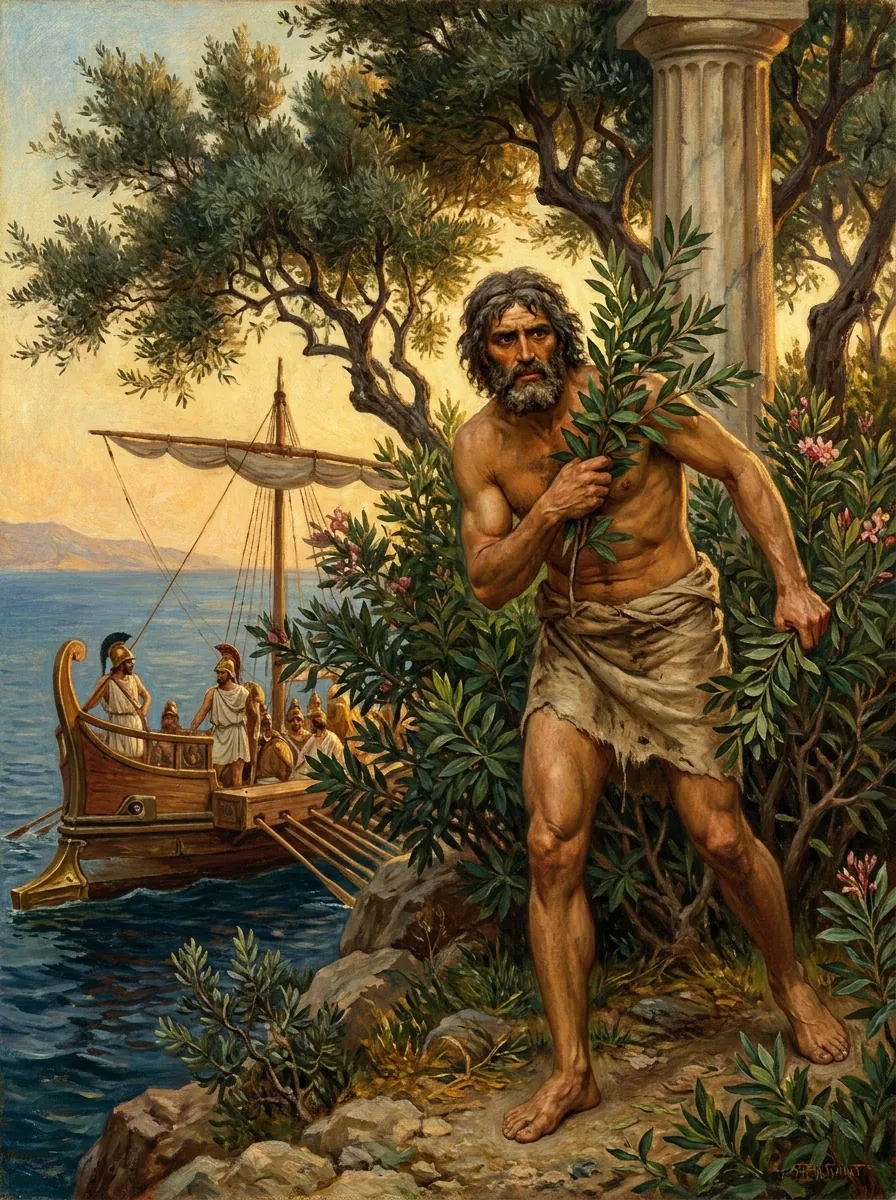
He crept from under his bush and broke off a leafy bough to hide his nakedness. He looked like a wilderness lion, stalking about, exulting in his strength, defying wind and rain. His eyes glare as he prowls for oxen, sheep, or deer, for he is famished and will dare break into a well-fenced homestead to get at the sheep. Odysseus seemed like that to the young women as he drew near, naked and in great need. Seeing someone so unkempt and begrimed with salt water, the others scampered off along the spits jutting into the sea, but Alcinous’s daughter stood firm, for Athena gave her courage and took away all fear. She stood in front of Odysseus, and he wondered if he should go to her, throw himself at her feet, and embrace her knees as a suppliant, or stay where he was and ask her for clothes and directions to the town. He decided to entreat her from a distance, in case she took offense at his getting close enough to clasp her knees, so he addressed her persuasively:
“O queen, I beg your aid. Tell me, are you a goddess or a mortal woman? If you’re a goddess in heaven, I guess you’re Artemis, Zeus’s daughter, because your face and figure resemble hers. If you’re a mortal on earth, happy are your parents, happy your siblings. How proud and delighted they must be to see such a fair scion going out to a dance. Most happy will be the man whose wedding gifts have been richest, who takes you home. I’ve never seen anyone so beautiful, man or woman. I’m lost in admiration. I can only compare you to a young palm tree I saw at Delos near Apollo’s altar. I was there with many people, on the journey that caused all my troubles. Never did such a young plant shoot out of the ground. I admired it as I now admire you. I dare not clasp your knees, but I’m in distress. Yesterday was the twentieth day I’ve been tossing on the sea. The winds and waves have taken me from the island of Ogygia, and now fate has flung me on this coast to endure more suffering. I don’t think I’ve come to the end of it; heaven has more evil in store.
“Now, O queen, pity me. You’re the first person I’ve met, and I know no one else here. Show me the way to your town, and give me something you brought to wrap your clothes in. May heaven grant you your heart’s desire: a husband, a house, a happy, peaceful home. Nothing is better than a husband and wife of one mind in a house. It discomfits their enemies, gladdens their friends, and they know more about it than anyone.”
“Stranger, you seem sensible and well-disposed. Luck is unpredictable. Zeus gives prosperity to rich and poor as he chooses, so take what he’s sent you and make the best of it. Now that you’ve come to our country, you’ll have clothes and anything else a distressed foreigner might reasonably want. I’ll show you the way to town and tell you our people’s name. We’re called Phaeacians, and I’m Alcinous’s daughter. He holds all the power here.”
Then she called her maids and said:
“Stay where you are, girls. Can’t you see a man without running away? Do you think he’s a robber or a murderer? Neither he nor anyone else can harm us Phaeacians here. We are dear to the gods and live apart on a land’s end jutting into the sounding sea, with nothing to do with other people. This is just some poor man who has lost his way, and we must be kind to him, for strangers and foreigners in distress are under Zeus’s protection and will take what they can get and be thankful. So, girls, give the poor fellow something to eat and drink, and wash him in the stream at some place sheltered from the wind.”
At this, the maids stopped running and began calling each other back. They had Odysseus sit down in the shelter, as Nausicaa had told them, and brought him a shirt and cloak. They also brought him the little golden cruse of oil and told him to go wash in the stream. But Odysseus said:
“Young women, please stand a little to one side so I can wash the salt from my shoulders and anoint myself with oil. It’s been long enough since my skin has had a drop of oil on it. I can’t wash while you all stand there. I’m ashamed to strip before a number of good-looking young women.”
Then they stood to one side and went to tell Nausicaa, while Odysseus washed himself in the stream and scrubbed the salt from his back and broad shoulders. When he had thoroughly washed and gotten the salt out of his hair, he anointed himself with oil and put on the clothes Nausicaa had given him. Athena then made him look taller and stronger than before. She also made the hair grow thick on the top of his head and flow down in curls like hyacinth blossoms. She glorified him about the head and shoulders as a skilled craftsman who has studied art of all kinds under Hephaestus and Athena enriches a piece of silver plate by gilding it—and his work is full of beauty. Then he went and sat down a little way off upon the beach, looking quite young and handsome, and Nausicaa gazed at him with admiration. Then she said to her maids:
“Hush, my dears, I want to say something. I believe the gods who live in heaven have sent this man to the Phaeacians. When I first saw him, I thought him plain, but now he looks like the gods who dwell in heaven. I’d like my future husband to be just like him, if he would only stay here and not want to go away. However, give him something to eat and drink.”
They did as they were told and set food before Odysseus, who ate and drank ravenously, for it had been long since he’d had food of any kind. Meanwhile, Nausicaa considered another matter. She got the linen folded and placed in the wagon. Then she yoked the mules, and as she took her seat, she called to Odysseus:
“Stranger, rise and let’s go back to town. I’ll introduce you at my excellent father’s house, where you’ll meet all the best people among the Phaeacians. But be sure to do as I tell you, for you seem sensible. As long as we’re going past the fields and farmlands, follow briskly behind the wagon along with the maids, and I’ll lead the way myself. Presently, though, we’ll come to the town, where you’ll find a high wall running all around it and a good harbor on either side with a narrow entrance into the city. The ships will be drawn up by the roadside, for everyone has a place where his own ship can lie. You’ll see the marketplace with a temple of Poseidon in the middle, paved with large stones set in the earth. Here people deal in ship’s gear of all kinds, like cables and sails. Here, too, are the places where oars are made, for the Phaeacians aren’t a nation of archers. They know nothing about bows and arrows but are a seafaring folk and pride themselves on their masts, oars, and ships, with which they travel far over the sea.
“I’m afraid of the gossip and scandal that may be set on foot against me later on, for the people here are very ill-natured, and some low fellow, if he met us, might say, ‘Who is this fine-looking stranger going about with Nausicaa? Where did she find him? I suppose she’s going to marry him. Maybe he’s a vagabond sailor she’s taken from some foreign vessel, for we have no neighbors; or some god has at last come down from heaven in answer to her prayers, and she’s going to live with him all her life. It would be a good thing if she’d take herself off and find a husband somewhere else, for she won’t look at one of the many excellent young Phaeacians who are in love with her.’ That’s the kind of disparaging remark that would be made about me, and I couldn’t complain, for I’d be scandalized myself at seeing any other girl do the like and go about with men in spite of everybody, while her father and mother were still alive, and without having been married in the face of all the world.
“So, if you want my father to give you an escort and help you home, do as I tell you. You’ll see a beautiful grove of poplars by the roadside dedicated to Athena. It has a well in it and a meadow all around it. Here my father has a field of rich garden ground, about as far from the town as a man’s voice will carry. Sit down there and wait for a while till the rest of us can get into town and reach my father’s house. Then, when you think we must have done this, come into town and ask the way to the house of my father Alcinous. You’ll have no difficulty finding it; any child will point it out to you, for no one else in the whole town has such a fine house. When you’ve gotten past the gates and through the outer court, go right across the inner court till you come to my mother. You’ll find her sitting by the fire and spinning her purple wool by firelight. It’s a fine sight to see her leaning back against one of the bearing-posts with her maids all ranged behind her. Close to her seat stands my father’s, on which he sits and drinks like an immortal god. Never mind him, but go up to my mother and lay your hands on her knees if you want to get home quickly. If you can win her over, you may hope to see your own country again, no matter how distant it may be.”
With that, she lashed the mules with her whip, and they left the river. The mules pulled well, and their hooves went up and down on the road. She was careful not to go too fast for Odysseus and the maids, who were following on foot along with the wagon, so she plied her whip with judgment. As the sun was going down, they came to the sacred grove of Athena, and there Odysseus sat down and prayed to the mighty daughter of Zeus.
“Hear me, daughter of Aegis-bearing Zeus, untiring one, hear me now, for you paid no heed to my prayers when Poseidon was wrecking me. Now, therefore, have pity on me and grant that I may find friends and be hospitably received by the Phaeacians.”
So he prayed, and Athena heard his prayer, but she would not show herself to him openly, for she was afraid of her uncle Poseidon, who was still furious in his efforts to prevent Odysseus from getting home.
Translation: Samuel Butler (1900) · Public domain · SPDX: PD-1900-Butler