So Odysseus waited and prayed, while the girl drove on to town. When she reached her father’s house, she pulled up at the gate. Her brothers—handsome as gods—gathered around, took the mules from the wagon, and carried the clothes inside. She went to her room, where an old servant, Eurymedusa from Apeira, lit the fire for her. This old woman had been brought by sea from Apeira and given to Alcinous as a prize, because he was king over the Phaeacians, and the people obeyed him as if he were a god. She had been Nausicaa’s nurse, and now she lit the fire and brought supper to her room.
Odysseus got up to go to town, and Athena shrouded him in a thick mist to hide him, in case any of the proud Phaeacians who met him were rude or asked who he was. As he entered the town, she came to him as a little girl carrying a pitcher. She stood in front of him, and Odysseus said:
“My dear, would you show me the house of King Alcinous? I'm a distressed foreigner and don't know anyone in your town and country.”
“Yes, father stranger, I'll show you the house you want. Alcinous lives near my father. I'll go ahead and show you the way, but don't say a word as you go. Don't look at anyone or ask questions. The people here can't abide strangers and don't like men from other places. They're seafarers and sail the seas by the grace of Poseidon in ships that glide like thought or like a bird in the air.”
She led the way, and Odysseus followed. None of the Phaeacians saw him as he passed through the city. Athena, in her goodwill, had hidden him in a thick cloud of darkness. He admired their harbors, ships, meeting places, and the city's high walls, which, with the palisade on top, were striking. When they reached the king’s house, Athena said:
“This is the house, father stranger, that you wanted me to show you. You'll find many important people at table, but don't be afraid. Go straight in. The bolder a man is, the more likely he is to get what he wants, even if he's a stranger. First, find the queen. Her name is Arete, and she's from the same family as her husband, Alcinous. They both descend from Poseidon, who fathered Nausithous with Periboea, a beautiful woman. Periboea was the youngest daughter of Eurymedon, who once ruled the giants, but he ruined his people and lost his own life.
“Poseidon slept with his daughter, and she had a son, the great Nausithous, who ruled the Phaeacians. Nausithous had two sons, Rhexenor and Alcinous. Apollo killed Rhexenor while he was a bridegroom and without male issue, but he left a daughter, Arete, whom Alcinous married. He honors her more than any other woman who keeps house with her husband.
“She is respected by her children, by Alcinous, and by the whole people, who see her as a goddess and greet her when she goes about the city. She's a good woman in head and heart, and when women are her friends, she helps their husbands settle disputes. If you gain her goodwill, you can hope to see your friends again and get safely back home.”
Then Athena left Scheria and went over the sea to Marathon and the spacious streets of Athens, where she entered the abode of Erechtheus. Odysseus went to Alcinous's house and paused before the bronze threshold, pondering. The palace's splendor was like the sun or moon. The walls were bronze from end to end, and the cornice was blue enamel. The doors were gold, hung on silver pillars rising from a bronze floor. The lintel was silver, and the door's hook was gold.
On either side stood gold and silver mastiffs that Hephaestus, with his skill, had fashioned to watch over King Alcinous's palace. They were immortal and could never age. Seats lined the wall, with fine woven coverings made by the women of the house. The Phaeacian chiefs sat there to eat and drink, with abundance at all times. Golden figures of young men with lighted torches stood on pedestals, giving light at night to those at the table. Fifty maidservants worked in the house. Some ground rich yellow grain at the mill, while others worked at the loom or spun. Their shuttles moved like fluttering aspen leaves, and the linen was so closely woven that it would turn oil. The Phaeacians are the best sailors, and their women excel in weaving, for Athena has taught them all kinds of useful arts, and they are very intelligent.
Outside the gate of the outer court was a large garden of about four acres, walled all around. It was full of beautiful trees—pears, pomegranates, and delicious apples. There were luscious figs and olives in full growth. The fruits never rotted or failed, neither winter nor summer, for the air was so soft that a new crop ripened before the old one dropped. Pear grew on pear, apple on apple, fig on fig, and so with the grapes, for there was an excellent vineyard. On the level ground, grapes were being made into raisins; in another part, they were being gathered; some were being trodden in the wine tubs; others had shed their blossom and were beginning to show fruit; others were just changing color. In the furthest part of the ground were beautifully arranged beds of flowers that bloomed all year. Two streams ran through it, one turned into ducts throughout the garden, while the other was carried underground to the house and the townspeople drew water from it. Such were the splendors with which the gods had endowed King Alcinous's house.
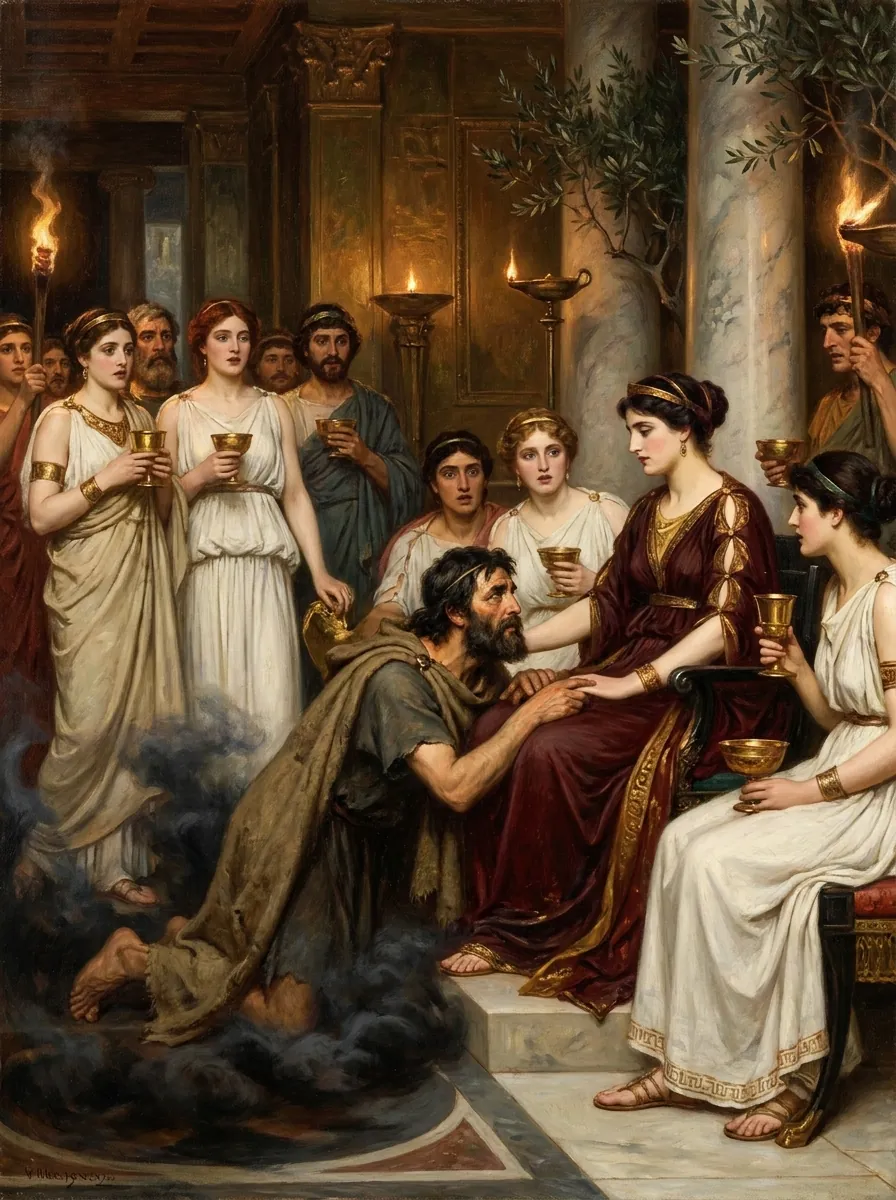
Odysseus stood there for a while, looking around. Then he crossed the threshold and went inside. He found the Phaeacian chiefs making drink offerings to Hermes, which they always did before going to bed. He went through the court, still hidden by the cloak of darkness Athena had put on him, until he reached Arete and King Alcinous. He laid his hands on the queen's knees, and the darkness fell away, making him visible. Everyone was speechless at seeing a man there, but Odysseus began his petition at once.
“Queen Arete, daughter of great Rhexenor, in my distress I beg you, your husband, and these guests—may heaven prosper them with long life and happiness, and may they leave their possessions and honors to their children—to help me home as soon as possible, for I have been in trouble and away from my friends for a long time.”
Then he sat on the hearth among the ashes, and they all held their peace. The old hero Echeneus, an excellent speaker and an elder among the Phaeacians, addressed them plainly and honestly:
“Alcinous, it's not right for a stranger to sit among the ashes of your hearth. Everyone is waiting to hear what you'll say. Tell him to rise and take a seat on a stool inlaid with silver, and tell your servants to mix wine and water so we can make a drink offering to Zeus, who protects all well-disposed suppliants. Let the housekeeper give him supper, whatever there is in the house.”
When Alcinous heard this, he took Odysseus by the hand, raised him from the hearth, and told him to take the seat of Laodamas, his favorite son. A maidservant brought water in a golden ewer and poured it into a silver basin for him to wash his hands. She drew a clean table beside him. An upper servant brought him bread and offered him many good things from the house, and Odysseus ate and drank. Then Alcinous said to one of the servants:
“Pontonous, mix a cup of wine and hand it around so we can make drink offerings to Zeus, who protects all well-disposed suppliants.”
Pontonous mixed wine and water and handed it around after giving everyone his drink offering. When they had made their offerings and drunk as much as they wanted, Alcinous said:
“Councilmen and town leaders of the Phaeacians, listen to me. You've had supper, so go home to bed. Tomorrow morning, I'll invite an even larger group of councilmen and host a sacrificial banquet for our guest. Then we can discuss his escort and figure out how to send him back to his own country, rejoicing, without any trouble or inconvenience to him, no matter how far away it is. We must ensure he comes to no harm on his journey home. Once he's home, he'll have to accept the luck he was born with, for better or worse, like everyone else. It's possible, though, that the stranger is one of the immortals who has come down from heaven to visit us. But if so, the gods are changing their usual behavior, because they've always made themselves perfectly clear to us when we've been offering them hecatombs. They come and sit at our feasts just like one of us, and if a solitary traveler happens to stumble upon one of them, they don't try to hide, because we're as closely related to the gods as the Cyclopes and the savage giants are.”
“Please, Alcinous, don't get any such idea in your head. I have nothing immortal about me, either in body or mind. I'm mostly like the most afflicted among you. In fact, if I told you everything that heaven has seen fit to lay on me, you'd say I was even worse off than they are. Still, let me eat despite my sorrow, because an empty stomach is very insistent. It forces itself on a man's attention, no matter how dire his distress. I'm in great trouble, yet it insists that I eat and drink, tells me to set aside all memory of my sorrows and focus only on filling it up. As for you, do as you plan, and at daybreak start helping me get home. I'll be content to die if I can first see my property, my servants, and all the greatness of my house again.”
That's what he said. Everyone approved, agreeing that he should have his escort since he had spoken reasonably. After they poured out their drink offerings and each drank as much as they wanted, they went home to bed, each to his own place, leaving Odysseus in the cloister with Arete and Alcinous while the servants cleared away the supper things. Arete spoke first, recognizing the shirt, cloak, and fine clothes Odysseus was wearing as her own work and that of her maids. So she said:
“Stranger, before we go any further, I'd like to ask you a question. Who are you, where are you from, and who gave you those clothes? Didn't you say you came here from beyond the sea?”
“It would be a long story, Madam, if I were to tell you the full tale of my misfortunes, because heaven has weighed heavily on me. But as for your question, there's an island far away in the sea called Ogygia. The cunning and powerful goddess Calypso, daughter of Atlas, lives there by herself, far from any neighbors, human or divine. Fortune brought me to her hearth, desolate and alone, because Zeus struck my ship with his thunderbolts and broke it up in mid-ocean. My brave comrades all drowned, but I clung to the keel and was carried here and there for nine days. Finally, during the darkness of the tenth night, the gods brought me to Ogygia, where the great goddess Calypso lives. She took me in and treated me with the utmost kindness. She even wanted to make me immortal so I would never grow old, but she couldn't persuade me to let her do it.
“I stayed with Calypso for seven years straight, watering the good clothes she gave me with my tears the whole time. But when the eighth year came around, she told me to leave of her own free will, either because Zeus had told her she had to, or because she had changed her mind. She sent me from her island on a raft, which she stocked with plenty of bread and wine. She also gave me good, sturdy clothing and sent a wind that blew both warm and fair. For seventeen days I sailed over the sea, and on the eighteenth I caught sight of the first outlines of the mountains on your coast—and I was very glad to see them. Nevertheless, there was still much trouble in store for me, because at that point Poseidon wouldn't let me go any further and raised a great storm against me. The sea was so terribly high that I could no longer stay on my raft, which broke apart under the fury of the gale, and I had to swim for it until wind and current brought me to your shores.
“There I tried to land, but I couldn't, because it was a bad place and the waves dashed me against the rocks. So I went back to the sea and swam on until I came to a river that seemed like the most likely landing place, because there were no rocks and it was sheltered from the wind. There, I got out of the water and gathered my senses again. Night was coming on, so I left the river and went into a thicket, where I covered myself all over with leaves. Soon heaven sent me into a very deep sleep. Sick and sorry as I was, I slept among the leaves all night and through the next day until afternoon, when I woke as the sun was setting and saw your daughter’s maidservants playing on the beach, and your daughter among them, looking like a goddess. I begged for her help, and she turned out to be of an excellent disposition, much more so than you'd expect from someone so young—because young people are often thoughtless. She gave me plenty of bread and wine, and after having me washed in the river, she also gave me the clothes you see me wearing. Now, even though it has pained me to do so, I've told you the whole truth.”
“Stranger, my daughter was wrong not to bring you to my house at once along with the maids, since she was the first person you asked for help.”
“Please don't scold her; she's not to blame. She did tell me to follow along with the maids, but I was ashamed and afraid, because I thought you might be displeased if you saw me. Everyone is sometimes a little suspicious and irritable.”
“Stranger, I'm not the kind of man to get angry about nothing; it's always better to be reasonable. But by Zeus, Athena, and Apollo, now that I see what kind of person you are, and how much you think like me, I wish you would stay here, marry my daughter, and become my son-in-law. If you stay, I'll give you a house and an estate. But no one—heaven forbid—will keep you here against your will. To assure you of this, I'll take care of your escort tomorrow. You can sleep during the whole voyage if you like, and the men will sail you over smooth waters either to your own home, or wherever you want, even if it's farther away than Euboea. My people who saw it when they took yellow-haired Rhadamanthus to see Tityus, son of Gaia, tell me it's the farthest place of all—and yet they made the whole voyage in a single day without any trouble, and came back again afterward. You'll see how much my ships excel all others, and what magnificent oarsmen my sailors are.”
“Zeus, grant that Alcinous may do everything as he has said. That way, he'll win an imperishable name among mankind, and I'll return to my country.”
That's how they talked. Then Arete told her maids to set up a bed in the room in the gatehouse, make it with good red rugs, and spread coverlets on top of them with woolen cloaks for Odysseus to wear. The maids went out with torches and, after making the bed, came to Odysseus and said:
“Rise, sir stranger, and come with us; your bed is ready.”
He was very glad to go to his rest.
So Odysseus slept in a bed in a room over the echoing gateway, while Alcinous lay in the inner part of the house with the queen, his wife, by his side.
Translation: Samuel Butler (1900) · Public domain · SPDX: PD-1900-Butler