When dawn came, Alcinous and Odysseus got up, and Alcinous led the way to the Phaeacian assembly place near the ships. They sat down side by side on a seat of polished stone, while Athena, disguised as one of Alcinous’ servants, went around town to help Odysseus get home. She went up to the citizens, one by one, and said,
“Aldermen and town councilors of the Phaeacians, come to the assembly and listen to the stranger who has just arrived after a long voyage at the house of King Alcinous; he looks like an immortal god.”
With these words, she made them all want to come, and they flocked to the assembly until seats and standing room were crowded. Everyone was struck by Odysseus's appearance, for Athena had beautified him about the head and shoulders, making him look taller and stouter than he really was, so he might favorably impress the Phaeacians as a remarkable man, and might come off well in the many trials of skill to which they would challenge him. Then, when they had gathered, Alcinous spoke:
“Hear me, aldermen and town councilors of the Phaeacians, so I can speak my mind. This stranger, whoever he may be, has found his way to my house from somewhere or other, either east or west. He wants an escort and wishes to have the matter settled. Let's get one ready for him, as we have for others before; no one who has ever come to my house has been able to complain about me not speeding him on his way soon enough. Let's draw a ship into the sea—one that has never yet made a voyage—and man her with fifty-two of our smartest young sailors. Then, when you have secured your oars each by his own seat, leave the ship and come to my house to prepare a feast. I will provide everything. I'm giving these instructions to the young men who will form the crew, for you aldermen and town councilors will join me in entertaining our guest in the cloisters. I can take no excuses, and we will have Demodocus sing for us; there is no bard like him, whatever he may choose to sing about.”
Alcinous led the way, and the others followed, while a servant went to fetch Demodocus. The fifty-two picked oarsmen went to the seashore as they had been told. When they got there, they drew the ship into the water, got her mast and sails inside, bound the oars to the thole-pins with twisted thongs of leather, all in due course, and spread the white sails aloft. They moored the vessel a little way out from land, then came ashore and went to the house of King Alcinous. The outhouses, yards, and all the precincts were filled with crowds of men, old and young, in great multitudes. Alcinous killed a dozen sheep, eight full-grown pigs, and two oxen. These they skinned and dressed to provide a magnificent banquet.
A servant led in the famous bard Demodocus, whom the Muse had dearly loved, but to whom she had given both good and evil; though she had endowed him with a divine gift of song, she had robbed him of his eyesight. Pontonous set a seat for him among the guests, leaning it against a bearing-post. He hung the lyre for him on a peg over his head, and showed him where he was to feel for it. He also set a fair table with a basket of victuals by his side, and a cup of wine from which he might drink whenever he wanted.
The company then laid their hands upon the good things before them, but as soon as they had had enough to eat and drink, the Muse inspired Demodocus to sing the feats of heroes, especially the quarrel between Odysseus and Achilles, and the fierce words they exchanged as they sat together at a banquet. Agamemnon was glad when he heard his chieftains quarreling, for Apollo had foretold this to him at Pytho when he crossed the stone floor to consult the oracle. Here was the beginning of the evil that, by the will of Zeus, fell upon both Danaans and Trojans.
Thus sang the bard, but Odysseus drew his purple mantle over his head and covered his face, ashamed to let the Phaeacians see him weeping. When the bard stopped singing, he wiped the tears from his eyes, uncovered his face, and, taking his cup, made a drink-offering to the gods. But when the Phaeacians pressed Demodocus to sing further, for they delighted in his lays, Odysseus again drew his mantle over his head and wept bitterly. No one noticed his distress except Alcinous, who was sitting near him and heard his heavy sighs. So he said at once,
“Aldermen and town councilors of the Phaeacians, we have had enough now, both of the feast and of the minstrelsy that is its due accompaniment; let's proceed to the athletic sports, so that our guest, on his return home, may be able to tell his friends how much we surpass all other nations as boxers, wrestlers, jumpers, and runners.”
With these words, he led the way, and the others followed. A servant hung Demodocus’s lyre on its peg, led him out of the cloister, and set him on the same way as the chief men of the Phaeacians were going to see the sports. A crowd of several thousands of people followed them, and there were many excellent competitors for all the prizes: Acroneos, Ocyalus, Elatreus, Nauteus, Prymneus, Anchialus, Eretmeus, Ponteus, Proreus, Thoon, Anabesineus, and Amphialus son of Polyneus son of Tecton. There was also Euryalus son of Naubolus, who was like Ares himself, and was the best-looking man among the Phaeacians except Laodamas. Three sons of Alcinous, Laodamas, Halios, and Clytoneus, also competed.
The foot races came first. The course was set out for them from the starting post, and they raised a dust upon the plain as they all flew forward at the same moment. Clytoneus came in first by a long way; he left everyone else behind him by the length of the furrow that a couple of mules can plow in a fallow field. They then turned to the painful art of wrestling, and here Euryalus proved to be the best man. Amphialus excelled all the others in jumping, while at throwing the disc there was no one who could approach Elatreus. Alcinous’s son Laodamas was the best boxer, and he it was who said, when they had all been diverted by the games,
“Let's ask the stranger whether he excels in any of these sports; he seems very powerfully built; his thighs, calves, hands, and neck are of prodigious strength. He isn't old, but he has suffered much lately, and there is nothing like the sea for making havoc with a man, no matter how strong he is.”
“You are quite right, Laodamas. Go up to your guest and speak to him about it yourself.”
When Laodamas heard this, he made his way into the middle of the crowd and said to Odysseus,
“I hope, sir, that you will enter yourself for some one or other of our competitions if you are skilled in any of them—and you must have gone in for many before now. There is nothing that does anyone so much credit all his life long as showing himself a proper man with his hands and feet. Have a try at something, and banish all sorrow from your mind. Your return home will not be long delayed, for the ship is already drawn into the water, and the crew is found.”
“Laodamas, why do you taunt me this way? My mind is set on cares rather than contests. I have been through infinite trouble and have come among you now as a suppliant, begging your king and people to further my return home.”
“So, you're not skilled in any of the sports that men usually enjoy? I guess you're one of those greedy traders who captain ships or work as merchants, thinking only of cargo coming and going. You don't seem like much of an athlete.”
“For shame, sir, you're an insolent fellow. It's true the gods don't grace everyone equally with speech, looks, and understanding. One man might be weak in presence, but heaven has given him such a good way with words that he charms everyone who sees him. His honeyed moderation wins over his listeners, so he leads in every gathering and is looked up to wherever he goes. Another might be as handsome as a god, but his good looks aren't matched by good sense. That's you. No god could make a finer-looking fellow, but you're a fool. Your ill-judged remarks have made me extremely angry, and you're quite wrong. I excel in many athletic exercises. When I had youth and strength, I was among the best athletes of the age. Now, though, I'm worn out by labor and sorrow. I've been through much on the battlefield and on the waves of the weary sea. Still, despite all this, I'll compete, because your taunts have stung me.”
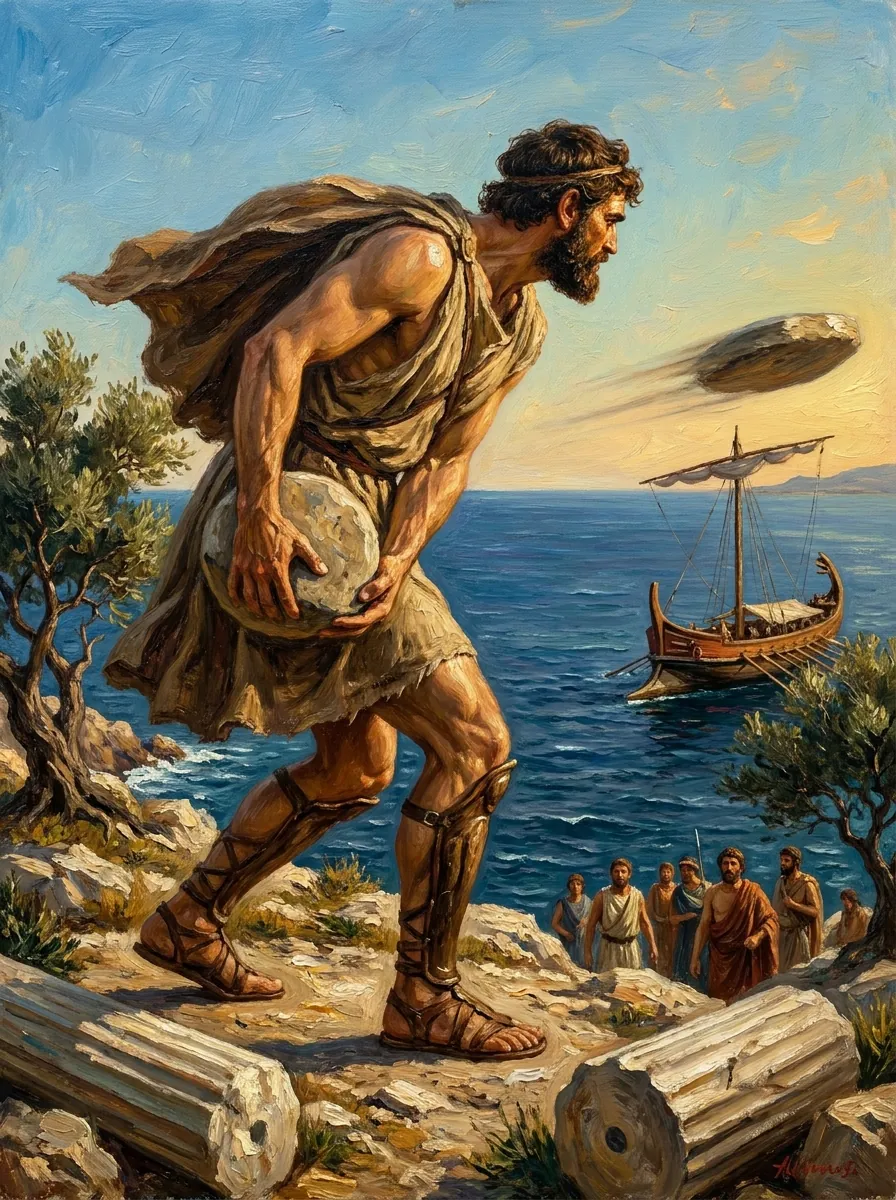
He hurried up without even taking off his cloak, and grabbed a disc—larger, more massive, and much heavier than the ones the Phaeacians used when throwing discs among themselves. Swinging it back, he threw it from his strong hand, and it hummed as it flew. The Phaeacians flinched at the rushing sound as it sped gracefully from his hand, flying beyond any mark made so far. Athena, disguised as a man, marked where it landed.
“A blind man could find your mark by groping—it's so far ahead of the others. You can relax about this contest; no Phaeacian can come close to a throw like that.”
“Young men, try to beat that throw if you can, and I'll throw another disc as heavy or heavier. If anyone wants to fight me, let him come on, because I'm extremely angry. I'll box, wrestle, or run—I don't care what it is—with any of you except Laodamas. I won't compete with him because I'm his guest, and it's not prudent or sensible for a guest to challenge his host's family at any game, especially in a foreign country. He'll undermine himself if he does. But I make no exception for anyone else, because I want to settle this and see who's the best man. I'm good at every kind of athletic sport known to humankind. I'm an excellent archer. In battle, I'm always the first to bring a man down with my arrow, no matter how many others are aiming at him. Philoctetes was the only man who could shoot better than me when we Achaeans were at Troy and in practice. I'm far better than anyone else in the world, of those who still eat bread on earth, but I wouldn't want to shoot against the mighty dead, like Heracles, or Eurytus the Oechalian—men who could shoot against the gods themselves. That's how Eurytus died young; Apollo was angry with him and killed him because he challenged him as an archer. I can throw a dart farther than anyone else can shoot an arrow. Running is the only thing where I'm afraid some of the Phaeacians might beat me, because I've been brought very low at sea. My provisions ran out, so I'm still weak.”
They all remained silent except King Alcinous, who began:
“Sir, we've enjoyed hearing what you've told us. I understand you're willing to show your prowess because you were displeased by some insolent remarks made by one of our athletes—remarks that no one with any sense of propriety would ever utter. I hope you understand, and will explain to any of your leading men dining with you and your family when you get home, that we have a natural talent for all kinds of accomplishments. We aren't particularly remarkable at boxing or wrestling, but we're singularly fleet of foot and excellent sailors. We're extremely fond of good dinners, music, and dancing. We also like frequent changes of linen, warm baths, and good beds. So, please, some of you who are the best dancers, start dancing, so our guest can tell his friends how much we surpass all other nations as sailors, runners, dancers, and minstrels. Demodocus has left his lyre at my house, so someone run and fetch it for him.”
A servant hurried off to bring the lyre from the king's house, and the nine men chosen as stewards stepped forward. It was their job to manage everything connected with the sports, so they smoothed the ground and marked a wide space for the dancers. Soon the servant returned with Demodocus's lyre, and he took his place in the middle of them. Then the best young dancers in town began to dance so nimbly that Odysseus was delighted by their merry footwork.
Meanwhile, the bard began to sing about the love affair between Ares and Aphrodite, and how it started in Hephaestus's house. Ares gave Aphrodite many gifts and defiled King Hephaestus's marriage bed, so the sun, who saw what they were doing, told Hephaestus. Hephaestus was furious when he heard this dreadful news, so he went to his smithy, plotting mischief. He put his great anvil in place and began to forge chains that no one could unloose or break, so they would stay there. When he had finished his snare, he went into his bedroom and draped the bedposts with chains like cobwebs. He also hung many down from the great beam of the ceiling. Not even a god could see them, they were so fine and subtle. As soon as he had spread the chains all over the bed, he pretended to set out for the fair state of Lemnos, which was his favorite place in the world. But Ares was watching, and as soon as he saw Hephaestus leave, he hurried to his house, burning with love for Aphrodite.
Now Aphrodite had just returned from visiting her father Zeus, and was about to sit down when Ares came into the house and took her hand in his.
“Let's go to Hephaestus's couch. He's not home; he's gone off to Lemnos among the Sintians, whose speech is barbaric.”
She was willing, so they went to the couch to rest. They were caught in the toils that cunning Hephaestus had spread for them, and couldn't get up or move. They realized too late that they were trapped. Then Hephaestus came up to them; he had turned back before reaching Lemnos, when the sun, his scout, told him what was happening. He was furious, and stood in the vestibule making a dreadful noise as he shouted to all the gods.
“Father Zeus, and all you other blessed gods who live forever, come here and see the ridiculous and disgraceful sight I'll show you. Zeus's daughter Aphrodite is always dishonoring me because I'm lame. She's in love with Ares, who is handsome and well-built, while I'm a cripple—but my parents are to blame for that, not me. They should never have begotten me. Come and see the pair asleep on my bed. It makes me furious to look at them. They're very fond of each other, but I don't think they'll lie there longer than they can help, or sleep much. They'll stay there until her father has repaid me the sum I gave him for his baggage of a daughter, who is fair but not honest.”
The gods gathered at Hephaestus's house. Earth-encircling Poseidon came, and Hermes, the bringer of luck, and King Apollo, but the goddesses all stayed home out of shame. The givers of all good things stood in the doorway, and the blessed gods roared with laughter when they saw how cunning Hephaestus had been. One would turn to his neighbor and say:
“Ill deeds don't prosper; the weak confound the strong. See how limping Hephaestus, lame as he is, has caught Ares, the fleetest god in heaven. Now Ares will have to pay heavy damages.”
That's what they said. Then King Apollo said to Hermes:
“Hermes, giver of good things, you wouldn’t care how strong the chains were, would you, if you could sleep with Aphrodite?”
“King Apollo, I only wish I might get the chance, even if there were three times as many chains—and you might look on, all of you, gods and goddesses, but I would sleep with her if I could.”
The immortal gods burst out laughing when they heard him, but Poseidon took it all seriously and kept begging Hephaestus to set Ares free again.
“Let him go, and I will promise, as you require, that he will pay you all the damages that are held reasonable among the immortal gods.”
“Do not ask me to do this; a bad man’s word is bad security. What remedy could I enforce against you if Ares should go away and leave his debts behind him along with his chains?”
“Hephaestus, if Ares goes away without paying his damages, I will pay you myself.”
“In this case I cannot and must not refuse you.”
Then he loosed the bonds that bound them, and as soon as they were free they scampered off, Ares to Thrace and laughter-loving Aphrodite to Cyprus and to Paphos, where is her grove and her altar fragrant with burnt offerings. Here the Graces bathed her and anointed her with oil of ambrosia such as the immortal gods use, and they clothed her in raiment of the most enchanting beauty.
Thus sang the bard, and both Odysseus and the seafaring Phaeacians were charmed as they heard him.
Then Alcinous told Laodamas and Halius to dance alone, for there was no one to compete with them. So they took a red ball which Polybus had made for them, and one of them bent himself backwards and threw it up towards the clouds, while the other jumped from off the ground and caught it with ease before it came down again. When they had thrown the ball straight up into the air, they began to dance, and at the same time kept throwing it backwards and forwards to one another, while all the young men in the ring applauded and made a great stamping with their feet. Then Odysseus said:
“King Alcinous, you said your people were the nimblest dancers in the world, and indeed they have proven themselves to be so. I was astonished as I watched them.”
“Aldermen and town councillors, our guest seems to be a person of singular judgment. Let us give him such proof of our hospitality as he may reasonably expect. There are twelve chief men among you, and counting myself there are thirteen. Each of you contribute a clean cloak, a shirt, and a talent of fine gold. Let us give him all this in a lump down at once, so that when he gets his supper he may do so with a light heart. As for Euryalus, he will have to make a formal apology and a present too, for he has been rude.”
Thus he spoke. The others all applauded his saying, and sent their servants to fetch the presents. Then Euryalus said:
“King Alcinous, I will give the stranger all the satisfaction you require. He will have my sword, which is of bronze, all but the hilt, which is of silver. I will also give him the scabbard of newly sawn ivory into which it fits. It will be worth a great deal to him.”
As he spoke, he placed the sword in the hands of Odysseus and said:
“Good luck to you, father stranger. If anything has been said amiss, may the winds blow it away with them, and may heaven grant you a safe return, for I understand you have been long away from home and have gone through much hardship.”
“Good luck to you, friend. May the gods grant you every happiness. I hope you won't miss the sword you gave me, along with your apology.”
With these words, he girded on the sword. As dusk approached, the gifts began to arrive, brought by the servants of the donors to King Alcinous's house. His sons received them and placed them under their mother's care. Then Alcinous led the way inside and told his guests to take their seats.
“Wife, go fetch our best chest and put a clean cloak and shirt in it. Also, set a copper pot on the fire and heat some water. Our guest will take a warm bath. See to the careful packing of the gifts the noble Phaeacians have given him, so he can better enjoy his supper and the singing that will follow. I'll give him this golden goblet—exquisitely made—so he'll remember me for the rest of his life whenever he makes a drink offering to Zeus or any of the gods.”
Then Arete told her maids to set a large tripod on the fire as fast as they could. They put a tripod full of bathwater over a clear fire, threw on sticks to make it blaze, and the water grew hot as the flame played around the tripod's belly. Meanwhile, Arete brought a magnificent chest from her own room and packed all the beautiful gifts of gold and clothing the Phaeacians had brought. Finally, she added a cloak and a good shirt from Alcinous and said to Odysseus:
“See to the lid yourself, and have the whole thing bound tight, in case anyone robs you on the way while you're asleep on your ship.”
When Odysseus heard this, he put the lid on the chest and secured it with a bond that Circe had taught him. He had just finished when an upper servant told him to come to the bath and wash himself. He was very glad for a warm bath, since he'd had no one to wait on him since he left Calypso's house. While he was with her, she had taken as good care of him as if he were a god. When the servants had finished washing him and anointing him with oil, and had given him a clean cloak and shirt, he left the bathroom and joined the guests sitting over their wine. Lovely Nausicaa stood by one of the bearing-posts supporting the roof of the cloister, and admired him as she saw him pass.
“Farewell, stranger. Don't forget me when you're safe at home again, because you owe me your life.”
“Nausicaa, daughter of great Alcinous, may Zeus, the mighty husband of Hera, grant that I reach my home. I will bless you as my guardian angel all my days, for you saved me.”
When he had said this, he sat down beside Alcinous. Supper was served, and the wine was mixed. A servant led in the favorite bard Demodocus and set him in the middle of the company, near one of the bearing-posts supporting the cloister, so he could lean against it. Then Odysseus cut off a piece of roast pork with plenty of fat (since there was plenty left on the joint) and said to a servant:
“Take this piece of pork over to Demodocus and tell him to eat it. Despite the pain his lays cause me, I salute him nonetheless. Bards are honored and respected throughout the world, because the Muse teaches them their songs and loves them.”
The servant carried the pork in his fingers to Demodocus, who took it and was very pleased. They laid their hands on the good things before them, and as soon as they had eaten and drunk, Odysseus said to Demodocus:
“Demodocus, there's no one in the world I admire more than you. You must have studied under the Muse, Zeus’s daughter, and under Apollo, you sing so accurately of the Achaeans' return, with all their sufferings and adventures. If you weren't there yourself, you must have heard it all from someone who was. Now, change your song and tell us about the wooden horse that Epeus made with Athena's help, and that Odysseus got by stratagem into the fort of Troy after filling it with the men who later sacked the city. If you sing this tale aright, I'll tell the world how magnificently heaven has endowed you.”
The bard, inspired by heaven, took up the story at the point where some of the Argives set fire to their tents and sailed away, while others, hidden inside the horse, were waiting with Odysseus in the Trojan place of assembly. The Trojans had drawn the horse into their fortress, and it stood there while they sat in council around it, in three minds about what to do. Some wanted to break it up then and there; others wanted to drag it to the top of the rock where the fortress stood and throw it down the precipice; still others wanted to let it remain as an offering and propitiation for the gods. This was how they settled it in the end, for the city was doomed when it took in that horse, inside which were all the bravest of the Argives, waiting to bring death and destruction on the Trojans. He sang how the sons of the Achaeans issued from the horse and sacked the town, breaking out from their ambush. He sang how they overran the city, ravaging it, and how Odysseus went raging like Ares along with Menelaus to the house of Deiphobus. The fight raged most furiously there, but with Athena’s help, he was victorious.
All this he told, but Odysseus was overcome as he heard him, and his cheeks were wet with tears. He wept as a woman weeps when she throws herself on the body of her husband, who has fallen before his own city and people, fighting bravely in defense of his home and children. She screams and flings her arms about him as he lies gasping for breath and dying, but her enemies beat her from behind, on her back and shoulders, and carry her off into slavery, to a life of labor and sorrow, and the beauty fades from her cheeks—even so piteously did Odysseus weep, but no one present perceived his tears except Alcinous, who was sitting near him and could hear his sobs and sighs. The king rose and said:
“Aldermen and town councilors of the Phaeacians, let Demodocus stop his song, because some present don't seem to like it. From the moment we finished supper and Demodocus began to sing, our guest has been groaning and lamenting. He's evidently in great trouble, so let the bard stop, so we can all enjoy ourselves, hosts and guest alike. This will be much better, because all these festivities, with the escort and the gifts we're giving with so much good will, are wholly in his honor. Anyone with even a moderate amount of right feeling knows he should treat a guest and a suppliant as his own brother.
“Therefore, sir, don't conceal or hold back any longer about what I'm going to ask you. It would be more polite to give me a plain answer. Tell me the name your father and mother used to call you over there, and by which you were known among your neighbors and fellow citizens. No one, rich or poor, is absolutely without a name, because people’s fathers and mothers give them names as soon as they're born. Tell me also your country, nation, and city, so our ships can shape their purpose accordingly and take you there. The Phaeacians have no pilots. Their vessels have no rudders like other nations' ships. Instead, the ships themselves understand what we're thinking about and want. They know all the cities and countries in the world and can cross the sea even when it's covered with mist and cloud, so there's no danger of being wrecked or harmed. Still, I remember hearing my father say that Poseidon was angry with us for being too easy-going in giving people escorts. He said that one day he'd wreck one of our ships as it was returning from escorting someone, and bury our city under a high mountain. That's what my father used to say, but whether the god will carry out his threat is up to him.
“Now, tell me the truth. Where have you been wandering, and in what countries have you traveled? Tell us about the peoples themselves, and their cities—who were hostile, savage, and uncivilized, and who, on the other hand, were hospitable and humane. Tell us also why you're so unhappy hearing about the return of the Argive Danaans from Troy. The gods arranged all this and sent them their misfortunes so future generations would have something to sing about. Did you lose some brave kinsman of your wife’s when you were before Troy? A son-in-law or father-in-law—the closest relations a man has outside his own flesh and blood? Or was it some brave and kindly comrade—because a good friend is as dear to a man as his own brother?”
Translation: Samuel Butler (1900) · Public domain · SPDX: PD-1900-Butler