“King Alcinous, it's a good thing to hear a bard with such a divine voice. Nothing is better than when a whole people celebrate together, with guests sitting orderly to listen, while the table is loaded with bread and meat, and the cup-bearer draws wine and fills each person's cup. It's as fair a sight as one could see. But since you're inclined to ask about my sorrows, and rekindle my own sad memories, I don't know how to begin, or how to continue and conclude my tale, for heaven has weighed heavily on me.”
“First, I'll tell you my name, so you too may know it, and one day, if I outlive this sorrow, may become my guests, though I live so far away. I am Odysseus, son of Laertes, renowned among humankind for all manner of subtlety, so that my fame ascends to heaven. I live in Ithaca, where there's a high mountain called Neritum, covered with forests; and nearby is a group of islands—Dulichium, Same, and wooded Zacynthus. It lies squat on the horizon, highest up in the sea towards the sunset, while the others lie away from it towards dawn. It's a rugged island, but it breeds brave men, and my eyes know none I'd rather look upon. The goddess Calypso kept me with her in her cave, wanting me to marry her, as did the cunning Aeaean goddess Circe; but neither could persuade me, for nothing is dearer to a man than his own country and his parents. However splendid a home he may have in a foreign country, if it's far from father or mother, he doesn't care about it. Now, though, I'll tell you of the many hazardous adventures that, by Zeus’ will, I met with on my return from Troy.”
“When I had set sail, the wind took me first to Ismarus, city of the Cicons. I sacked the town and put the people to the sword. We took their wives and much booty, which we divided equitably, so none might complain. I said we'd better make off at once, but my men foolishly disobeyed. They stayed there drinking much wine and killing great numbers of sheep and oxen on the seashore. Meanwhile, the Cicons cried out for help to other Cicons inland. These were more numerous, stronger, and more skilled in war, fighting from chariots or on foot. In the morning, they came as thick as leaves and bloom in summer, and heaven was against us, so we were hard pressed. They set the battle in array near the ships, and the hosts aimed their bronze-shod spears. As long as the day waxed and it was still morning, we held our own, though they outnumbered us; but as the sun went down, around the time men loose their oxen, the Cicons got the better of us, and we lost half a dozen men from every ship. So we got away with those left.”
“Thence we sailed onward with sorrow in our hearts, glad to have escaped death though we'd lost our comrades. We didn't leave till we had invoked each of the poor fellows who'd perished by the hands of the Cicons three times. Then Zeus raised the North Wind against us till it blew a hurricane, hiding land and sky in thick clouds, and night sprang forth. We let the ships run before the gale, but the wind tore our sails to tatters, so we took them down for fear of shipwreck and rowed our hardest towards land. We lay there two days and nights, suffering from toil and distress of mind. On the morning of the third day, we again raised our masts, set sail, and took our places, letting the wind and steersmen direct our ship. I'd have gotten home unharmed had not the North Wind and currents been against me as I was doubling Cape Malea, setting me off course hard by the island of Cythera.”
“I was driven thence by foul winds for nine days. On the tenth, we reached the land of the Lotus-eaters, who live on a food from a kind of flower. We landed to take in fresh water, and our crews got their midday meal on the shore near the ships. When they had eaten and drunk, I sent two of my company to see what manner of men the people might be, with a third man under them. They started at once, and went among the Lotus-eaters, who did them no hurt, but gave them lotus to eat. It was so delicious that those who ate it stopped caring about home. They didn't even want to go back and say what had happened, but wanted to stay and munch lotus with the Lotus-eaters, without thinking of return. Nevertheless, though they wept bitterly, I forced them back to the ships and made them fast under the benches. Then I told the rest to go on board at once, lest any taste the lotus and stop wanting to get home. So they took their places and struck the dark sea with their oars.”
“We sailed hence, always in much distress, till we came to the land of the lawless and inhuman Cyclopes. The Cyclopes neither plant nor plow, but trust in providence, living on wheat, barley, and grapes that grow wild without tillage; their wild grapes yield them wine as the sun and rain allow. They have no laws nor assemblies, but live in caves on high mountains; each is lord and master in his family, and they take no account of their neighbors.”
“Off their harbor lies a wooded and fertile island, not quite close to the land of the Cyclopes, but not far. It's overrun with wild goats, breeding in great numbers, never disturbed by man. Sportsmen—who suffer so much hardship in forest or among mountain precipices—don't go there. Nor is it ever plowed or fed down; it lies a wilderness, untilled and unsown from year to year, with no living thing but goats. The Cyclopes have no ships, nor shipwrights to make them. They can't go from city to city, or sail over the sea to one another’s country as people with ships can. If they had them, they'd have colonized the island, for it's very good, yielding everything in season. There are meadows coming right down to the seashore, well-watered and full of luscious grass. Grapes would do excellently; there's level land for plowing, always yielding heavily at harvest, for the soil is deep. There's a good harbor where no cables or anchors are wanted; a ship need not be moored. All one has to do is beach one’s vessel and stay there till the wind is fair for putting out to sea again. At the head of the harbor, a spring of clear water comes out of a cave, with poplars growing all around.”
“We entered here, but the night was so dark some god must have brought us in, for there was nothing to be seen. A thick mist hung around our ships; the moon was hidden behind clouds, so no one could have seen the island, nor were there breakers to tell us we were close inshore before we found ourselves upon the land. When we had beached the ships, we took down the sails, went ashore, and camped on the beach till daybreak.”
“When dawn appeared, we admired the island and wandered all over it, while the nymphs, Zeus’ daughters, roused the wild goats so we could get meat for dinner. We fetched our spears, bows, and arrows from the ships, and dividing into three bands began to shoot the goats. Heaven sent us excellent sport. I had twelve ships, and each got nine goats, while my own had ten. Thus, through the livelong day to the going down of the sun, we ate and drank our fill, with plenty of wine left. Each of us had taken many jars when we sacked the city of the Cicons, and this hadn't yet run out. While feasting, we kept turning our eyes towards the land of the Cyclopes, nearby, and saw the smoke of their stubble fires. We could almost fancy we heard their voices and the bleating of their sheep and goats, but when the sun went down and it grew dark, we camped on the beach, and next morning I called a council.”
“'Stay here, my brave fellows,' I said, 'all of you, while I go with my ship and scout these people myself. I want to see if they're uncivilized savages, or a hospitable and humane race.'”
“I went on board, telling my men to do so also and loose the hawsers. They took their places and struck the dark sea with their oars. When we got to the land, not far off, we saw a great cave on the face of a cliff near the sea, overhung with laurels. It was a station for many sheep and goats, and outside was a large yard, with a high wall of stones built into the ground and of pine and oak trees. This was the abode of a huge monster, away from home shepherding his flocks. He'd have nothing to do with others, living as an outlaw. He was a horrid creature, not like a human being at all, but resembling some crag standing out boldly against the sky on a high mountain.”
“I told my men to draw the ship ashore and stay there, all but the twelve best, who were to go with me. I also took a goatskin of sweet black wine given me by Maron, son of Euanthes, priest of Apollo, patron god of Ismarus, living within the wooded precincts of the temple. When we sacked the city, we respected him, sparing his life, and his wife and child. He gave me valuable presents—seven talents of fine gold, a silver bowl, and twelve jars of sweet wine, unblended, of exquisite flavor. Not a man nor maid in the house knew about it, but only himself, his wife, and one housekeeper. When he drank it, he mixed twenty parts of water to one of wine, yet the fragrance from the mixing-bowl was so exquisite it was impossible to refrain from drinking. I filled a large skin with this wine, and took a wallet of provisions, fearing I might have to deal with some savage of great strength, respecting neither right nor law.”
“We soon reached his cave, but he was out shepherding, so we went inside and took stock. His cheese-racks were loaded, and he had more lambs and kids than his pens could hold. They were kept in separate flocks: first the hoggets, then the oldest of the younger lambs, and lastly the very young ones, all apart. As for his dairy, all the vessels, bowls, and milk pails were swimming with whey. Seeing all this, my men begged me to steal some cheeses, make off with them to the ship, then return, drive down the lambs and kids, put them on board, and sail away. It would have been better if we had, but I wouldn't listen, wanting to see the owner himself, hoping he might give me a present. When we saw him, my poor men found him ill to deal with.”
“We lit a fire, offered some cheeses in sacrifice, ate others, and sat waiting for the Cyclops to come in with his sheep. When he came, he brought a huge load of dry firewood to light the fire for his supper, flinging it onto the cave floor with such noise we hid in fear at the far end. He drove all the ewes inside, as well as the she-goats he was going to milk, leaving the males outside in the yards. Then he rolled a huge stone to the mouth of the cave—so huge that twenty-two strong four-wheeled wagons wouldn't be enough to draw it from the doorway. Having done so, he sat down and milked his ewes and goats, all in due course, then let each have her young. He curdled half the milk and set it aside in wicker strainers, pouring the other half into bowls to drink for supper. When he'd finished, he lit the fire and caught sight of us, whereon he said:”
“Strangers, who are you? Where do you sail from? Are you traders, or do you sail the sea as rovers, with your hands against every man, and every man’s hand against you?”
“We were frightened out of our senses by his loud voice and monstrous form, but I managed to say, ‘We are Achaeans on our way home from Troy, but by the will of Zeus and stress of weather, we've been driven far off course. We are the people of Agamemnon, son of Atreus, who has won infinite renown throughout the world by sacking so great a city and killing so many. We humbly beg you to show us hospitality, and make us such presents as visitors may reasonably expect. May your excellency fear the wrath of heaven, for we are your suppliants, and Zeus takes all respectable travelers under his protection, for he is the avenger of all suppliants and foreigners in distress.’”
To this, he gave me a pitiless answer:
“Stranger, you’re a fool, or you know nothing about this place. You talk to me about fearing the gods or shunning their anger? We Cyclopes don’t care about Zeus or any of your blessed gods; we’re stronger than them. I won’t spare you or your companions out of any regard for Zeus, unless I feel like it. Now, tell me where you tied up your ship when you came ashore. Was it around the point, or is she lying straight off the land?”
He said this to draw me out, but I was too cunning to be caught that way, so I answered with a lie: ‘Poseidon,’ I said, ‘sent my ship onto the rocks at the far end of your country and wrecked it. We were driven onto them from the open sea, but I and those with me escaped the jaws of death.’
The brute didn’t answer. He lunged, snatched up two of my men, and slammed them to the ground like puppies. Their brains spilled out; the earth went dark with blood. Then he tore them limb from limb and devoured them. He gobbled them up like a lion in the wilderness — flesh, bones, marrow, entrails — leaving nothing uneaten. We wept and lifted our hands to heaven at the horrid sight, helpless. When the Cyclops had filled his huge paunch and washed down his meal of human flesh with a drink of neat milk, he stretched out full length on the ground among his sheep and went to sleep. At first, I wanted to seize my sword, draw it, and drive it into his vitals, but I knew that would doom us all; we’d never be able to move the stone he’d put in front of the door. So we stayed there, sobbing and sighing, until morning came.
When dawn appeared, he again lit his fire, milked his goats and ewes (doing everything just right), and then let each have her own young one. As soon as he’d finished all his work, he snatched up two more of my men and began eating them for breakfast. Then, with the utmost ease, he rolled the stone away from the door and drove out his sheep, immediately putting it back again — as easily as clapping the lid on a quiver full of arrows. Once he’d done so, he shouted and cried ‘Shoo, shoo’ after his sheep to drive them onto the mountain, leaving me to scheme some way of taking revenge and covering myself with glory.
In the end, I decided the best plan was this: the Cyclops had a great club lying near one of the sheep pens. It was of green olive wood, and he’d cut it intending to use it for a staff as soon as it dried. It was so huge we could only compare it to the mast of a twenty-oared merchant vessel, large enough to venture out into open sea. I went up to this club and cut off about six feet of it. I gave this piece to the men and told them to trim it evenly at one end, which they did. Finally, I brought it to a point myself, charring the end in the fire to harden it. When I’d done this, I hid it under dung lying all over the cave and told the men to cast lots to see who would venture with me to lift it and bore it into the monster’s eye while he slept. The lot fell on the four I would have chosen, making five with me. In the evening, the brute came back from shepherding and drove his flocks into the cave — this time driving them all inside, not leaving any in the yards. I suppose some fancy took him, or a god prompted him to do it. As soon as he’d put the stone back in place against the door, he sat down, milked his ewes and goats (doing everything just right), and then let each have her own young one. When he’d finished all this work, he grabbed two more of my men and made his supper of them. So I went up to him with an ivy-wood bowl of black wine in my hands:
“Look here, Cyclops,” I said, “you’ve been eating a lot of man’s flesh, so take this and drink some wine, so you can see what kind of liquor we had on board my ship. I was bringing it to you as a drink-offering, hoping you’d take compassion on me and help me on my way home, but all you do is rampage and rave intolerably. You ought to be ashamed of yourself. How can you expect people to visit you if you treat them this way?”
He took the cup and drank. He was so delighted with the taste of the wine that he begged me for another bowlful.
“Be so kind as to give me some more, and tell me your name at once. I want to give you a present you’ll be glad to have. We have wine even in this country, since our soil grows grapes and the sun ripens them, but this drinks like nectar and ambrosia all in one.”
I gave him some more. Three times I filled the bowl for him, and three times he drained it without thought or heed. When I saw the wine had gotten to his head, I said as plausibly as I could: ‘Cyclops, you ask my name, and I’ll tell it to you. Give me the present you promised. My name is Noman. That’s what my father, mother, and friends have always called me.’
But the cruel brute said,
“Then I’ll eat all of Noman’s comrades before Noman himself, and keep Noman for last. That’s the present I’ll give him.”
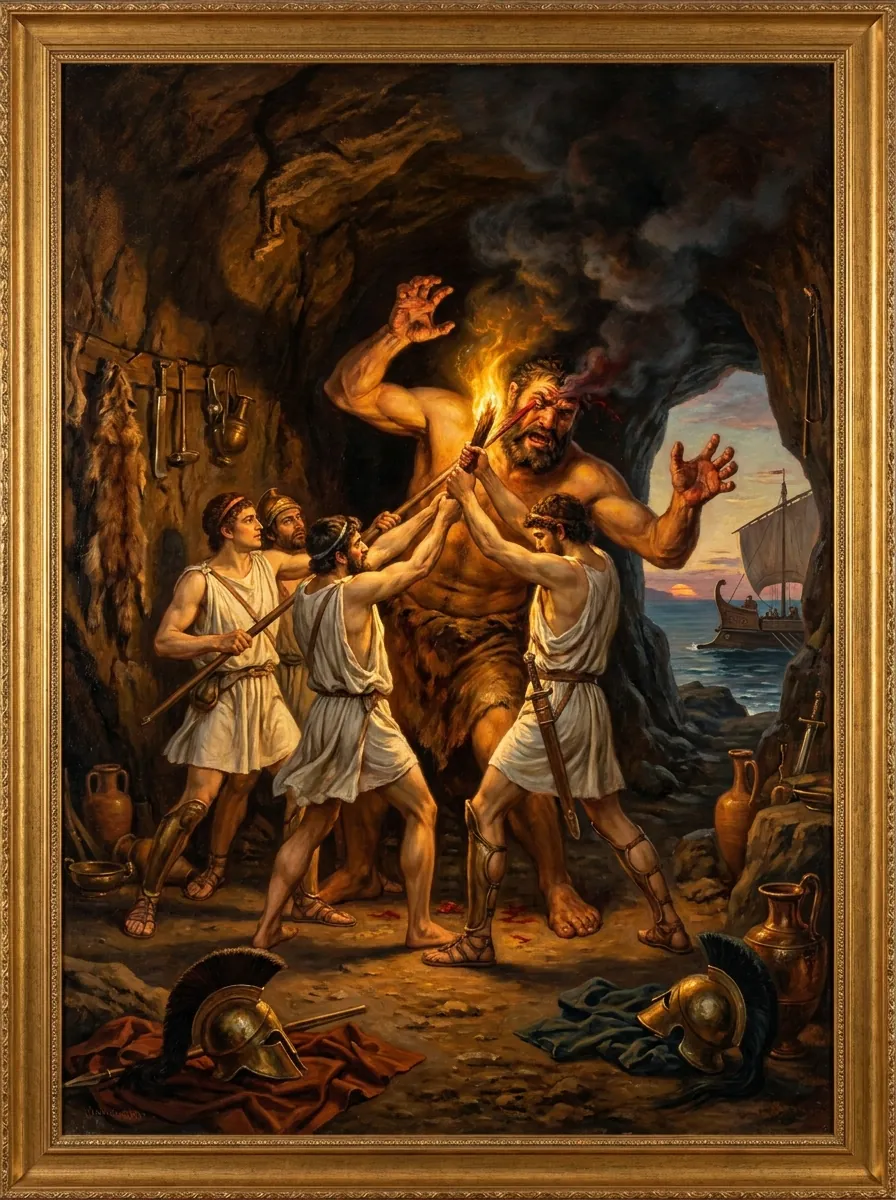
As he spoke, he reeled and fell sprawling face-up on the ground. His great neck hung heavily backward, and a deep sleep took hold of him. Soon he turned sick and threw up both wine and the gobbets of human flesh he’d been gorging on; he was very drunk. Then I thrust the beam of wood far into the embers to heat it, encouraging my men lest any lose heart. When the wood, green as it was, was about to blaze, I drew it from the fire, glowing with heat. My men gathered around me, for heaven had filled their hearts with courage. We drove the sharp end of the beam into the monster’s eye, and bearing down on it with all my weight, I kept turning it round and round as though I were boring a hole in a ship’s plank with an auger — which two men with a wheel and strap can keep turning as long as they choose. Even so, we bored the red-hot beam into his eye, until the boiling blood bubbled all over it as we worked it round and round, so that the steam from the burning eyeball scalded his eyelids and eyebrows, and the roots of the eye sputtered in the fire. As a blacksmith plunges an axe or hatchet into cold water to temper it (that’s what gives strength to the iron), and it makes a great hiss as he does so, even so did the Cyclops’ eye hiss around the beam of olive wood, and his hideous yells made the cave ring. We ran away in fright, but he plucked the beam, all besmirched with gore, from his eye and hurled it from him in a frenzy of rage and pain, shouting to the other Cyclopes who lived on the bleak headlands near him. They gathered from all quarters around his cave when they heard him crying and asked what was the matter.
“What’s wrong, Polyphemus, that you’re making such a noise, breaking the stillness of the night and keeping us from sleeping? Surely no one is carrying off your sheep? Surely no one is trying to kill you, either by fraud or force?”
“Noman is killing me by fraud; no man is killing me by force!”
“Then, if no one is attacking you, you must be ill. When Zeus makes people ill, there’s no help for it, and you’d better pray to your father Poseidon.”
“Then they left, and I laughed at my clever trick. The Cyclops, groaning in agony, felt around until he found the stone, took it from the door, and then sat in the doorway, stretching out his hands to catch anyone trying to leave with the sheep, thinking I might be foolish enough to try.”
“I kept racking my brain for a way to save myself and my men. I schemed, knowing my life depended on it, because the danger was immense. Finally, I decided this was the best plan: the rams were well-grown and had thick, dark fleeces, so I silently bound them together in threes, using some of the willow branches the wicked monster slept on. A man would be under the middle sheep, covered by the two on either side, so there were three sheep for each man. I chose a ram that was finer than the rest, grabbed its back, nestled into the thick wool under its belly, and held on tight to its fleece, face up, the whole time.”
“So we waited, terrified, until morning. When dawn arrived, the rams rushed out to pasture, while the ewes bleated around the pens, waiting to be milked, their udders full. Despite his pain, their master felt the backs of all the sheep as they stood, but he wasn't sharp enough to realize the men were underneath. As the ram went out last, heavy with its fleece and my crafty self, Polyphemus grabbed it and said:”
“My good ram, why are you the last to leave my cave this morning? You never let the ewes go ahead of you; you lead the flock at a run to flowery meadow or bubbling spring, and you're the first to come home at night. But now you lag behind. Is it because you know your master has lost his eye, and you're sorry that wicked ‘Noman’ and his horrible crew got me drunk and blinded me? But I'll get my revenge. If you could understand and talk, you'd tell me where the wretch is hiding, and I'd smash his brains on the ground until they splattered all over the cave. That would give me some satisfaction for the harm that no-good ‘Noman’ has done me.”
“As he spoke, he pushed the ram outside. When we were a short distance from the cave, I first got out from under the ram's belly and freed my comrades. We herded the fat sheep down to the ship. The crew rejoiced to see those of us who had escaped death, but they wept for the others the Cyclops had killed. I signaled to them, nodding and frowning, to hush their crying, and told them to get all the sheep on board at once and put out to sea. They went aboard, took their places, and rowed out on the dark sea. When I was far enough away for my voice to carry, I began to taunt the Cyclops.”
“‘Cyclops,’ I said, ‘you should have sized up your man better before eating his comrades in your cave. You wretch — eating your visitors in your own house? You should have known your sin would find you out, and now Zeus and the other gods have punished you.’”
“He grew even more furious when he heard me. He tore off the top of a high mountain and flung it just in front of my ship, nearly hitting the rudder. The sea shook as the rock fell, and the wave's backwash carried us toward the mainland, forcing us toward shore. But I grabbed a long pole and fended the ship off, signaling to my men to row for their lives. They pulled with a will. When we were two times as far out as before, I wanted to taunt the Cyclops again, but the men begged me to be quiet.”
“‘Don't be crazy enough to provoke this savage creature further,’ they cried. ‘He already threw one rock that drove us back to the mainland, and we were sure it would kill us. If he hears any more voices, he'll pound our heads and our ship's timbers to jelly with the rugged rocks he'll hurl at us, because he can throw them so far.’”
“But I wouldn't listen. I shouted at him in my rage, ‘Cyclops, if anyone asks who blinded you and spoiled your good looks, tell them it was Odysseus, the city-sacker, son of Laertes, who lives in Ithaca.’”
“At this, he groaned and cried out:”
“Alas, the old prophecy is coming true. There was a prophet here once, a brave and imposing man named Telemus, son of Eurymus. He was an excellent seer and prophesied for all the Cyclopes until he grew old. He told me this would happen someday: I would lose my sight at the hand of Odysseus. I've been expecting someone of imposing presence and superhuman strength, but it turns out to be a little, insignificant weakling who blinded me by taking advantage of me while I was drunk. Come here, Odysseus, so I can give you gifts to show my hospitality and urge Poseidon to help you on your journey—Poseidon and I are father and son. He can heal me, if he chooses, which no one else, god or man, can do.”
“Then I said, ‘I wish I could be as sure of killing you and sending you down to Hades' house as I am that it will take more than Poseidon to cure that eye of yours.’”
“At this, he lifted his hands to the heavens and prayed, saying:”
“Hear me, great Poseidon! If I am truly your son, grant that Odysseus never reaches home alive. Or, if he must get back to his friends at last, let him do so late, in dire straits, after losing all his men — let him reach his home in another man's ship and find trouble waiting there.”
“That was his prayer, and Poseidon heard it. Then he picked up a rock much larger than the first, swung it high, and hurled it with tremendous force. It fell just short of the ship, nearly hitting the rudder. The sea shook as the rock fell, and the wave's backwash drove us onward toward the island's shore.”
“When we finally reached the island where we had left the rest of our ships, we found our comrades lamenting us and anxiously awaiting our return. We ran our vessel onto the sand and got out onto the shore. We also unloaded the Cyclops’ sheep and divided them fairly among us, so no one would complain. My companions agreed I should have the ram as an extra share, so I sacrificed it on the shore and burned its thigh bones to Zeus, lord of all. But he paid no attention to my sacrifice, and only thought about how to destroy my ships and my comrades.”
“So all day long, until sunset, we feasted. When it grew dark, we camped on the beach. When dawn appeared, I told my men to get on board and cast off the hawsers. They took their places and beat the sea with their oars. We sailed on with sorrow in our hearts, glad to have escaped death even though we had lost our comrades.”
Translation: Samuel Butler (1900) · Public domain · SPDX: PD-1900-Butler