From there, we sailed to the Aeolian island, home to Aeolus, son of Hippotas, beloved by the gods. The island floats on the sea, girded by an iron-bound wall. Aeolus had six daughters and six strapping sons, so he married the sons to the daughters. They all live with their dear father and mother, feasting and enjoying every luxury imaginable. The house is filled all day with the aroma of roasting meats, and at night, they sleep on well-made beds, each man with his wife between the blankets. These were the people we had come to.
Aeolus entertained me for a whole month, constantly asking about Troy, the Argive fleet, and the Achaeans' return. I told him everything that had happened. When I said I had to leave and asked for his help to continue my journey, he readily agreed. He flayed a prime ox-hide to contain the roaring winds, shutting them up inside like a sack—for Zeus had made him master of the winds, able to stir or still each one as he pleased. He put the sack in the ship and bound the mouth so tightly with a silver thread that not even a breath of a side-wind could escape. He let only the West wind blow, as it was fair for us. But it was all for nothing; our own folly ruined us.
For nine days and nights we sailed, and on the tenth day, our homeland appeared on the horizon. We got so close that we could see the stubble fires burning. Exhausted, I fell into a light sleep, never letting the rudder out of my hands so we could get home faster. Then the men started talking among themselves, saying I was bringing back gold and silver in the sack Aeolus had given me.
**Crewman 1:** “Look at this guy, getting honored and making friends wherever he goes. See the fine prizes he's taking home from Troy, while we, who traveled just as far, come back with empty hands. And now Aeolus has given him even more. Quick—let's see what's inside, how much gold and silver is in that sack.”
That's how they talked, and their evil plan won out. They loosed the sack. The winds flew out howling, raising a storm that carried us, weeping, out to sea and away from our country. I woke up, unsure whether to throw myself into the sea or live on and make the best of it. I endured it, covered myself, and lay down in the ship, while the men lamented as the fierce winds bore our fleet back to the Aeolian island.
When we reached the island, we went ashore for water and ate dinner near the ships. After dinner, I took a herald and one of my men and went straight to Aeolus's house, where I found him feasting with his wife and family. We sat down as suppliants on the threshold. They were shocked to see us and said:
“Odysseus, what brings you here? What god has mistreated you? We took great pains to help you on your way home to Ithaca, or wherever you wanted to go.”
That's what they said, and I answered sorrowfully:
“My men have ruined me; they and cruel sleep. Friends, fix this, if you can.”
I spoke as movingly as I could, but they said nothing, until their father answered:
“Vile creature, get out of this island at once. I will in no way help someone the heavens hate. Be gone. You come here as someone abhorred by the gods.”
With those words, he sent me sorrowing from his door.
We sailed sadly on until the men were worn out from rowing, with no wind to help. For six days and nights we toiled, and on the seventh day, we reached the rocky stronghold of Lamus—Telepylus, city of the Laestrygonians. There, the shepherd driving in his sheep and goats salutes the shepherd driving out his flock, and the second answers. In that country, someone who didn't need sleep could earn double wages, working as both a cattle herdsman and a shepherd, because they work as much by night as by day.
When we reached the harbor, we found it landlocked under steep cliffs, with a narrow entrance between two headlands. My captains took all their ships inside and tied them up close together, because there was never a breath of wind inside; it was always dead calm. I kept my own ship outside, moored to a rock at the very end of the point. I climbed a high rock to scout, but saw no sign of man or cattle, only smoke rising from the ground. So I sent two of my men with an attendant to find out what kind of people lived there.
The men went ashore and followed a level road where the people haul firewood from the mountains into town. They met a young woman fetching water, the daughter of a Laestrygonian named Antiphates. She was going to the Artacia fountain, where the people get their water. My men approached her and asked who the king of that country was and what kind of people he ruled. She directed them to her father’s house, but when they got there, they found his wife to be a giantess, as huge as a mountain, and they were horrified.
She called her husband Antiphates from the assembly, and he immediately began killing my men. He snatched one of them and started eating him right there. The other two ran back to the ships as fast as they could. But Antiphates raised the alarm, and thousands of sturdy Laestrygonians sprang up from everywhere—ogres, not men. They threw vast rocks at us from the cliffs as if they were pebbles. I heard the horrid sound of ships crunching against each other and the death cries of my men as the Laestrygonians speared them like fish and took them home to eat. While they were killing my men in the harbor, I drew my sword, cut the cable of my ship, and told my men to row with all their might if they didn't want to end up like the rest. They rowed for their lives, and we were grateful to reach open water, out of range of the rocks. None of the others survived.
We sailed sadly on, glad to have escaped death, though we had lost our comrades, and came to the Aeaean island, where Circe lives—a great and cunning goddess, sister to the magician Aeetes. They are both children of Helios by Perse, daughter of Oceanus. We brought our ship into a safe harbor without a word, guided there by some god. We landed and lay there for two days and nights, worn out in body and mind. On the morning of the third day, I took my spear and sword and went from the ship to scout, hoping to find signs of human activity or hear voices. Climbing to the top of a high lookout, I saw smoke rising from Circe’s house amid a dense forest. I hesitated, wondering if I should go at once to investigate, but decided it was best to return to the ship, give the men their dinners, and send some of them instead of going myself.
When I had almost made it back to the ship, some god took pity on my loneliness and sent a fine stag with antlers right into my path. It was coming down from its pasture in the forest to drink from the river, driven by the heat of the sun. As it passed, I struck it in the middle of the back. The bronze point of the spear went clean through, and it lay groaning in the dust until it died. Then I set my foot on it, drew my spear from the wound, and laid the spear down. I gathered rough grass and rushes and twisted them into a fathom or so of good stout rope. I bound the four feet of the creature together, hung him around my neck, and walked back to the ship leaning on my spear. The stag was much too big for me to carry on my shoulder, steadying him with one hand. As I threw him down in front of the ship, I called the men and spoke cheeringly to each of them.
“Look here, my friends, we aren’t going to die before our time after all. At any rate, we won’t starve as long as we have something to eat and drink on board.”
At this, they uncovered their heads on the seashore and admired the stag, for he was indeed splendid. When they had looked at him long enough, they washed their hands and began to cook him for dinner.
Thus, all day long until sunset, we stayed there eating and drinking our fill. When the sun went down and darkness fell, we camped on the seashore. When dawn came, I called a council and said:
“My friends, we are in very great difficulties. Listen to me, therefore. We have no idea where the sun sets or rises, so we don’t even know east from west. I see no way out of it, but we must try to find one. We are certainly on an island, for I went as high as I could this morning and saw the sea reaching all around it to the horizon. It lies low, but toward the middle, I saw smoke rising from a thick forest of trees.”
Their hearts sank when they heard me, for they remembered how they had been treated by the Laestrygonian Antiphates, and by the savage ogre Polyphemus. They wept bitterly in their dismay, but there was nothing to be gained by crying. I divided them into two companies and set a captain over each. I gave one company to Eurylochus, while I took command of the other myself. Then we cast lots in a helmet, and the lot fell upon Eurylochus. He set out with his twenty-two men, and they wept, as did we who were left behind.
When they reached Circe’s house, they found it built of cut stones, on a site that could be seen from far, in the middle of the forest. There were wild mountain wolves and lions prowling all around—poor bewitched creatures whom she had tamed by her enchantments and drugged into subjection. They did not attack my men, but wagged their great tails, fawned upon them, and rubbed their noses lovingly against them. As hounds crowd around their master when they see him coming from dinner—for they know he will bring them something—so did these wolves and lions with their great claws fawn upon my men, but the men were terribly frightened at seeing such strange creatures. Presently they reached the gates of the goddess’s house, and as they stood there they could hear Circe within, singing beautifully as she worked at her loom, making a web so fine, so soft, and of such dazzling colors as no one but a goddess could weave. Polites, whom I valued and trusted more than any other of my men, said:
“There is someone inside working at a loom and singing beautifully. The whole place resounds with it. Let’s call her and see whether she is woman or goddess.”
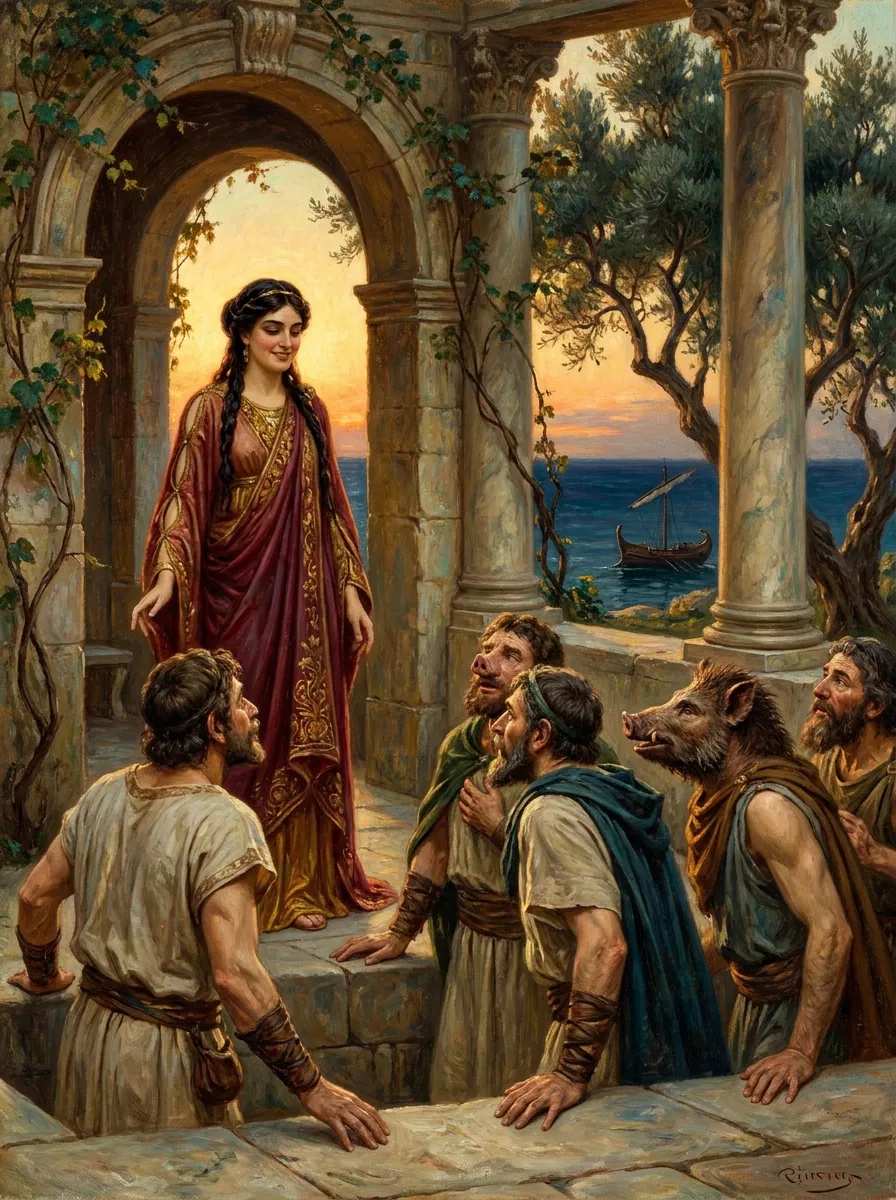
They called her, and she came down, unfastened the door, and bade them enter. They, thinking nothing was amiss, followed her, all except Eurylochus, who suspected mischief and stayed outside. When she had gotten them into her house, she set them upon benches and seats and mixed them a mess with cheese, honey, meal, and Pramnian wine, but she drugged it with wicked poisons to make them forget their homes. When they had drunk, she turned them into pigs with a stroke of her wand and shut them up in her pigsties. They were like pigs—head, hair, and all, and they grunted just as pigs do, but their senses were the same as before, and they remembered everything.
Thus they were shut up squealing, and Circe threw them some acorns and beech masts such as pigs eat, but Eurylochus hurried back to tell me about the sad fate of our comrades. He was so overcome with dismay that though he tried to speak he could find no words to do so. His eyes filled with tears, and he could only sob and sigh, until at last we forced his story out of him, and he told us what had happened to the others.
“We went, as you told us, through the forest, and in the middle of it there was a fine house built with cut stones in a place that could be seen from far. There we found a woman, or else she was a goddess, working at her loom and singing sweetly. So the men shouted to her and called her, at which she at once came down, opened the door, and invited us in. The others didn’t suspect any mischief, so they followed her into the house, but I stayed where I was, for I thought there might be some treachery. From that moment I saw them no more, for not one of them ever came out, though I sat a long time watching for them.”
Then I took my sword of bronze and slung it over my shoulders. I also took my bow, and told Eurylochus to come back with me and show me the way. But he laid hold of me with both his hands and spoke piteously, saying:
“Sir, don’t force me to go with you, but let me stay here, for I know you won’t bring one of them back with you, or even return alive yourself. Let’s rather see if we can’t escape at any rate with the few that are left to us, for we may still save our lives.”
“Stay where you are, then, eating and drinking at the ship, but I must go, for I am urgently bound to do so.”
With this I left the ship and went inland. When I got through the charmed grove and was near the great house of the enchantress Circe, I met Hermes with his golden wand, disguised as a young man in the prime of his youth and beauty with the down just coming upon his face. He came up to me and took my hand in his, saying:
“My poor unhappy man, where are you going over this mountaintop, alone and without knowing the way? Your men are shut up in Circe’s pigsties, like so many wild boars in their lairs. You surely don’t imagine that you can set them free? I can tell you that you will never get back and will have to stay there with the rest of them. But never mind, I will protect you and get you out of your difficulty. Take this herb, which is one of great virtue, and keep it with you when you go to Circe’s house. It will be a talisman to you against every kind of mischief.
“And I will tell you about all the wicked witchcraft that Circe will try to practice on you. She will mix a mess for you to drink, and she will drug the meal with which she makes it, but she won’t be able to charm you, for the virtue of the herb that I will give you will prevent her spells from working. I will tell you all about it. When Circe strikes you with her wand, draw your sword and spring upon her as though you were going to kill her. She will then be frightened and will want you to sleep with her. You must not refuse her outright, for you want her to set your companions free, and to take good care of yourself, but you must make her swear solemnly by all the blessed gods that she will plot no further mischief against you, or else when she has gotten you naked she will unman you and make you fit for nothing.”
As he spoke, he pulled the herb out of the ground and showed me what it was like. The root was black, while the flower was as white as milk. The gods call it Moly, and mortal men cannot uproot it, but the gods can do whatever they like.
Then Hermes went back to high Olympus, passing over the wooded island, but I fared onward to Circe's house, my heart clouded with care as I walked. When I got to the gates, I stood there and called to the goddess. As soon as she heard me, she came down, opened the door, and asked me to come in, so I followed her—much troubled in my mind. She set me on a richly decorated seat inlaid with silver. There was a footstool under my feet, and she mixed a potion in a golden goblet for me to drink, but she drugged it, intending me mischief. When she had given it to me, and I had drunk it without being charmed, she struck me with her wand.
“There now, be off to the pigsty, and make your lair with the rest of them.”
I rushed at her with my sword drawn as though to kill her, whereon she fell with a loud scream, clasped my knees, and spoke plaintively, saying,
“Who and where are you from? What place and people are you from? How can it be that my drugs have no power to charm you? Never yet was any man able to stand so much as a taste of the herb I gave you. You must be spell-proof. Surely you can be none other than the bold hero Odysseus, who Hermes always said would come here someday with his ship while on his way home from Troy. So be it then; sheathe your sword and let us go to bed, that we may make friends and learn to trust each other.”
And I answered,
“Circe, how can you expect me to be friendly with you when you have just been turning all my men into pigs? Now that you have got me here myself, you mean me mischief when you ask me to go to bed with you, and will unman me and make me fit for nothing. I certainly will not consent to go to bed with you unless you first take your solemn oath to plot no further harm against me.”
So she swore at once as I had told her, and when she had completed her oath, then I went to bed with her.
Meanwhile, her four servants, who are her housemaids, set about their work. They are the children of the groves and fountains, and of the holy waters that run down into the sea. One of them spread a fair purple cloth over a seat and laid a carpet underneath it. Another brought tables of silver up to the seats and set them with baskets of gold. A third mixed some sweet wine with water in a silver bowl and put golden cups upon the tables, while the fourth brought in water and set it to boil in a large cauldron over a good fire which she had lighted. When the water in the cauldron was boiling, she poured cold water into it till it was just as I liked it, and then she set me in a bath and began washing me from the cauldron about the head and shoulders, to take the weariness and stiffness out of my limbs. As soon as she had washed me and anointed me with oil, she arrayed me in a good cloak and shirt and led me to a richly decorated seat inlaid with silver; there was a footstool also under my feet. A maidservant then brought me water in a beautiful golden ewer and poured it into a silver basin for me to wash my hands, and she drew a clean table beside me; an upper servant brought me bread and offered me many things of what there was in the house, and then Circe bade me eat, but I would not, and sat without heeding what was before me, still moody and suspicious.
When Circe saw me sitting there without eating, and in great grief, she came to me and said,
“Odysseus, why do you sit like that as though you were dumb, gnawing at your own heart, and refusing both meat and drink? Is it that you are still suspicious? You ought not to be, for I have already sworn solemnly that I will not hurt you.”
And I said,
“Circe, no man with any sense of what is right can think of either eating or drinking in your house until you have set his friends free and let him see them. If you want me to eat and drink, you must free my men and bring them to me that I may see them with my own eyes.”
When I had said this, she went straight through the court with her wand in her hand and opened the pigsty doors. My men came out like so many prime hogs and stood looking at her, but she went about among them and anointed each with a second drug, whereon the bristles that the bad drug had given them fell off, and they became men again, younger than they were before, and much taller and better looking. They knew me at once, seized me each of them by the hand, and wept for joy till the whole house was filled with the sound of their halloo-ballooing, and Circe herself was so sorry for them that she came up to me and said,
“Odysseus, noble son of Laertes, go back at once to the sea where you have left your ship, and first draw it onto the land. Then, hide all your ship’s gear and property in some cave, and come back here with your men.”
I agreed to this, so I went back to the seashore and found the men at the ship weeping and wailing most piteously. When they saw me, the silly blubbering fellows began frisking around me as calves break out and gambol around their mothers when they see them coming home to be milked after they have been feeding all day, and the homestead resounds with their lowing. They seemed as glad to see me as though they had got back to their own rugged Ithaca, where they had been born and bred.
“Sir, we’re as glad to see you back as if we’d made it safely home to Ithaca. But tell us everything about what happened to our comrades.”
I tried to comfort them, saying:
“We need to haul our ship onto the shore and hide the gear, along with all our belongings, in a cave. Then, all of you, come with me as quickly as you can to Circe’s house. You’ll find your comrades there, eating and drinking in the midst of plenty.”
The men were ready to come with me at once, but Eurylochus tried to hold them back, saying:
“Alas, poor wretches that we are! What’s going to become of us? Don’t rush to your ruin by going to Circe’s house. She’ll turn us all into pigs, or wolves, or lions, and we’ll have to stand guard over her house. Remember how the Cyclops treated us when our comrades went inside his cave, Odysseus included? It was all through his folly that those men lost their lives.”
When I heard this, I was of two minds whether to draw the sharp sword that hung by my sturdy thigh and cut his head off, even though he was a close relative of mine. But the men pleaded for him, saying:
“Sir, if it’s alright with you, let this fellow stay here and watch the ship. But take the rest of us with you to Circe’s house.”
So we all went inland. Eurylochus didn’t stay behind after all, but came along too, because he was frightened by the severe reprimand I’d given him.
Meanwhile, Circe had seen to it that the men who had been left behind were washed and anointed with olive oil. She had also given them woolen cloaks and shirts. When we arrived, we found them all comfortably at dinner in her house. As soon as the men saw each other face to face and recognized one another, they wept for joy and cried aloud until the whole palace rang again. Then Circe came up to me and said:
“Odysseus, noble son of Laertes, tell your men to stop crying. I know how much all of you have suffered at sea, and how badly you’ve fared among cruel savages on the mainland. But that’s over now. Stay here, eat and drink until you’re once more as strong and hearty as you were when you left Ithaca. At present, you’re weakened in both body and mind. You keep thinking about the hardships you’ve suffered during your travels, so you have no cheerfulness left in you.”
That’s what she said, and we agreed. We stayed with Circe for a whole year, feasting on an untold quantity of both meat and wine. But when the year had passed, as the moons waned and the long days had come round again, my men called me aside and said:
“Sir, it’s time you started thinking about going home, if you’re to be spared to see your house and native country at all.”
That’s what they said, and I agreed. So, all day long until the sun went down, we feasted our fill on meat and wine. But when the sun went down and darkness fell, the men lay down to sleep in the covered cloisters. I, however, after I had got into bed with Circe, begged her by her knees, and the goddess listened to what I had to say.
“Circe, please keep the promise you made me about helping me on my homeward voyage. I want to get back, and so do my men. They’re always pestering me with their complaints as soon as your back is turned.”
“Odysseus, noble son of Laertes, none of you will stay here any longer if you don’t want to. But there’s another journey you have to take before you can sail homewards. You must go to the house of Hades and dread Persephone to consult the ghost of the blind Theban prophet Teiresias, whose reason is still unshaken. Persephone has left him alone his understanding even in death; the other ghosts flit about aimlessly.”
I was dismayed when I heard this. I sat up in bed and wept, and would gladly have lived no longer to see the light of the sun. But presently, when I was tired of weeping and tossing myself about, I said:
“And who will guide me on this voyage? The house of Hades is a port no ship can reach.”
“You'll need no guide. Raise your mast, set your white sails, sit still, and the North Wind will blow you there. Once your ship has crossed the waters of Oceanus, you'll reach the fertile shore of Persephone's country, with its groves of tall poplars and willows that shed their fruit too soon. Beach your ship there, on the shore of Oceanus, and go straight to the dark abode of Hades. You'll find it near where the rivers Pyriphlegethon and Cocytus (a branch of the river Styx) flow into Acheron. There's a rock nearby, right where the two roaring rivers meet.
“When you reach this spot, dig a trench about a cubit long, wide, and deep. Pour into it a drink offering to all the dead: first, honey mixed with milk; then wine; and third, water—sprinkling white barley meal over everything. Offer many prayers to the poor, feeble ghosts. Promise them that when you return to Ithaca, you'll sacrifice a barren heifer to them—the best you have—and load the pyre with good things. Promise, especially, that Teiresias will have a black sheep all to himself, the finest in your flocks.
“When you've begged the ghosts with your prayers, offer them a ram and a black ewe, bending their heads toward Erebus. But turn away yourself, as if heading toward the river. Then, many dead men's ghosts will come to you. Tell your men to skin the two sheep you've just killed and offer them as a burnt sacrifice, with prayers to Hades and Persephone. Then, draw your sword and sit there, preventing any other poor ghost from nearing the spilled blood until Teiresias has answered your questions. The seer will come to you soon and tell you about your voyage—what stages to make and how to sail the sea to reach home.”
Day was breaking as she finished speaking, so she dressed me in my shirt and cloak. She threw a beautiful, light gossamer fabric over her shoulders, fastening it with a golden girdle around her waist, and covered her head with a mantle. Then I went among the men all over the house, speaking kindly to each one.
“You can't lie sleeping here any longer. We have to go. Circe has told me everything.”
They did as I told them.
Even so, I didn't get them away without trouble. We had a certain young man named Elpenor with us, not known for sense or courage. He'd gotten drunk and was sleeping off his liquor on the roof, away from the others, in the cool. When he heard the noise of the men bustling about, he jumped up suddenly and forgot about using the main staircase to come down. He tumbled right off the roof and broke his neck, and his soul went down to the house of Hades.
When I had gathered the men, I said to them,
“You think you're about to start home, but Circe explained to me that instead, we have to go to the house of Hades and Persephone to consult the ghost of the Theban prophet Teiresias.”
The men were broken-hearted to hear me. They threw themselves on the ground, groaning and tearing their hair, but crying didn't help. When we reached the sea shore, weeping and lamenting our fate, Circe brought the ram and the ewe, and we tied them up near the ship. She passed through our midst without our knowing it, for who can see the comings and goings of a god, if the god doesn't want to be seen?
Translation: Samuel Butler (1900) · Public domain · SPDX: PD-1900-Butler