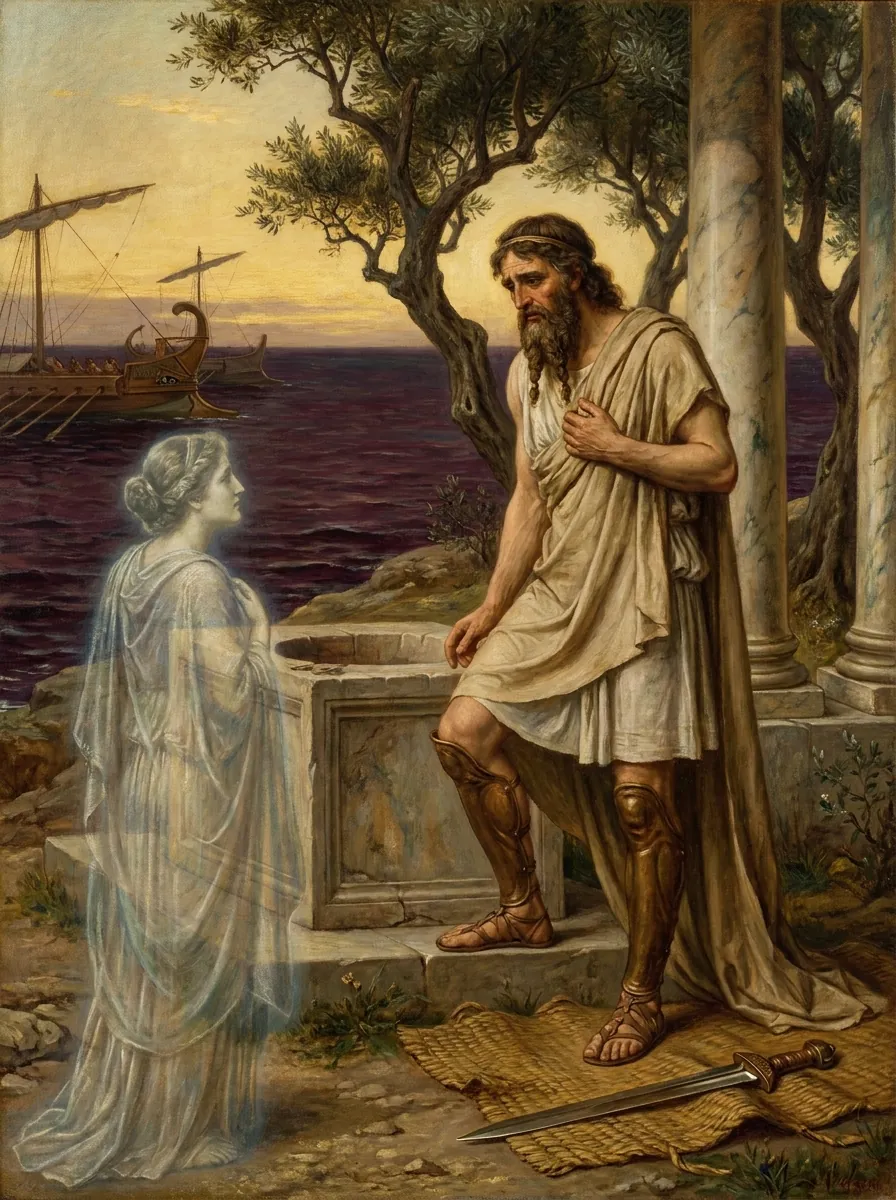
Once we reached the shore, we pulled our ship into the water, got the mast and sails up, loaded the sheep, and took our places, weeping and in great distress. Circe, that great and cunning goddess, sent us a fair wind that blew steadily from astern, keeping our sails full. We did what needed doing with the ship’s gear and let her go as the wind and helmsman directed. All day long her sails were full as she held her course, but when the sun went down and darkness covered the earth, we entered the deep waters of the river Oceanus, where lies the land and city of the Cimmerians, who live shrouded in mist and darkness. The rays of the sun never pierce there, neither at his rising nor as he sets, but the poor wretches live in one long melancholy night. When we arrived, we beached the ship, unloaded the sheep, and went along by the waters of Oceanus until we came to the place Circe had told us about.
Here, Perimedes and Eurylochus held the victims, while I drew my sword and dug a trench, a cubit each way. I made a drink-offering to all the dead, first with honey and milk, then with wine, and thirdly with water. I sprinkled white barley meal over the whole, praying earnestly to the poor, drifting ghosts and promising them that when I returned to Ithaca, I would sacrifice a barren heifer for them—the best I had—and load the pyre with good things. I also promised Teiresias a black sheep all to himself, the best in all my flocks. When I had prayed sufficiently to the dead, I cut the throats of the two sheep and let the blood run into the trench. The ghosts came trooping up from Erebus: brides, young bachelors, old men worn out with toil, maids who had been crossed in love, and brave men killed in battle, their armor still smeared with blood. They came from every quarter and flitted around the trench with a strange, screaming sound that made me turn pale with fear. Seeing them come, I told the men to quickly flay the carcasses of the two dead sheep and make burnt offerings of them, repeating prayers to Hades and Persephone. I sat with my sword drawn, refusing to let the poor, drifting ghosts near the blood until Teiresias had answered my questions.
The first ghost that came was my comrade Elpenor, who had not yet been laid beneath the earth. We had left his body unmourned and unburied at Circe’s house because we had too much else to do. I was very sorry for him and cried when I saw him:
“Elpenor, how did you come down here into this gloom and darkness? You've arrived on foot faster than I have with my ship.”
“Sir, it was all bad luck and my own unspeakable drunkenness. I was asleep on the roof of Circe’s house and never thought of coming down again by the great staircase. I fell right off the roof and broke my neck, so my soul came down to the house of Hades. Now I beg you, by all those you have left behind—though they are not here—by your wife, by the father who raised you, and by Telemachus, the one hope of your house, do what I ask. I know that when you leave this limbo, you will again hold your ship for the Aeaean island. Do not go without waking and burying me, or I may bring heaven’s anger upon you. Burn me with whatever armor I have, build a barrow for me on the sea shore to tell people what a poor, unlucky fellow I was, and plant over my grave the oar I used to row with when I was alive and with my messmates.”
And I said,
“My poor fellow, I will do all you have asked.”
So we sat and talked sadly, I on one side of the trench with my sword held over the blood, and the ghost of my comrade speaking from the other. Then came the ghost of my dead mother, Anticlea, daughter of Autolycus. I had left her alive when I set out for Troy and was moved to tears when I saw her. Even with all my sorrow, I would not let her near the blood until I had asked my questions of Teiresias.
Then came the ghost of Theban Teiresias, with his golden scepter in his hand. He knew me and said:
“Odysseus, noble son of Laertes, why have you left the light of day and come down to visit the dead in this sad place? Stand back from the trench and withdraw your sword so I can drink the blood and answer your questions truly.”
I drew back and sheathed my sword. When he had drunk the blood, he began his prophecy.
“You want to know about your return home, but heaven will make this hard. I don’t think you will escape the eye of Poseidon, who still nurses his bitter grudge because you blinded his son. Still, after much suffering, you may get home if you can restrain yourself and your companions when your ship reaches the Thrinacian island. There, you will find the sheep and cattle belonging to the sun, who sees and hears everything. If you leave these flocks unharmed and think only of getting home, you may still reach Ithaca after much hardship. But if you harm them, I forewarn you of the destruction of both your ship and your men. Even if you yourself escape, you will return in bad shape after losing all your men, in another man’s ship, and you will find trouble in your house, which will be overrun by high-handed people, who are devouring your substance under the pretext of paying court and making presents to your wife.
“When you get home, you will take your revenge on these suitors. After you have killed them by force or fraud in your own house, you must take a well-made oar and carry it on and on until you come to a country where the people have never heard of the sea and do not even mix salt with their food. They know nothing about ships or oars that are like the wings of a ship. I will give you this certain token: a wayfarer will meet you and say it must be a winnowing shovel you have on your shoulder. There, you must fix the oar in the ground and sacrifice a ram, a bull, and a boar to Poseidon. Then go home and offer hecatombs to all the gods in heaven, one after the other. As for yourself, death shall come to you from the sea, and your life will ebb away very gently when you are full of years and peace of mind, and your people shall bless you. All that I have said will come true.”
“This must be as heaven pleases, but tell me truly: I see my poor mother’s ghost close by us. She is sitting by the blood without a word. Though I am her own son, she does not remember me and speak to me. Tell me, sir, how I can make her know me.”
“That I can soon do. Any ghost you let taste the blood will talk with you like a reasonable being, but if you do not let them have any blood, they will go away again.”
On this, the ghost of Teiresias went back to the house of Hades, his prophecies now spoken. I sat still until my mother came up and tasted the blood. Then she knew me at once and spoke fondly to me, saying,
“My son, how did you come down to this abode of darkness while you are still alive? It’s hard for the living to see these places. Between us and them are great, terrible waters, and Oceanus, which no one can cross on foot; you have to have a good ship. Have you been trying to find your way home from Troy all this time? Have you still not gotten back to Ithaca or seen your wife in your own house?”
“Mother, I was forced to come here to consult the ghost of the Theban prophet Teiresias. I have never been near the Achaean land or set foot on my native country. I’ve had nothing but one long series of misfortunes from the very first day that I set out with Agamemnon for Ilion, the land of noble steeds, to fight the Trojans. But tell me truly, how did you die? Did you have a long illness, or did heaven grant you a gentle, easy passage to eternity? Tell me also about my father and the son whom I left behind. Is my property still in their hands, or has someone else gotten hold of it, thinking I won’t return to claim it? Tell me again what my wife intends doing, and what she’s thinking. Does she live with my son and guard my estate securely, or has she made the best match she could and married again?”
“Your wife still remains in your house, but she’s in great distress of mind and spends her whole time in tears, night and day. No one has yet gotten possession of your fine property, and Telemachus still holds your lands undisturbed. He has to entertain a lot, as of course he must, considering his position as a magistrate, and how everyone invites him. Your father remains at his old place in the country and never goes near the town. He has no comfortable bed or bedding; in the winter he sleeps on the floor in front of the fire with the men and goes about all in rags. But in summer, when the warm weather comes on again, he lies out in the vineyard on a bed of vine leaves thrown any which way upon the ground. He grieves continually about your never having come home, and suffers more and more as he grows older. As for my own end, it was like this: heaven did not take me swiftly and painlessly in my own house, nor was I attacked by any illness such as those that generally wear people out and kill them. It was my longing to know what you were doing and the force of my affection for you—that was the death of me.”
Then I tried to find some way of embracing my poor mother’s ghost. Three times I sprang towards her and tried to clasp her in my arms, but each time she flitted from my embrace as if she were a dream or phantom. Touched to the quick, I said to her,
“Mother, why do you not stay still when I would embrace you? If we could throw our arms around one another, we might find sad comfort in sharing our sorrows, even in the house of Hades. Does Persephone want to lay a still further load of grief upon me by mocking me with only a phantom?”
“My son, most ill-fated of all mankind, it is not Persephone who is beguiling you. All people are like this when they are dead. The sinews no longer hold the flesh and bones together; these perish in the fierceness of consuming fire as soon as life has left the body, and the soul flits away as though it were a dream. Now, however, go back to the light of day as soon as you can, and note all these things so that you may tell them to your wife later.”
Thus we conversed, and soon Persephone sent up the ghosts of the wives and daughters of all the most famous men. They gathered in crowds about the blood, and I considered how I might question them one by one. In the end, I decided it would be best to draw the keen blade that hung by my sturdy thigh and keep them from all drinking the blood at once. So they came up one after the other, and each one, as I questioned her, told me her race and lineage.
The first I saw was Tyro. She was the daughter of Salmoneus and wife of Cretheus, the son of Aeolus. She fell in love with the river Enipeus, who is much the most beautiful river in the whole world. Once, when she was taking a walk by his side as usual, Poseidon, disguised as her lover, slept with her at the mouth of the river, and a huge blue wave arched itself like a mountain over them to hide both woman and god. There, he loosed her virgin girdle and laid her in a deep slumber. When the god had accomplished the deed of love, he took her hand in his own and said,
“Tyro, may all go well with you. The embraces of the gods are not fruitless, and you will have fine twins about this time in twelve months. Take great care of them. I am Poseidon, so now go home, but hold your tongue and do not tell anyone.”
Then he dove under the sea, and she in due course bore Pelias and Neleus, who both of them served Zeus with all their might. Pelias was a great breeder of sheep and lived in Iolcus, but the other lived in Pylos. The rest of her children were by Cretheus: Aeson, Pheres, and Amythaon, who was a mighty warrior and charioteer.
Next to her, I saw Antiope, daughter of Asopus, who could boast of having slept in the arms of Zeus himself. She bore him two sons, Amphion and Zethus. These founded Thebes with its seven gates and built a wall all around it, for strong though they were, they could not hold Thebes until they had walled it.
Then I saw Alcmena, the wife of Amphitryon, who also bore to Zeus indomitable Heracles; and Megara, who was daughter to great King Creon and married the redoubtable son of Amphitryon.
I also saw fair Epicaste, mother of King Oedipus, whose awful lot it was to marry her own son without suspecting it. He married her after having killed his father, but the gods proclaimed the whole story to the world. Thereupon, he remained king of Thebes, in great grief for the spite the gods had borne him, but Epicaste went to the house of the mighty jailer Hades, having hanged herself for grief, and the avenging spirits haunted him as for an outraged mother—to his bitter ruing thereafter.
Then I saw Chloris, whom Neleus married for her beauty, having given priceless presents for her. She was the youngest daughter of Amphion, son of Iasus and king of Minyan Orchomenus, and was Queen in Pylos. She bore Nestor, Chromius, and Periclymenus, and she also bore that marvelously lovely woman Pero, who was wooed by all the country round. But Neleus would only give her to him who should raid the cattle of Iphicles from the grazing grounds of Phylace, and this was a hard task. The only man who would undertake to raid them was a certain excellent seer, but the will of heaven was against him, for the rangers of the cattle caught him and put him in prison. Nevertheless, when a full year had passed and the same season came around again, Iphicles set him at liberty, after he had expounded all the oracles of heaven. Thus, then, was the will of Zeus accomplished.
And I saw Leda, the wife of Tyndarus, who bore him two famous sons: Castor, breaker of horses, and Pollux, the mighty boxer. Both these heroes are lying under the earth, though they are still alive, for by a special dispensation of Zeus, they die and come to life again, each one of them every other day throughout all time, and they have the rank of gods.
After her, I saw Iphimedeia, wife of Aloeus, who boasted of the embrace of Poseidon. She bore two sons, Otus and Ephialtes, but both were short-lived. They were the finest children that were ever born in this world, and the best looking, Orion only excepted, for at nine years old they were nine fathoms high and measured nine cubits around the chest. They threatened to make war with the gods in Olympus and tried to set Mount Ossa on the top of Mount Olympus, and Mount Pelion on the top of Ossa, so that they might scale heaven itself. They would have done it, too, if they had grown up, but Apollo, son of Leto, killed both of them before they had so much as a sign of hair upon their cheeks or chin.
Then I saw Phaedra, Procris, and fair Ariadne, daughter of the magician Minos. Theseus was carrying her off from Crete to Athens, but he didn't enjoy her, because Artemis killed her on the island of Dia on account of what Dionysus had said against her before he could.
I also saw Maera, Clymene, and hateful Eriphyle, who sold her own husband for gold. But it would take me all night to name every single one of the wives and daughters of heroes whom I saw. It's time for me to go to bed, either on board ship with my crew, or here. As for my escort, heaven and yourselves will see to it.”
Here he ended, and the guests sat, all of them enthralled and speechless throughout the covered cloister. Then Arete said to them:—
“What do you think of this man, Phaeacians? Isn't he tall and good looking, and isn't he clever? True, he is my own guest, but all of you share in the distinction. Don't be in a hurry to send him away, or stingy with the presents you give to one who is in such great need, for heaven has blessed all of you with great abundance.”
“My friends, what our august queen has just said to us is both reasonable and to the purpose, therefore be persuaded by it; but the decision, whether in word or deed, rests ultimately with King Alcinous.”
“It shall be done, as surely as I still live and reign over the Phaeacians. Our guest is indeed very anxious to get home, still we must persuade him to remain with us until tomorrow. By then, I'll be able to get together the whole sum that I mean to give him. As regards his escort, it will be a matter for you all, and mine above all others as the chief person among you.”
And Odysseus answered:
“King Alcinous, if you were to ask me to stay here for a whole twelve months, and then speed me on my way, loaded with your noble gifts, I would obey you gladly, and it would greatly benefit me. I would return fuller-handed to my own people, and would thus be more respected and beloved by all who see me when I get back to Ithaca.”
“Odysseus, not one of us who sees you has any idea that you are a charlatan or a swindler. I know there are many people going about who tell such plausible stories that it is very hard to see through them, but there is a style about your language which assures me of your good disposition. Moreover, you have told the story of your own misfortunes, and those of the Achaeans, as though you were a practiced bard. But tell me, and tell me truly, whether you saw any of the mighty heroes who went to Troy at the same time as yourself, and perished there. The evenings are still at their longest, and it is not yet bedtime—go on, therefore, with your divine story, for I could stay here listening till tomorrow morning, so long as you continue to tell us of your adventures.”
“Alcinous, there is a time for making speeches, and a time for going to bed. Nevertheless, since you so desire, I will not refrain from telling you the still sadder tale of those of my comrades who did not fall fighting with the Trojans, but perished on their return, through the treachery of a wicked woman.
When Persephone had dismissed the female ghosts in all directions, the ghost of Agamemnon son of Atreus came sadly up to me, surrounded by those who had perished with him in the house of Aegisthus. As soon as he had tasted the blood, he knew me, and weeping bitterly stretched out his arms towards me to embrace me; but he had no strength or substance any more, and I too wept and pitied him as I beheld him.
“How did you die, King Agamemnon? Did Poseidon raise his winds and waves against you when you were at sea, or did your enemies kill you on the mainland when you were cattle-lifting or sheep-stealing, or while they were fighting in defense of their wives and city?”
“Odysseus, noble son of Laertes, I was not lost at sea in any storm Poseidon raised, nor did my foes dispatch me upon the mainland. Aegisthus and my wicked wife killed me between them. He asked me to his house, feasted me, and then butchered me most miserably as though I were a fat beast in a slaughter house, while all around me my comrades were slain like sheep or pigs for the wedding breakfast, or picnic, or gorgeous banquet of some great nobleman. You must have seen numbers of men killed either in a general engagement, or in single combat, but you never saw anything so truly pitiable as the way in which we fell in that cloister, with the mixing bowl and the loaded tables lying all about, and the ground reeking with our blood. I heard Priam’s daughter Cassandra scream as Clytemnestra killed her close beside me. I lay dying upon the earth with the sword in my body, and raised my hands to kill the slut of a murderess, but she slipped away from me; she wouldn't even close my lips or my eyes when I was dying, for there is nothing in this world so cruel and so shameless as a woman when she has fallen into such guilt as hers was. Fancy murdering her own husband! I thought I was going to be welcomed home by my children and my servants, but her abominable crime has brought disgrace on herself and all women who shall come after—even on the good ones.”
“In truth Zeus has hated the house of Atreus from first to last in the matter of their women’s counsels. See how many of us fell for Helen’s sake, and now it seems that Clytemnestra hatched mischief against you too during your absence.”
“Be sure, therefore, and not be too friendly even with your own wife. Don't tell her all that you know perfectly well yourself. Tell her only a part, and keep your own counsel about the rest. Not that your wife, Odysseus, is likely to murder you, for Penelope is a very admirable woman, and has an excellent nature. We left her a young bride with an infant at her breast when we set out for Troy. This child no doubt has now grown up happily to man’s estate, and he and his father will have a joyful meeting and embrace one another as it is right they should do, whereas my wicked wife did not even allow me the happiness of looking upon my son, but killed me before I could do so. Furthermore I say—and lay my saying to your heart—don't tell people when you are bringing your ship to Ithaca, but steal a march upon them, for after all this there is no trusting women. But now tell me, and tell me truly, can you give me any news of my son Orestes? Is he in Orchomenus, or at Pylos, or is he at Sparta with Menelaus—for I presume that he is still living.”
“Agamemnon, why do you ask me? I do not know whether your son is alive or dead, and it is not right to talk when one does not know.”
As we two sat weeping and talking sadly, the ghost of Achilles came up to us with Patroclus, Antilochus, and Ajax, who was the finest and most handsome of all the Danaans after the son of Peleus. The swift descendant of Aeacus knew me and spoke piteously, saying:
“Odysseus, noble son of Laertes, what daring deed will you undertake next, that you venture down to the house of Hades among us silly dead, who are but the ghosts of those who can labor no more?”
“Achilles, son of Peleus, foremost champion of the Achaeans, I came to consult Teiresias, and see if he could advise me about my return home to Ithaca. I have never yet been able to get near Achaean land or set foot in my own country, but have been in trouble the whole time. As for you, Achilles, no one was ever so fortunate as you have been, nor ever will be, for you were adored by all us Argives as long as you were alive, and now that you are here you are a great prince among the dead. Therefore, do not take it so much to heart even if you are dead.”
“Don’t say a word in death’s favor. I would rather be a paid servant in a poor man’s house and be above ground than king of kings among the dead. But give me news about my son; has he gone to the wars and will he be a great soldier, or is this not so? Tell me also if you have heard anything about my father Peleus—does he still rule among the Myrmidons, or do they show him no respect throughout Hellas and Phthia now that he is old and his limbs fail him? If only I could stand by his side, in the light of day, with the same strength that I had when I killed the bravest of our foes upon the plain of Troy—if only I could be as I then was and go even for a short time to my father’s house, anyone who tried to do him violence or supersede him would soon regret it.”
“I have heard nothing of Peleus, but I can tell you all about your son Neoptolemus, for I took him in my own ship from Scyros with the Achaeans. In our war councils before Troy he was always first to speak, and his judgment was unerring. Nestor and I were the only two who could surpass him; and when it came to fighting on the plain of Troy, he would never remain with the body of his men, but would dash on far in front, foremost of them all in valor. He killed many men in battle—I cannot name every single one of those whom he slew while fighting on the side of the Argives, but will only say how he killed that valiant hero Eurypylus son of Telephus, who was the handsomest man I ever saw except Memnon; many others also of the Ceteians fell around him because of a woman’s bribes. Moreover, when all the bravest of the Argives went inside the horse that Epeus had made, and it was left to me to settle when we should either open the door of our ambuscade or close it, though all the other leaders and chief men among the Danaans were drying their eyes and quaking in every limb, I never once saw him turn pale nor wipe a tear from his cheek; he was all the time urging me to break out from the horse—grasping the handle of his sword and his bronze-shod spear, and breathing fury against the foe. Yet when we had sacked the city of Priam he got his handsome share of the prize money and went on board (such is the fortune of war) without a wound upon him, neither from a thrown spear nor in close combat, for the rage of Ares is a matter of great chance.”
When I had told him this, the ghost of Achilles strode off across a meadow full of asphodel, exulting over what I had said concerning the prowess of his son.
The ghosts of other dead men stood near me and told me each his own melancholy tale, but that of Ajax son of Telamon alone held aloof—still angry with me for having won the cause in our dispute about the armor of Achilles. Thetis had offered it as a prize, but the Trojan prisoners and Athena were the judges. I wish I had never gained the day in such a contest, for it cost the life of Ajax, who was foremost of all the Danaans after the son of Peleus, alike in stature and prowess.
When I saw him I tried to pacify him and said:
“Ajax, will you not forget and forgive even in death? Must the judgment about that hateful armor still rankle with you? It cost us Argives dearly enough to lose such a tower of strength as you were to us. We mourned you as much as we mourned Achilles son of Peleus himself, nor can the blame be laid on anything but on the spite which Zeus bore against the Danaans, for it was this that made him counsel your destruction—come here, therefore, bring your proud spirit into subjection, and hear what I can tell you.”
He would not answer, but turned away to Erebus and to the other ghosts. Nevertheless, I should have made him talk to me in spite of his being so angry, or I should have gone on talking to him, only that there were still others among the dead whom I desired to see.
Then I saw Minos son of Zeus with his golden scepter in his hand sitting in judgment on the dead. The ghosts were gathered, sitting and standing around him in the spacious house of Hades, to learn his sentences upon them.
After him I saw huge Orion in a meadow full of asphodel driving the ghosts of the wild beasts that he had killed upon the mountains. He had a great bronze club in his hand, unbreakable forever.
And I saw Tityus son of Gaia stretched upon the plain, covering some nine acres of ground. Two vultures on either side of him were digging their beaks into his liver, and he kept trying to beat them off with his hands, but could not, for he had violated Zeus’ mistress Leto as she was going through Panopeus on her way to Pytho.
I also saw the dreadful fate of Tantalus, who stood in a lake that reached his chin. He was dying to quench his thirst, but could never reach the water, for whenever the poor creature stooped to drink, it dried up and vanished, so that there was nothing but dry ground—parched by the spite of heaven. There were tall trees, moreover, that shed their fruit over his head—pears, pomegranates, apples, sweet figs and juicy olives, but whenever the poor creature stretched out his hand to take some, the wind tossed the branches back again to the clouds.
And I saw Sisyphus at his endless task raising his prodigious stone with both his hands. With hands and feet he tried to roll it up to the top of the hill, but always, just before he could roll it over onto the other side, its weight would be too much for him, and the pitiless stone would come thundering down again onto the plain. Then he would begin trying to push it uphill again, and the sweat ran off him and the steam rose after him.
After him I saw mighty Heracles, but it was his phantom only, for he is feasting ever with the immortal gods, and has lovely Hebe to wife, who is daughter of Zeus and Hera. The ghosts were screaming around him like scared birds flying all whithers. He looked black as night with his bare bow in his hands and his arrow on the string, glaring around as though ever on the point of taking aim. About his breast there was a wondrous golden belt adorned in the most marvelous fashion with bears, wild boars, and lions with gleaming eyes; there was also war, battle, and death. The man who made that belt, do what he might, would never be able to make another like it. Heracles knew me at once when he saw me, and spoke piteously, saying:
“Poor Odysseus, noble son of Laertes, are you also leading the same sorry life I did when I was alive? I was the son of Zeus, but I went through endless suffering, becoming a slave to someone far beneath me—a low fellow who set me all kinds of labors. Once, he sent me here to fetch the hell-hound, thinking he couldn't find anything harder for me. But I got the hound out of Hades and brought him to him, with Hermes and Athena's help.”
Then Heracles went back down into the house of Hades. I stayed where I was, in case some other of the mighty dead came to me. I would have seen others who are gone—Theseus and Pirithous, glorious children of the gods—but so many thousands of ghosts swarmed around me, uttering such appalling cries, that I panicked, fearing Persephone would send the head of that awful Gorgon monster up from the house of Hades. I hurried back to my ship and ordered my men to board at once and loose the hawsers. They embarked and took their places, and the ship went down the stream of the river Oceanus. We had to row at first, but soon a fair wind sprang up.
Translation: Samuel Butler (1900) · Public domain · SPDX: PD-1900-Butler